

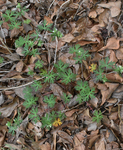
Geraniaceae: Geranium carolinianum
Files
Family Name
Geraniaceae
Common Name
Carolina crane's-bill, Carolina geranium
Description
Geranium carolinianum is a winter or summer annual, or occasionally a biennial, herbaceous forb that develops from a shallow, fibrous taproot system. The plant typically grows to a height of 10 to 40 centimeters (occasionally up to 65 centimeters), producing erect, loosely ascending, or sprawling, multi-branched stems that are round, frequently pinkish red to reddish-brown, and covered in dense, short, downward-pointing or spreading white hairs. Leaf insertion is primarily alternate along upper branches but opposite below. The leaves are simple, grayish-green, and round to kidney-shaped, measuring 2 to 7 cm in length and width. They are deeply palmately cleft into 3 to 9 primary lobed segments, which feature bluntly toothed or secondary narrow-oblong ultimate segments. Both the upper and lower leaf surfaces are finely pubescent and hairy. Long, hairy petioles are present on lower leaves (often exceeding several centimeters), while upper leaves have much shorter petioles; pairs of small, pointed stipules are present at the nodes and leaf bases. Flowering occurs from March to July in tight, compact, or loose terminal umbel-like clusters roughly 1 to 3 cm across. Each flower features 5 free, green, ovate sepals that are 4 to 8 mm long, heavily pubescent, and adorned with distinct, stiff, pointed awn-tipped or bristle-tipped apexes. The corolla contains 5 free, pale pink, lavender, or white petals that are 4 to 8 mm long (roughly equal to or slightly shorter than the sepals), radially symmetrical, and often notched or slightly indented at the apex. Inside the corolla are 10 fertile, glabrous stamens arranged in two whorls, featuring yellowish-white filaments and small, purplish anthers. The single compound pistil contains a 5-lobed superior ovary connected to an elongated, fused central style column with 5 yellow, spreading stigma branches. The fruit is a dry schizocarp, resembling an upraised crane’s bill, measuring 19 to 25 mm long including the elongated style column or beak. It matures from late spring through mid-summer, splitting from the base into 5 dark brown, hairy, single-seeded mericarp sections. Carolina crane's-bill is native to South Dakota, where it can be found in scattered locations across the state, particularly in the southern and western counties (such as Pennington County), thriving in dry, gravelly, or sandy soils, open fields, disturbed areas, rocky woods, and prairies.
Horticulture Notes
Seed Collection: Collect the fruit in late spring or summer when the elongated, beak-like capsules turn a dark brown or black color. Harvest the capsules just before they split, or place a fine mesh bag over the developing clusters to catch the catapulted, oblong brown seeds.
Seed Germination: Sow seeds directly onto a firm seedbed in autumn or early spring; they germinate easily as cool-season annuals once soil temperatures drop or stabilize.
Vegetative Propagation: This species does not easily propagated vegetatively.
Soils: Highly adaptable to low-nutrient soils, thriving in dry sandy, gravelly, or heavy clay soils. It handles shallow, rocky ground exceptionally well and accommodates alkaline, neutral, or acidic pH ranges.
Light: Full sun, receiving 6 or more hours of direct light. It will tolerate light partial shade, but growth becomes more sprawling.
Water: Excellent natural drought tolerance once its root framework is established. Prefers occasionally dry, well-drained conditions and has zero tolerance for chronically saturated or waterlogged soils.
Additional Notes
Carolina geranium is a hardy pioneer species that provides exceptional early-season ground cover and stabilizes soil in disturbed or low-fertility residential garden spaces. Ecologically, its early spring blooms offer a reliable and vital nectar source for long-tongued and short-tongued native bees, as well as beneficial flower flies. The protein-rich seeds are a highly favored and critical food resource for native wildlife, particularly Mourning Doves and northern bobwhite quail. Historically, humans have utilized the entire plant in traditional medicines, exploiting its high tannin content to brew astringent remedies for treating diarrhea, stomachaches, and minor skin inflammations.