

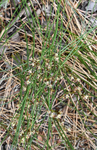
Juncaceae: Juncus arcticus ssp. littoralis
Family Name
Juncaceae
Common Name
Mountain rush, Baltic rush, Arctic rush
Description
Juncus arcticus ssp. littoralis is a perennial, grass-like herbaceous rush that spreads vigorously through thick, creeping, horizontal, scaly dark-colored rhizomes. The plant typically grows to a mature height of 35 to 110 cm. Its unbranched stems are erect, solid, cylindrical, smooth to finely striate, 1 to 5 mm wide, and light green to dark green. The leaves are entirely basal and lack an expanded lamina or blade, rendering the leaf type a simple, vestigial structure wrapped around the stem base. These bladeless leaf sheaths are 2 to 15 cm long, varying from light tan to dark chestnut brown, and can be dull or shiny. The leaf sheaths feature fused margins that tightly clasp the stem, terminating in small, rounded, ear-like extensions (auricles) at the top. They lack a true distinct ligule or collar. Flowering occurs from June to August. The inflorescence is a lateral-appearing, branched cyme measuring 1 to 7 cm long and contains 5 to 50+ individual flowers. It appears to emerge from the side of the stem because the lowest involucral bract is green, cylindrical, and extends vertically up to 20 centimeters past the flowers, mimicking a seamless continuation of the stem. Individual flowers are small, bisexual, and radial with 6 separate perianth segments (tepals) arranged in two rows. The 3 outer sepals are free, lanceolate, 3.5 to 5 mm long, dark brown to purplish with green midribs, and sharply pointed. The 3 inner petals are similarly free, lanceolate, 3 to 4.5 mm long, and share the same dark brown coloration, but are distinguished by having wider, translucent membranous margins. The flowers have 6 stamens with very short filaments and prominent, linear, yellowish anthers. The single pistil consists of a superior, 3-chambered ovary bearing a short style and 3 long, feathery, protruding reddish-brown stigmas. The fruit is a small, 3-sided ovoid-oblong capsule measuring 3 to 4.5 mm long. It transitions from green to a glossy, dark chestnut brown or blackish color as it reaches maturity between July and October. Mountain rush is native to South Dakota. It is widely distributed across the state, with high concentrations throughout the central prairies and the western wet meadow complexes of the Black Hills region. It is primarily found in wetland habitats, including fens, marshes, wet meadows, stream margins, lake shores, roadside ditches, and low-lying alkali flats.
Synonym: Juncus balticus
Horticulture Notes
Seed Collection: Snip the upright capsule clusters into deep paper collection bags in late summer (August to September) when they turn a glossy dark brown but before they split open to disperse seeds.
Seed Germination: Seeds require light and constant moisture to break dormancy. Subjecting the seeds to cold, moist stratification for 60 to 90 days greatly improves overall germination rates.
Vegetative Propagation: Divide the thick, creeping rhizomes easily during early spring before active growth starts or in late autumn during dormancy. Ensure each divided clump retains at least two or three healthy stem nodes or buds.
Soils: Thrives in saturated clays, silts, or loams and possesses an exceptionally high tolerance for heavily alkaline, brackish, or saline conditions (pH 5.5 - 9.0).
Light: Full sun to partial shade.
Water: Wet, saturated soils to shallow standing water up to 10 centimeters deep. It can tolerate temporary seasonal drought once its deep root system is fully established.
Additional Notes
Mountain rush has a high ecological value due to its dense, deep-binding rhizome network, making it highly effective for shoreline stabilization, wetland restoration, and erosion control along waterways. The plant's tough, vertical structure establishes crucial nesting sites and protective thermal cover for waterfowl, small marsh mammals, and amphibians. Its tiny seeds are an important food source for songbirds and ducks, while the young shoots provide minor forage for larger grazing wildlife. In horticultural landscaping, it functions well as an architectural accent plant in rain gardens, bioswales, and backyard pond borders due to its reliable growth under fluctuating water levels.