

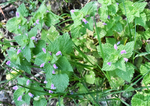
Lamiaceae: Lamium purpureum
Files
Family Name
Lamiaceae
Common Name
Purple deadnettle, Red deadnettle
Description
Lamium purpureum is a winter annual, herbaceous dicot supported by a shallow, ultra-fine fibrous root system. The plant typically reaches a height of 10 to 30 cm. Its stems are sharply four-angled (square), mostly hollow, and branched at the base before growing erect. Leaf insertion is opposite along the stem. The simple leaves are broad-ovate to cordate, 1 to 4 cm long and wide, featuring deeply rounded-toothed margins and a blunt apex. While lower leaves are medium green, the upper leaves are densely crowded and conspicuously tinted with a reddish-purple hue. Both upper and lower leaf surfaces are covered in fine, soft hairs with prominent, wrinkled reticulate veining. A petiole is present, measuring 1 to 3 cm long on lower leaves, but becoming much shorter or nearly sessile on the topmost purple-tinted floral bracts. Flowering occurs primarily in early spring through mid-summer (March to July), though it can bloom sporadically during any mild period. The inflorescence consists of dense, multi-flowered axillary whorls stacked vertically at the stem apex to form a compact, leafy spike. The calyx consists of 5 fused sepals that form a tubular base roughly 5 to 7 mm long, terminating in 5 narrow, free, lanceolate, hair-fringed teeth that spread wide as the fruit develops. The corolla consists of 5 fused petals forming a two-lipped, elongated tube measuring 10 to 15 mm long. It is pinkish purple to lavender, with a hood-like upper lip that arches and a spreading, 3-lobed lower lip marked with deeper purple spots. Tucked beneath the hooded upper lip are 4 stamens arranged in two unequal pairs (didynamous); they bear small, dark purple, hairy anthers with pale yellow pollen. The single pistil consists of a superior, deeply 4-lobed ovary and a slender style that splits into 2 equal stigma lobes at its tip. The fruit is a dry schizocarp that splits into 4 distinct, 3-angled, club-shaped, obovoid nutlets. These nutlets measure 2 mm long, are greyish brown with small white speckles, and reach full maturity from May through August. Purple deadnettle is not native to South Dakota. It is an introduced species native to Eurasia and North Africa. In South Dakota, it is naturalized across scattered counties, predominantly in agricultural regions, urban settings, and eastern river valleys. It is commonly found in disturbed habitats, including home lawns, gardens, cultivated crop fields, nursery plots, parklands, and roadside ditches.
Additional Notes
Purple deadnettle provides important ecological value as one of the earliest available spring nectar and pollen sources for emerging beneficial insects, particularly bumblebees and honeybees, when few other plants are in bloom. In agricultural ecology, it functions as a rapid ground cover that cushions soil against early spring rain erosion and suppresses more aggressive weed species, though its high seed production allows it to spread rapidly in open soil. Horticulturally, it is rarely planted intentionally due to its invasive tendencies in managed garden beds, but it is sometimes permitted in wild pollinator lawns or low-maintenance orchard floors. Humans also value the plant for its historical herbal properties and edibility; the young, tender tops and leaves are completely safe to eat raw in salads, blended into smoothies, or cooked into stir-fries.