

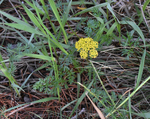
Apiaceae: Lomatium cous
Files
Family Name
Apiaceae
Common Name
Cous biscuitroot, cous-root desert-parsley, cous, biscuitroot
Native American Name
Lakota: waȟčá zí iyawicaskapa
Description
Lomatium cous is a long-lived perennial, low-growing, non-woody, herbaceous plant that develops from a deeply buried, subglobose to elongated, starchy, thickened globose root or tuber-like caudex, devoid of rhizomes. The plant reaches a mature height of 10 to 25 cm. It is largely subacaulescent or acaulescent, meaning the true above-ground stems are virtually absent, reduced to minimal structures measuring 2 to 10 cm long, and are enveloped at the base by a weathered thatch of fibrous sheaths. Leaf insertion is entirely basal, forming an airy, low-spreading rosette. The compound leaves are green to glaucous blue-green, 5 to 15 cm long, and multiply pinnately dissected three times into small, crowded, oval or oblong ultimate leaflets measuring 2 to 5 mm long. Both upper and lower leaf surfaces are smooth, glabrous, or slightly papillate, and the leaf possesses a distinct, expanded basal petiole that sheaths the stem. Flowering occurs between April and July. The inflorescence is a compound umbel consisting of several separated flower clusters borne on naked peduncles spanning 5 to 15 cm across. True sepals are absent or reduced to microscopic, indistinguishable green teeth surrounding the inferior ovary. The corolla contains 5 free petals that are bright yellow to pale yellow, oblanceolate, small (under 1.5 mm long), and exhibit strongly inrolled tips. Contained within each small flower are 5 free stamens featuring slender, pale yellow filaments and yellow anthers that extend outward past the petals. There is 1 inferior pistil with 2 distinct carpels, featuring 2 short, thread-like, divergent styles and tiny, terminal stigmas. The fruit is a flattened, dry schizocarp that is oblong to broadly elliptic, 5 to 12 mm long, and 3 to 5 mm wide with broad, thin lateral wings. It matures to a roughened or smooth dark tan to brown color between June and September. Cous biscuitroot is native to South Dakota, where it is found sparsely across the dry, open rocky grasslands, fellfields, ridges, and sagebrush steppe communities of the westernmost counties.
Horticulture Notes
Seed Collection: Harvest seed heads in mid-to-late summer (June–August) as the umbel stalks turn brown and dry. Gently crush the mature seed heads to separate the flat, winged fruits from the stalks.
Seed Germination: Direct-sow fresh seeds outdoors in the fall. Stored seeds require 60 to 90 days of cold, moist stratification at temperatures near 1–4°C to trigger spring germination.
Vegetative Propagation: Extremely difficult and generally.
Soils: Rocky, sandy, or gravelly well-drained soils. It exhibits a strong preference for nutrient-poor, alkaline substrates and tolerates clay only if it dries out completely in summer.
Light: Full sun.
Water: Very low water requirements once established. It is highly drought-tolerant, adapted to arid winters and hot, completely dry summers, but requires moisture during its brief spring growing phase.
Additional Notes
Cous biscuitroot acts as a critical early-season resource in native rock gardens and steppe restorations, providing ground cover on exposed slopes prone to wind erosion. Ecologically, its early spring blooms offer vital nectar and pollen to native bees, flies, beetles, and early emerging butterflies. Historically, the starchy roots were a primary staple food harvested extensively by the Nez Perce and other Indigenous Plateau cultures, who peeled, dried, and ground them into a nutritious flour used to bake durable travel biscuits.