

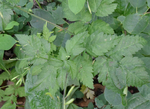
Apiaceae: Osmorhiza berteroi
Family Name
Apiaceae
Common Name
Mountain Sweet Cicely, Common Sweet Cicely
Description
Osmorhiza berteroi is a perennial, caulescent herbaceous forb developing from a well-developed, thick, clustered, fleshy taproot system that exudes a distinct licorice or anise scent. The plant reaches a mature height of 30 to 120 cm. The stems are erect, solitary to few (typically 1 to 3), branched above, and vary from nearly glabrous to finely covered in short, spreading hairs. Leaf insertion is alternate, though several long-petioled leaves form a prominent basal cluster while only 1 to 3 leaves are positioned along the upper stem. The leaves are thin, light to medium green, and ternate-pinnate or biternate (twice-compound) into 3 to 9 main leaflets. The entire leaf blade spans 4 to 20 cm in width. Leaflets are broadly ovate to lanceolate, 2 to 8 cm long, and 1 to 5.5 cm wide, featuring coarsely toothed, serrate, or deeply incised margins. The leaf surfaces are sparsely hairy along the prominent veins on the lower surface and mostly glabrous on the upper surface. Petioles are present and elongated on basal leaves, measuring 5 to 16 cm long, but become dramatically reduced to sub-sessile sheaths on the cauline leaves. Flowering occurs from April to July. The inflorescence is a loose, compound umbel elevated on a long peduncle measuring 5 to 25 cm. Each umbel produces 3 to 8 spreading-ascending rays that are 2 to 12 cm long. The calyx (sepals) are completely absent. The corolla is composed of 5 minute, free, distinct petals that are greenish white to pure white, obovate in shape, and feature narrowed, inwardly curved tips. There are 5 distinct stamens with short, delicate white filaments capped by tiny, pale yellow to white anthers. The gynoecium features an inferior ovary topped by a small, conic style-bearing platform supporting 2 very short styles measuring less than 1 mm in length, each ending in a minute, simple stigma. The fruit is a dry, side-to-side compressed schizocarp that splits into 2 linear-fusiform or club-shaped mericarps measuring 12 to 25 mm in length. The fruit features a long, tapering tail-like base (2 to 8.5 mm long) and a beak-like tip; its prominent ribs are covered with upward-pointing, stiff, Velcro-like bristles. The fruit remains a dark green during development and dries to a black or dark brownish-black color when it reaches maturity between late July and September. Mountain sweet cicely is native to South Dakota. Within the state, its distribution is concentrated in the western montane region, specifically throughout the mesic understories, rich ravines, and damp canyon floors of the Black Hills. It thrives in fertile, cool, shaded habitats like montane deciduous forests, mixed evergreen-deciduous woodlands, and moist stream banks.
Horticulture Notes
Seed Collection: Strip the dry, blackish, needle-like fruits manually from the spent umbels in late summer or autumn.
Seed Germination: Seeds possess deep physiological dormancy and require 60 to 90 days of moist cold stratification at 2°C to 4°C to successfully sprout in the spring. Fall planting is recommended.
Vegetative Propagation: Dig and divide established plant crowns or separate the thick, clustered taproots during their early autumn dormancy period.
Soils: Humus-heavy, mesic soils; prefers loamy or organic forest soils but can adapt to sandier or clay-heavy soils if adequate organic matter is present.
Light: Dappled sunlight, partial shade, or deep woodland shade; it does not tolerate hot, direct midday sunlight.
Water: Consistent, medium-to-high moisture conditions. Low tolerance for prolonged drought or dried-out root zones.
Additional Notes
Mountain sweet cicely serves as a highly functional, delicate groundcover for deep-shade or woodland restoration gardens. Ecologically, the tiny, accessible flowers provide early-summer nectar and pollen to generalist pollinators, including small native bees, hoverflies, and beetles. Historically, the plant was a highly versatile resource for several Native American groups, including the tribes of the Great Plains. The thick, licorice-scented roots were consumed as an aromatic food source or brewed into traditional botanical medicines to relieve sore throats, coughs, and chest colds.