

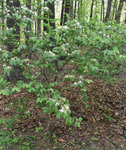
Caprifoliaceae: Lonicera maackii
Files
Family Name
Caprifoliaceae
Common Name
Amur honeysuckle, bush honeysuckle
Description
Lonicera maackii is a long-lived, multi-stemmed, deciduous, upright, woody shrub that develops from a shallow, wide-spreading, fibrous root system. The plant reaches a mature height of 2 to 6 meters. It possesses robust, arching, grayish-brown twigs and stems with a hollow, dark brown pith. When new branches and twigs first emerge, they are moderately to densely covered in short, fine, and sometimes tangled hairs. The older bark characteristically splits into long, thin, shaggy vertical strips. Leaf insertion along the twigs is opposite. The simple leaves are dark green, ovate to broadly elliptic with a distinct, sharply tapered acuminate tip, measuring 40 to 90 mm long and 20 to 45 mm wide with entire, smooth margins. The upper leaf surface is dull green and mostly glabrous, while the lower leaf surface features fine, soft hairs distributed primarily along the main veins. The leaf possesses a short, pubescent petiole measuring 2 to 8 mm long. Flowering occurs from mid-spring to early summer (typically May to June). The inflorescence consists of paired, axillary flowers borne along the upper twigs on short peduncles measuring 1 to 3 mm long. The calyx contains 5 small, green, fused sepals forming a short, cup-like rim that is roughly 1 to 2 mm long with triangular teeth. The corolla features 5 fused petals forming a strongly bilateral, two-lipped tube that opens pristine white and ages to a deep creamy yellow, measuring 15 to 25 mm long. The upper lip is broad and 4-lobed, while the lower lip consists of a single, narrow, downward-curving lobe, all releasing a powerful, sweet fragrance. Contained within the petal tube are 5 free stamens with slender, pale green filaments and yellow anthers that exert well past the corolla rim. There is 1 inferior, 3-loculed pistil topped with a single, elongated style and a capitate, green stigma. The fruit is a smooth, glossy, globose berry measuring 6 to 8 mm in diameter. It matures to a brilliant, translucent red color between September and November, remaining tightly clustered along the branches through winter and housing several small, dark brown seeds. Amur honeysuckle is introduced to South Dakota; it is native to temperate regions of China, Japan, Korea, and southeastern Russia. In South Dakota, it escapes cultivation primarily in southeastern and southern counties, aggressively invading disturbed woodlands, urban forest edges, floodplains, and riparian corridors.
Additional Notes
Amur honeysuckle was historically introduced to North America as a robust hedge, windbreak, and tool for soil erosion control, but it is now classified as a highly destructive invasive species across much of the United States. Ecologically, it poses a severe threat by leafing out earlier and holding its canopy later than native flora, effectively shading out native understory wildflowers, tree seedlings, and critical ground cover. While its abundant red berries are heavily consumed by migratory birds, the fruits are high in carbohydrates but poor in the essential lipids needed for long-distance migration, and its dense branching structures ironically correlate with higher nest predation rates for local songbirds.