

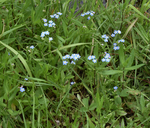
Boraginaceae Myosotis scorpioides
Files
Family Name
Boraginaceae
Common Name
True Forget-me-not, Water Forget-me-not
Description
Myosotis scorpioides is a perennial, herbaceous forb featuring fibrous roots and creeping, stoloniferous rhizomes that allow it to spread across mud and shallow water. The plant reaches a height of 10 to 60 cm on lax, spreading, or decumbent to upright angular stems that regularly root at the lower nodes and are covered in fine, appressed hairs. Leaves have an alternate insertion, are simple and entire, and display a bright green to shiny dark green color. Individual leaves are oblong to oblanceolate, measuring 8 to 10 cm long and 1.3 to 2.5 cm wide. The upper and lower leaf surfaces are pubescent with short, flat, appressed hairs. Lower leaves narrow gradually toward the base into short, winged petioles, while upper cauline leaves are completely sessile. Flowering occurs continuously from May through September, with blossoms arranged in terminal, paired, helicoid or scorpioid cymes that uncoil as the flowers open. The sepals consist of a single fused calyx tube with 5 flat, triangular lobes that are significantly shorter than the main tube; the calyx measures roughly 2 to 5 mm long, has a green color, and is covered with straight, tight, non-hooked hairs. The petals are fused basally into a short tube that expands into 5 flat, spreading, rounded lobes forming a salverform corolla that is 6 to 10 mm wide; the petals are light sky blue with a distinct, raised yellow eye at the center that serves as a nectar guide. Hidden within the corolla tube are 5 stamens that are exceptionally small, short, and possess yellow anthers. The pistil consists of a deeply 4-lobed ovary with a single slender style that is noticeably long, terminating in a capitate, slightly 2-lobed stigma. The fruit is composed of 4 small, smooth, highly polished, dark brown to black nutlets, each measuring about 1.5 mm long, which reach full maturity between July and October. The true forget-me-not is not native to South Dakota; it was introduced from its native range in Europe and western Asia as an ornamental garden plant and can occasionally be found naturalized in localized wetland environments, cold springs, fens, and slow-moving stream borders across parts of South Dakota.
Additional Notes
The true forget-me-not provides exceptional horticultural value as an attractive flowering ground cover, specialized water-garden accent, or stabilizing border plant along pond edges and boggy rain gardens. Ecologically, its protracted blooming season supplies an abundant source of nectar and pollen that draws in diverse native bees, butterflies, and hovering flies.