

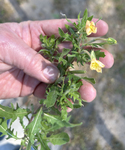
Onagraceae: Oenothera laciniata
Files
Family Name
Onagraceae
Common Name
Cutleaf Evening-primrose
Description
Oenothera laciniata is an annual, winter annual, or biennial herbaceous forb supported by a stout, branched taproot. The plant typically reaches a height of 10 to 60 cm with single or multi-branched stems that range from erect to reclining or prostrate along the ground. These angular stems are densely clothed in long, spreading, and sometimes sticky glandular hairs. Leaves exhibit an alternate insertion pattern, are simple, and possess a dull green to grayish-green color, often highlighted by a distinct whitish mid-vein. Individual cauline leaves are narrowly oblanceolate, elliptic, or oblong, 2.5 to 10 cm long and about 1.3 cm wide. They feature deeply toothed, wavy-edged, or pinnately cleft margins containing rounded lobes, with both the upper and lower leaf surfaces covered in fine, short hairs. Basal leaves narrow down into distinct petioles, whereas the upper stem leaves are mostly sessile or sit on very short petioles. Flowering occurs from May through September, with individual, sessile blossoms borne singly in the distal leaf axils rather than in complex clusters. The flowers open at twilight and close by midday. The calyx features 4 free, linear-lanceolate, reflexed sepals that are 5 to 15 mm long and 2 to 3 mm wide, carrying a green to strongly pinkish or reddish tinge and distinct appressed hairs. The corolla is composed of 4 free, broadly heart-shaped petals measuring 10 to 20 mm long, which open to a pale, whitish-yellow color and shift to an orange-red or pinkish hue as they age and wither. There are 8 prominent stamens with pale yellow filaments and large, versatile yellow anthers that release cobwebby pollen. The compound pistil consists of an inferior, 4-carpel ovary leading up an elongated hypanthium tube to a single long style that terminates in a prominent, deeply cross-shaped (4-lobed) stigma. The fruit is a linear-cylindrical, blunt, often upwardly curved, furry capsule measuring 1.5 to 3.5 cm long and 2 to 3 mm thick. It remains green before turning a dull grayish brown at maturity, which takes place from July through October. The cutleaf evening-primrose is native to South Dakota, where it is primarily distributed across the southern and eastern counties of the state. It thrives in open, highly disturbed habitats characterized by dry, well-drained, sandy soils, such as successional fields, sand prairies, riverbanks, roadsides, and railroad ballasts.
Horticulture Notes
Seed Collection: Clip the dry, brown, upright capsules in early autumn before they split completely open, then crush the pods to release the tiny, brownish seeds.
Seed Germination: Seeds require a bare, open substrate and direct light exposure to trigger germination; sow on the soil surface in spring.
Vegetative Propagation: This species relies almost exclusively on seed propagation.
Soils: Dry, loose sandy soils, gravels, or thin loams, showing an exceptional tolerance for low-nutrient substrates where weed competition is minimal.
Light: Full sun.
Water: Very low moisture; highly drought-tolerant once established due to its deep taproot, but it cannot tolerate soggy, waterlogged, or poorly drained soils.
Additional Notes
The cutleaf evening-primrose holds modest horticultural value as a rapid-growing addition to specialized night-blooming gardens or native prairie restoration projects on dry, sandy plots. Ecologically, its crepuscular blooming schedule provides vital nocturnal resources, acting as a key food source for sphinx moths, long-tongued native bees, and nocturnal beetles.