

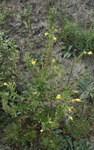
Onagraceae: Oenothera rhombipetala
Files
Family Name
Onagraceae
Common Name
Fourpoint Evening Primrose, Sand Evening Primrose
Description
Oenothera rhombipetala is a biennial herbaceous forb that initiates growth as a low-profile basal rosette from a deep, sturdy taproot system. During its second year, the plant shifts into a reproductive phase, developing an erect, robust growth form that reaches a height of 30 to 120 cm (rarely up to 150 cm). Stems are stout, usually unbranched to weakly branched near the apex, and covered in fine, appressed hairs. Leaves are alternate, simple, dull light green to grayish green, narrowly lance-shaped to oblong, measuring up to 10 cm long and 6 to 13 mm wide. Leaf surfaces are slightly crinkled, with both upper and lower planes displaying a finely hairy, texturized pubescence. Lower stem leaves are short-petioled, while upper leaves transition cleanly into sessile structures. Flowering occurs continuously from May through October, peaking mid-summer. The inflorescence forms a dense, terminal bracted spike up 30 cm long, opening progressively from the bottom upward. The flowers are structurally epigynous (petals and sepals attached above the ovary), with an elongated calyx tube (hypanthium) 2 to 4 cm long. The flower features 4 sepals that are free above the hypanthium, narrowly lance-shaped, 15 to 25 mm long, and typically colored green to light yellow with a reddish or tan tinge. These sepals are reflexed, folding sharply back at anthesis, often remaining loosely connected in pairs along one edge. The corolla consists of 4 free, vibrant butter-yellow petals that are distinctly rhombus-shaped, measuring 13 to 25 mm long, and tapering gracefully to a blunt point. The androecium consists of 8 prominent stamens with long, bright yellow filaments and versatile anthers that carry heavy strands of pollen. The gynoecium features a single pistil with an inferior, 4-chambered ovary; a slender, elongated style; and a deeply 4-lobed, cross-shaped stigma that extends outward, elevating itself well above or equal to the level of the stamens. The fruit reaches maturity from August to November as a sessile, narrowly cylindrical, slightly curved woody dehiscent capsule, 13 to 32 mm long. The capsule turns gray brown to tan at maturity, opening at the top via four distinct valves to scatter hundreds of tiny, pitted, golden-brown angular seeds. The fourpoint evening primrose is native to South Dakota. It is found infrequently along the extreme southern tier of counties, including Bennett, Todd, Tripp, and Gregory, where it populates high-drainage, open ecosystems like dry sand prairies, sandhills, blowout dunes, and sandy roadsides.
Horticulture Notes
Seed Collection: Clip dry, tan capsules from the woody central spike in autumn (September to November). Shake or crush capsules over a fine mesh strainer to detach the minute, dust-like seeds from the chamber walls; store dry at room temperature in paper sleeves.
Seed Germination: Seeds benefit from superficial scarification (light sanding). Sow directly on bare, uncovered soil because the seeds require direct exposure to sunlight.
Vegetative Propagation: Propagation by seed is the primary reliable method.
Soils: Coarse, nutrient-poor, excessively well-drained soils. It thrives on pure sand, sandy loam, and gravelly substrates; it will experience root rot in dense clay or waterlogged soils.
Light: Full sun.
Water: Drought-tolerant once its taproot is established in sand. Periodic supplemental watering during dry summer results in a denser array of blooms.
Additional Notes
Fourpoint evening primrose is gaining appreciation in xeriscaping and native meadows for its dramatic spikes of evening color and ability to lock down loose sand. Its blooms open rapidly at dusk and wither by the following morning, serving as a critical nectar station for nocturnal hawkmoths, hummingbird moths, sphinx moths, and the highly specialized, pollen-collecting native bee Lasioglossum texanum.