

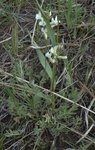
Fabaceae: Oxytropis campestris
Files
Family Name
Fabaceae
Description
Oxytropis campestris is a perennial, acaulescent (stemless) herbaceous forb anchored by a robust, deep, woody taproot system and a branched caudex. The plant grows from 5 to 30 cm tall. A true aerial stem is absent; instead, the leaves and flowering scapes emerge directly in dense, tufted basal rosettes from the crown. Leaf insertion is strictly basal. The leaves are odd-pinnately compound, stretching 3 to 20 cm in length. They comprise 11 to 35 leaflets that are grayish green to bright green. Each leaflet is lanceolate, oblong, or elliptic, measuring 5 to 25 mm long and 2 to 6 mm wide. Both upper and lower surfaces are covered in soft, appressed, silky-silvery hairs. The petioles are well-developed, measuring 2 to 8 cm long, and are flanked at the base by prominent, thin, papery stipules that are adnate to the petiole base and covered in fine hairs. Flowering occurs from May to July. The inflorescence is a dense, showy, spicate raceme or sub-capitate head elevated on an erect, leafless, hairy scape measuring 5 to 25 cm long, supporting 8 to 30 clustered flowers. The calyx consists of 5 sepals fused into a tubular, campanulate calyx tube that is 5 to 9 mm long and 2 to 3 mm wide. It terminates in 5 short, narrow teeth, colored light green to pale yellow, and characteristically covered in a mixture of white and conspicuous black hairs. The corolla is bilaterally symmetrical (papilionaceous) and composed of 5 free petals that are creamy-white, pale yellow, or occasionally tinged with purple. The broad upper standard petal stands 12 to 18 mm long; the two side wing petals are oblong, while the bottom two petals are fused into a narrow keel petal that is explicitly distinguished by a sharp, abrupt point at the apex (a diagnostic feature separating Oxytropis from Astragalus). The androecium contains 10 stamens configured in a diadelphous arrangement (9 filaments fused into a tube surrounding the pistil and 1 filament completely free), supporting small, bright yellow anthers. The gynoecium consists of a single pistil featuring a superior, oblong, unilocular ovary, a slender, inwardly curved style, and a minute, capitate stigma. The fruit is a dry, erect to spreading, oblong-ovoid legume capsule measuring 10 to 20 mm long. It features a short, hooked beak, is covered in short hairs, and changes from light green to a brittle, dark brownish-black color as it reaches maturity between July and September. Field locoweed is native to South Dakota. Within the state, its distribution is restricted to the western counties, primarily tracking the limestone plateaus, high ridges, and gravelly slopes of the Black Hills. It thrives in exposed, well-drained, and nutrient-poor habitats such as alpine meadows, native shortgrass prairies, rocky outcrops, and gravelly river bluffs.
Horticulture Notes
Seed Collection: Collect pods in late summer (August to September) as they turn dark brown and brittle.
Seed Germination: Seeds possess an impermeable, hard outer coat that requires mechanical scarification using sandpaper and 30 to 60 days of moist cold stratification. Fall planting will produce some germination the following spring without scarification.
Vegetative Propagation: Extremely difficult to propagate vegetatively.
Soils: Well drained, nutrient-poor, gravelly, sandy, or coarse loamy soils with a neutral to slightly alkaline pH.
Light: Full sun.
Water: Extremely low water requirements once established; possesses exceptional drought tolerance.
Additional Notes
Field locoweed is occasionally valued in specialized horticulture for rock gardens, xeric landscaping, and subalpine revegetation projects due to its striking tufted foliage and resilient blooming scapes. Ecologically, its blossoms supply nectar and pollen to early-season native bumblebees and butterflies, while its roots host symbiotic Rhizobium bacteria to fix atmospheric nitrogen into poor soils. However, the plant is historically infamous on western rangelands because it produces swainsonine, a toxic alkaloid that causes neurological loco disease in horses, cattle, and sheep if grazed heavily over extended periods. Despite this toxicity to domestic livestock, wild mountain goats and other native ungulates consume the foliage freely without ill effects.