

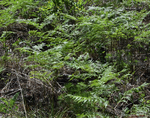
Dennstaedtiaceae: Pteridium aquilinum
Files
Family Name
Dennstaedtiaceae
Common Name
Bracken fern, common bracken
Description
Pteridium aquilinum is a long-lived, perennial, herbaceous geophytic fern that reproduces entirely via spores rather than flowers or seeds, absorbing nutrients through a fibrous root system anchored by extensive, deeply burying, creeping, scaly, brown-black rhizomes that can grow several meters long. The plant commonly reaches a height of 0.3 to 1.3 m, though it can exceptionally grow up to 3 m tall under optimal forest conditions. It lacks a true aboveground stem; instead, solitary, upright, smooth, and grooved stipes (leaf stalks) emerge directly from the subterranean rhizomes, changing in color from green or red maroon to deep brown by late season. Fronds exhibit an alternate leaf insertion and are large, coarse, and compound—specifically bi- to tri-pinnately divided into a distinct triangular shape held nearly horizontally. The leaflets (pinnules) are dark green, varying heavily in size by mature position but often possessing oblong or lanceolate shapes with distinct, inrolled margins. The upper surface features a smooth, somewhat leathery texture while the lower surface is frequently covered in fine, pale, appressed hairs along the veins. A distinct petiole (stipe) is always present and typically equals or exceeds the length of the blade itself. It possesses no flowers or traditional fruits. Its reproductive units consist of microscopic, trilete, tetrahedral-globose spores measuring 23–35 μm housed inside marginal sori which are continuous along the underrolled edges of the leaflets and mature from July through September. The bracken fern is native to South Dakota, where it can be found primarily in the Black Hills region inhabiting dry upland woods, woodland openings, old fields, thickets, and areas characterized by heavily disturbed or post-burn soils.
Horticulture Notes
Spore Collection: Reproductive spores are collected by placing mature, spore-bearing fronds showing dark marginal bands onto clean paper from July to September until the dust-like spores drop.
Germination: Spores have no dormancy period and require surface-sowing onto a sterilized, consistently moist, nutrient-poor substrate; germination occurs best in environments imitating post-fire conditions with a substrate pH between 5.5 and 7.5. Gametophytes emerge and will eventually produce a new sporophyte.
Vegetative Propagation: Underground rhizomes can be successfully lifted and severed cleanly with a sharp knife while the plant remains completely dormant during winter or early spring.
Soils: Best on deep, well-drained, sterile, or nutrient-poor soils including acidic clays, sands, coarse loams, and rocky substrates.
Additional Notes
Bracken fern provides exceptional ecological value by serving as an aggressive, dense native ground cover that provides excellent thermal and predatory shelter for small mammals, birds, and insects within woodland communities. Agriculturally and horticulturally, its use is severely restricted as it is highly toxic and carcinogenic to livestock and humans due to the presence of thiaminase and ptaquiloside. Historically and locally, humans have used the extracted juices of the plant to create textile dyes, harvested the ashes for soap and glass manufacturing, used the tough dried fronds as insulation thatch.