

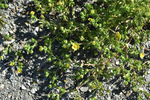
Rosaceae: Potentilla supina ssp. paradoxa
Files
Family Name
Rosaceae
Common Name
Bushy cinquefoil, trailing cinquefoil, paradox cinquefoil
Description
Potentilla supina is an annual, biennial, or short-lived perennial herbaceous forb that develops from a slender taproot with sparse lateral roots. The plant typically reaches a height of 10 to 50 cm, producing multiple spreading, prostrate, reclining, or ascending stems from the base that are dichotomously branched and moderately to densely covered in fine, spreading hairs. Leaf insertion is alternate, featuring odd-pinnately compound leaves. The green leaves are composed of 2 to 5 pairs of leaflets; basal leaves are situated on long petioles up to 6 cm long, while cauline leaves feature highly reduced petioles or are nearly sessile. Individual leaflets are elliptic, oblong, or obovate, measuring 1 to 3 cm long and 0.5 to 1.5 cm wide, with deeply incised-serrate or pinnatifid margins. The upper and lower leaf surfaces are light to medium green and sparsely to moderately pubescent with short hairs, lacking any dense white-tomentose coating on the lower side. Membranous, ovate to lanceolate stipules are present at the base of the petioles, featuring entire to slightly dentate margins. Flowering occurs from May through September. The inflorescence is a much-branched, leafy, terminal cyme where small, solitary flowers arise from the forks of the branching stems on long, hairy peduncles. The calyx consists of 5 free, green, ovate-lanceolate sepals measuring 3 to 5 mm long and 1.5 to 2.5 mm wide, alternating with 5 prominent bractlets (epicalyx segments) that are similar in shape and often slightly longer or equal to the sepals. There are 5 free, obovate, yellow petals that measure approximately 2.5 to 4 mm long, typically shorter than or equal to the surrounding sepals. Within the corolla reside 10 to 20 small stamens featuring short, yellow filaments and yellow anthers. The pistil collection is numerous and tightly clustered on a central receptacle, featuring tiny ovaries, a smooth, terminal style that equals the ovary in length, and a simple, slightly widened stigma. The fruit structure consists of a dense head of small, asymmetrical, smooth or slightly ridged achenes measuring roughly 1 mm in length. These achenes transition from green to a yellowish-brown or tan color at maturity, which occurs from July through October, and are uniquely distinguished by a conspicuous, corky, swollen appendage on the inner margin. Bushy cinquefoil is native to South Dakota, where it is broadly distributed across the state, heavily concentrated along the sandy shoals, reservoirs, and floodplains of the Missouri River, as well as on wet sandy shores, sandbars, and mudflats.
Synonym: Potentilla paradoxa
Horticulture Notes
Seed Collection: Collect the seed heads manually in late summer or autumn as the achenes turn tan and dry; crush the seed heads gently and screen through fine mesh to separate the microscopic seeds from the chaff.
Seed Germination: Surface-sow in late fall or very early spring because light exposure strongly enhances germination rates.
Vegetative Propagation: Non-flowering lateral branches in early summer can be rooted under high humidity using a well-drained medium.
Soils: Loose coarse sand or gravelly substrates, and alluvial muds, but will grow in sandy, loamy, or clay soils.
Light: Best in full sun but can successfully adapt to partial shade environments.
Water: Consistent, high moisture levels and seasonally saturated soils, showing an excellent tolerance for periodic flooding and water table fluctuations.
Additional Notes
Bushy cinquefoil offers valuable stabilization for damp, shifting soils along vulnerable riparian corridors and degraded wetland margins. Ecologically, its protracted flowering period provides a reliable source of pollen and nectar for small native bees, syrphid flies, and diverse beneficial insect pollinators. Though not standard in commercial landscapes due to its trailing, opportunistic growth habit, it functions well as a specialized addition to rain gardens, wetland restoration sites, and native retention basins.