

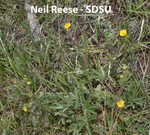
Rosaceae: Potentilla pulcherrima
Files
Family Name
Asteraceae
Common Name
Beautiful cinquefoil, soft cinquefoil
Description
Potentilla pulcherrima is a perennial, herbaceous forb that arises from a thick, woody caudex or short branched rhizomes anchored by a sturdy taproot. The plant reaches a mature height of 20 to 76 cm and with erect to ascending, often reclining stems covered in dense, soft, spreading or appressed white hairs. The leaves display alternate and predominantly basal insertion; they are palmately or sometimes subpalmate-pinnately compound with 5 to 7 leaflets. Each leaflet is oblong to oblanceolate, 2 to 7 cm long, and explicitly characterized by coarsely toothed margins. The leaflets are a contrasting deep glabrous green on the upper surface and a starkly distinct, densely tomentose white or silvery-hairy color on the lower surface. Basal leaves possess long petioles measuring 5 to 15 cm in length, whereas the reduced upper stem leaves are nearly sessile; conspicuous, leaf-like, lanceolate stipules are consistently present at the base of the petioles. Flowering occurs from June through August. The inflorescence is a loose, terminal, cyme-like cluster holding several radially symmetrical flowers that span roughly 1.5 to 2 cm in diameter. The flowers are subtended by a calyx of 5 free sepals that are lanceolate, 4 to 7 mm long, green with white pubescence, and alternate with 5 slightly narrower bractlets . The corolla consists of 5 free petals that are obovate, slightly notched at the apex, bright yellow in color, and measures 6 to 10 mm long, comfortably exceeding the sepals. Inside the petals are 15 to 20 stamens that are short, yellow, and tightly arranged around the base of the receptacle. The pistils are numerous (often 20 to 40), small, separate, and contain a smooth ovary with a slender, filiform style and simple stigma attached near the middle of the ovary wall. The fruit is a cluster of smooth, dry, teardrop-shaped achenes that measure about 1.5 mm long, turning tan to dark brown at maturity between August and September. The beautiful cinquefoil is native to South Dakota, where it is found primarily in the western portion of the state within the Black Hills and high plains, thriving in moist mountain meadows, open forest clearings, and grassy montane valleys.
Horticulture Notes
Seed Collection: Collect the tiny, dry brown achenes manually from August to late September by clipping dry, brown seed heads into paper bags. [1]
Seed Germination: Seeds require 60 to 90 days of cold, moist stratification and light. Surface sow the seeds in the fall.
Vegetative Propagation: Propagate by dividing the woody mature caudex in early spring before new growth begins.
Soils: Prefers moderately fertile, well-drained sandy loam or rocky soils; highly adaptable to clay and lean soils if drainage is adequate.
Light: Best in full, direct sun but tolerates light afternoon shade in hot climates.
Water: Moderate, regular moisture. Exhibits good drought tolerance once its deep taproot system is established.
Additional Notes
Beautiful cinquefoil boasts outstanding horticultural value for native plant gardens, sunny borders, and alpine rock gardens due to its vibrant, summer-long yellow blooms and highly ornamental, white-velvet foliage contrast. Ecologically, the open, accessible flowers serve as an exceptional nectar and pollen source for a diverse array of native bees, hoverflies, and small butterflies. The dense basal growth provides excellent protective groundcover for small insects and suppresses soil erosion on slopes.