

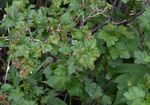
Grossulariaceae: Ribes lacustre
Files
Family Name
Grossulariaceae
Common Name
Prickly currant, bristly black currant, black swamp gooseberry
Description
Ribes lacustre is a long-lived perennial, deciduous woody shrub that grows from a fibrous, spreading shallow root system. Plants typically reach a height of 1 to 1.5 m, with erect to spreading, heavily armed stems. The grayish brown to reddish bark is covered with numerous slender, sharp, internodal prickles, supplemented by clustered, larger nodal spines protruding where leaves emerge. Leaves are arranged alternately, simple in structure, and display a deep, shiny green color on top. The blades measure 2.5 to 7.5 cm in both length and width, have a cordate base and 3 to 5 deeply indented, palmately arranged lobes with coarsely serrated margins. Both the upper and lower surfaces are mostly glabrous to sparsely hairy, with stalked, sticky glands embedded along the veins underneath. Slender, hairy, and glandular petioles are always present, measuring 1 to 4 cm in length; stipules are absent or reduced to indistinct margins at the petiole base. Flowering occurs from May through July, producing drooping axillary racemes containing 7 to 15 small, saucer-shaped flowers arranged along a glandular axis. Each flower features 5 sepals that are fused at the base to form a saucer-like hypanthium; the free sepal lobes are broadly ovate to flaring, measuring roughly 1 to 2 mm long and wide, and show a dull greenish-yellow, pinkish, or dark maroon-red coloration. Alternating with the sepals are 5 distinct, free petals that are pinkish to reddish, fan-shaped or obovate, and much smaller than the sepals (under 1 mm long). Directly inside the petals sit exactly 5 small stamens alternating with the petals, bearing short, pale filaments and cream-colored to yellow anthers that do not exceed the sepals. The single inferior ovary supports a pistil with a short style that is deeply cleft or divided into 2 distinct branches, each terminating in a small, capitate stigma. The fruit is a spherical, fleshy berry measuring 6 to 10 mm in diameter. It turns dark purple to black at full maturity, is densely covered in stiff, gland-tipped, bristly hairs, and ripens from late July through September. Prickly currant is native to South Dakota, where it is confined almost exclusively to cool, moist microclimates within the high-elevation Black Hills region, thriving in damp shaded habitats such as mountain streamsides, wet ravines, boggy woodlands, and talus slopes.
Horticulture Notes
Seed Collection: Extract the numerous small seeds from fully ripened, black berries in late summer by crushing the fruit in water and straining out the pulp.
Seed Germination: Seeds possess deep embryo dormancy and require approximately 90 days of cold, moist stratification at 32–40°F (0–5°C) prior to spring sowing. Fall sowing is recommended.
Vegetative Propagation: Rooting semi-hardwood cuttings taken in midsummer or hardwood cuttings collected in late autumn represents the most reliable method.
Soils: Rich, organic, moist to wet soils. They have a strong preference for peaty, acidic, or gravelly loams over heavy clay.
Light: Full sun in cold climates but strongly prefers part shade to deep woodland shade in warmer regions.
Water: Consistently moist, wet, or boggy conditions.
Additional Notes
Prickly currant provides distinct horticultural value as an attractive ornamental addition to woodland or wild gardens, particularly on properties featuring wet, shaded borders or pond margins. Ecologically, the early summer blossoms act as an important nectar source for native bumblebees, mining bees, and hovering flies, while the shrub serves as a larval host plant for various butterfly and moth species. The heavily armored, dense branching provides protective nesting cover for songbirds and small mammals, and the tart, ripe berries are heavily consumed by waterfowl, grouse, small rodents, and foraging black bears. For human utilization, the edible berries can be harvested to produce delicious jams, jellies, and tart pies.