

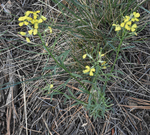
Brassicaceae: Sisymbrium altissimum
Files
Family Name
Brassicaceae
Common Name
Tall tumblemustard, tumble mustard
Description
Sisymbrium altissimum is a winter or summer annual, herbaceous forb that develops a deep, stout taproot. The plant typically reaches a height of 40 to 120 cm, supported by an erect, bushy stem that branches freely and distally; the stem is sparsely to densely hirsute with rough hairs at the base and transitions to glabrous and smooth above. Leaves exhibit an alternate insertion pattern, with lower basal leaves arranged in a rosette and upper cauline leaves transitioning along the stem. The leaves are simple but deeply pinnately divided, presenting a medium-green color. Basal leaves measure 5 to 20 cm long and 2 to 8 cm wide with 3 to 8 oblong, dentate lobes on each side, while the upper leaves are much smaller and feathery, containing narrow, linear to filiform lobes. The blade surfaces transition from hirsute on lower leaves to nearly glabrous on upper leaves, and petioles are present on lower leaves, 1 to 10 cm long, but shorten or become nearly absent above. Flowering occurs from April through September, producing elongated, loose, terminal racemes that can expand significantly as fruits develop. The flowers possess 4 free, oblong sepals measuring 4 to 6 mm long and 1 to 2 mm wide. They are yellowish-green, spreading, and hooded or horned at the apex. The 4 free, spatulate petals form a characteristic cross shape and measure 6 to 10 mm long and 2.5 to 4 mm wide. They are pale yellow to occasionally cream-white with a distinct basal claw measuring 3.5 to 6 mm. Following the petals are 6 tetradynamous stamens (4 long filaments measuring up to 6 mm and 2 short filaments) with pale yellow, oblong anthers that are 1.5 to 2.2 mm long. The single, superior pistil features a short style measuring 0.5 to 2 mm long and a prominently 2-lobed stigma. The fruit is a narrowly linear, silique capsule measuring 4.5 to 9 cm long and 1 to 2 mm wide, which matures from green to a dry, tan or straw-brown color between July and September. Tall tumblemustard is not native to South Dakota; it is introduced from its native range in Eurasia but it is now naturalized statewide across South Dakota in disturbed areas, roadsides, pastures, cultivated fields, and degraded grasslands.
Additional Notes
Tall tumblemustard holds very little horticultural value and is widely managed as an agricultural weed, but it plays a temporary ecological role by stabilizing heavily disturbed soils and offering early-season forage for standard livestock and certain wildlife when the growth is young and tender. Humans historically utilized the plant as a source of food; the young basal leaves can be eaten raw in salads or boiled as greens, and the seed can be ground into a meal.