

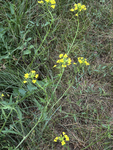
Brassicaceae: Sisymbrium loeselii
Files
Family Name
Brassicaceae
Common Name
Small tumbleweed mustard, tall hedge mustard, false London-rocket
Description
Sisymbrium loeselii is an annual or occasionally biennial herbaceous plant developing from a distinct taproot system. The plant reaches a height of 35 to 120 cm supported by erect, vertically upward branching stems that are densely covered in bristly, backward-pointing hairs near the base and typically become smooth (glabrous) toward the upper portion. The green leaves are alternate along the stem, with the earliest leaves arranged in a basal rosette. The leaves are simple, deeply divided into pinnatifid lobes. The lower basal leaves measure 4 to 13 cm long and up to 5 cm wide, characterized by a large, triangular or spear-shaped terminal lobe with irregular teeth flanked by 2 to 4 smaller pairs of lateral lobes; these basal leaves are borne on distinct petioles measuring 1 to 5 cm long. Upper cauline leaves are similar but much smaller, becoming progressively reduced, less lobed, and short-petioled to nearly sessile near the apex. Fine hairs cover both the upper and lower leaf surfaces. Flowering occurs from May through September, producing dense, rounded terminal raceme clusters. The flowers feature 4 separate, oblong, greenish-yellow sepals measuring 3 to 4 mm long and 1 to 1.5 mm wide that grow in an ascending fashion. The corolla consists of 4 free, bright lemon-yellow petals that are spatulate with a narrow claw, measuring 6 to 8 mm long and 2 to 3 mm wide. There are 6 stamens with filaments measuring 3 to 4.5 mm long and small ovate anthers measuring 0.6 to 1 mm long. The single compound pistil features a slender ovary with 40 to 60 ovules, topped by a short, stout style measuring 0.3 to 0.7 mm and a prominently 2-lobed stigma. The resulting fruit is a dry, dehiscent, narrowly linear cylindrical capsule known as a silique, measuring 2 to 3.5 cm long and about 1 mm wide. The fruits mature from green to a dull straw-yellow or buff color during the mid-to-late summer months. Small tumbleweed mustard is not native to South Dakota; it is an introduced exotic species native to temperate Eurasia, but it has naturalized across South Dakota where it can be found in disturbed habitats such as roadsides, waste areas, cultivated fields, and railroads.
Additional Notes
Small tumbleweed mustard holds virtually no horticultural value and is widely managed as a weedy or invasive species in North American landscapes. Ecologically, it serves as a pollen and nectar source for generalist insect pollinators like bees, flies, and butterflies during summer. However, it often exerts a negative ecological impact on native plant communities due to its allelopathic properties, secreting chemicals that inhibit the seed germination of native rangeland bunchgrasses and suppressing beneficial arbuscular mycorrhizal fungi in the soil.