

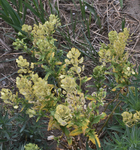
Brassicaceae: Thlaspi arvense
Files
Family Name
Brassicaceae
Common Name
Field Pennycress, Pennycress
Native American Name
Lakota: apé mázaská
Description
Thlaspi arvense is a winter or summer annual, herbaceous, erect forb that anchors into the substrate via a slender, distinct taproot system. Mature specimens typically reach an average height of 10 to 80 cm, featuring stems that are single or branched at the upper half, distinctly ribbed or angled, smooth, and entirely glabrous throughout. Leaf insertion transitions dynamically, presenting a basal rosette that senesces early, followed by alternate cauline leaves along the length of the stem. The leaves are simple, bright green to yellowish green, measuring 2 to 10 cm in length and 0.5 to 2.5 cm in width; the blades vary structurally from obovate-oblong in basal forms to lanceolate or narrowly oval in cauline leaves. Both upper and lower leaf surfaces are completely glabrous, smooth, and lack hairs. The lower basal leaves taper into a short petiole, whereas mid-to-upper cauline leaves are strictly sessile, clasping the stem closely via prominent, arrow-shaped or ear-shaped basal lobes. Flowering occurs progressively from April through July, with individual blossoms clustered tightly into an unbranched terminal raceme inflorescence that elongates substantially as the fruit matures, extending from a few centimeters to over 20 cm in total length. Each flower contains 4 sepals, which are roughly 1.5 to 2.2 mm long and 0.5 to 1.0 mm wide, oblong-ovate, light green with pale membranous margins, entirely free from one another, and ascending to erect. The 4 petals are free, distinctly cruciform, spatulate to spoon-shaped with a narrow claw base, snowy white, measuring 2.5 to 4.5 mm in length and roughly 1.0 to 1.5 mm in width, easily exceeding the sepals in length. The androecium consists of 6 stamens (tetradynamous, with 4 long and 2 short), featuring filaments up to 2 mm long and small, yellow anthers. The gynoecium consists of a single compound pistil with a superior, deeply flattened green ovary, measuring roughly 1.5 to 2.5 mm wide, terminated by a very brief style under 0.3 mm and a small, capitate, weakly two-lobed stigma. The fruit is a highly distinctive, strongly flattened, dry silicle pod that is circular to broad-obovate, measuring 10 to 20 mm long and nearly as wide, marked by a broad, paper-like wing surrounding the seed cavity and a deep notch at the apex. The pods mature from bright green to a golden, pale brownish-yellow color between June and August. Field pennycress is not native to South Dakota; it is an introduced weed native to temperate Eurasia that has fully naturalized across every county of South Dakota. It is primarily found growing in highly disturbed habitats, including agricultural crop fields, neglected gardens, rangelands, roadsides, waste ground, and vacant urban lots.
Additional Notes
Field pennycress holds high ecological and agricultural value as an emerging, cold-hardy winter cash cover crop engineered to prevent field erosion and prevent nutrient runoff between autumn corn harvests and spring soybean plantings. The blooms provide early foraging resources for emerging honeybees and native syrphid flies, while the plant's massive seed yields offer exceptional potential as an oilseed source for clean aviation biofuel production. For humans, the young, peppery leaves can be consumed raw or boiled as a wild vegetable, the seeds have a historical role in folk medicine as an anti-inflammatory treatment, and the uniquely structured, flattened dried seed pods are heavily utilized in commercial floral arrangements.