

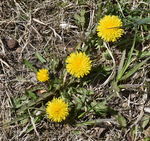
Asteraceae: Taraxacum officinale
Files
Family Name
Asteraceae
Common Name
Common Dandelion, Dandelion
Native American Name
Lakota: waȟčá zí
Description
Taraxacum officinale is a perennial, acaulescent, lactiferous herbaceous forb that develops a thick, fleshy, unbranched central taproot capable of penetrating up to 1 to 2 meters deep; it lacks true horizontal rhizomes, though root fragments readily regenerate cloned individuals. Mature plants typically range from 5 to 50 cm in height, lacking an upright, leafy stem; instead, the stem is reduced to a flattened basal crown, 1–2.5 cm long situated at or just below the soil surface, while the flowering scapes are erect, hollow, cylindrical, unbranched, leafless, and smooth to sparsely pubescent. Leaves are arranged in a dense, basal radial rosette, simple but highly variable in shape, ranging from oblong-lanceolate to oblanceolate with pinnately, deeply toothed, or sharply lobed margins. The leaves are bright green to olive green, measuring 5 to 40 cm long and 1 to 15 cm wide, with a glabrous upper surface and a glabrous to sparsely pubescent lower surface along the veins, tapering into a winged petiole of variable lengths. Flowering occurs primarily from April to June, though sporadic blooms persist through autumn, featuring a terminal, solitary flower head measuring 2.5 to 5 cm across, surrounded by an oblong involucre composed of 2 series of unequal phyllaries. The outer bracts are reflexed or downward-curved and the inner bracts erect. The calyx is highly modified into a pappus consisting of numerous white to silvery-white capillary bristles that are fused at the base into a small ring surrounding the corolla base. The petals are fused into a golden-yellow ligulate (ray-like) corolla, 5-toothed at the apex, measuring roughly 10 to 15 mm long and 1 to 2 mm wide. Each fertile floret contains 5 stamens featuring thin, pale yellow filaments and yellow anthers that are fused into a tube around the style, and a single inferior pistil with a slender, pale yellow style and a deeply two-lobed, coiled yellow stigma. The fruit is a dry, single-seeded achene, which is greyish-brown to olive-brown, oblong-lanceolate, 3 to 4 mm long, ribbed, and terminates in a long, slender beak attached to a parachute-like radiating cluster of silky white pappus hairs. Fruits achieve maturity from May to July, depending on ambient temperatures and geographic latitude. The common dandelion is not native to South Dakota; it is an introduced species native to Eurasia that has naturalized universally throughout all counties of South Dakota, thriving across disturbed habitats including lawns, agricultural pastures, gardens, roadsides, disturbed banks, and vacant fields.
Additional Notes
Though a noxious weed, common dandelions offer high ecological value as one of the most vital, early-spring nectar and pollen sources for native bees, honeybees, butterflies, and emerging macro-invertebrate pollinators. The nutritious seeds are heavily consumed by songbirds and small mammals, while the dense basal foliage supplies palatable forage for wildlife. For humans, the young leaves are harvested raw for salads or cooked as greens, the yellow blooms are utilized to formulate traditional dandelion wines and syrups, and the roasted taproot serves as a caffeine-free coffee substitute.