

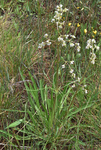
Valerianaceae: Valeriana edulis
Files
Family Name
Valerianaceae (Caprifoliaceae)
Common Name
Edible valerian, tobacco root, prairie valerian
Description
Valeriana edulis is a long-lived, dioecious perennial herbaceous forb that develops a stout, deeply penetrating, fleshy taproot extending from a short, branched woody crown. The plant reaches an overall height of 30 to 120 cm, supported by single or multiple erect, thick, succulent, hollow stems that are generally glabrous except at the slightly swollen nodes. Leaf insertion is primarily basal, forming a dense rosette, with none to a few opposite pairs distributed along the upper stem. The basal leaves are simple, light to medium green, thick, narrowly oblanceolate to linear-oblanceolate, measuring 10 to 30 cm long and less than 2.5 cm wide, with nearly parallel venation, a smooth margin densely fringed with short, stiff, white cilia, and a short, winged petiole. In contrast, the upper cauline leaves are sessile, much shorter, and pinnately compound or deeply cleft into 3 to 9 irregular, narrow, finger-like linear segments. Flowering occurs from May through August depending on elevation, featuring a dense, terminal, panicle-like cyme that measures 10 to 30 centimeters long, which elongates and becomes more open as the season advances. The sepals are highly modified, minute, and fused to the top of the inferior ovary during bloom, later unrolling into 10 to 20 free, plumose, feather-like bristles that expand up to 5 mm long to aid in wind dispersal. The petals are small, white to pinkish-white, 2 to 4 m long, and fused at the base into a short, funnelform corolla tube with 5 spreading, unequal, lobes. Staminate flowers possess 3 separate, long-exserted stamens featuring white filaments and yellow anthers, while pistillate flowers lack functional stamens. The single pistil consists of an inferior, 3-celled ovary (with only one fertile ovule) topped by a single slender style and a short, 3-lobed stigma. The fruit is a dry, 1-seeded achene (oval-oblong, 3 to 5 mm long, glabrous, straw-colored to light brown) that reaches full maturity from late July through September. Edible valerian is native to South Dakota, where it is restricted to three western counties within the Black Hills region, inhabiting moist subalpine meadows, grasslands, and calcareous mountain wetlands.
Horticulture Notes
Seed Collection: Gather dry, mature, straw-colored achenes by hand from female plants during August and September before the plumose calyx bristles carry them away.
Seed Germination: Seeds germinate readily at high percentages under warm, moist conditions (65–70°F) in light greenhouse setups; they are light-dependent germinators and should be surface-sown or only shallowly tamped down.
Vegetative Propagation: Plants can be propagated by carefully dividing the short, multi-headed branching crowns during early spring dormancy.
Soils: Rich, loamy, organic soils, fine rocky loams, or saturated peat, tolerating a wide pH range from mildly acidic to basic calcareous soils.
Light: Full, direct sun.
Water: Consistently moist to wet-mesic moisture regimes; it tolerates seasonal waterlogging or saturation in wetlands.
Additional Notes
Edible valerian serves an essential ecological role as a specialized food source for diverse native pollinators, including bees, flies, and butterflies, who are drawn to its nectar-rich terminal cymes. Because the species is dioecious, maintaining distinct populations of both male and female plants is vital for localized seed production and ecosystem continuity. Beyond its ecological importance, the species possesses significant historical human value. The thick taproot was used extensively as a staple food resource by indigenous Native American tribes; because it contains bitter, unpalatable compounds when raw, the roots were traditionally slow-baked or steamed underground for up to two days until they turned black, sweet, and mealy, often being ground into a nutritious flour.