

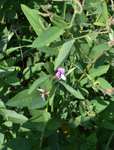
Fabaceae: Desmodium canadense
Files
Family Name
Fabaceae
Common Name
Showy Tick-trefoil, Canada Tickclover, Canadian Tick-trefoil
Native American Name
Lakota: wókaȟtaŋ blaskáska
Description
Desmodium canadense is a long-lived, perennial, herbaceous forb that develops from a stout, woody taproot. The plant typically reaches a mature height of 90 to 180 cm. Its central stem is erect, rigid, distinctively lined with vertical striations, and covered in an abundance of both fine hooked and spreading hairs, often branching exclusively within the upper half of the plant. Leaf insertion along the stem is alternate, supporting pinnately trifoliolate leaves. The medium-to-dark green leaflet blades are ovate to lanceolate with acute or obtuse tips and entire margins. Terminal leaflets measure 4 to 11 cm in length and 1.5 to 3 cm in width, which is noticeably larger than the lateral leaflets. The upper surface of the leaflet is sparsely puberulent to glabrescent, while the lower surface features a lighter pale-green coloration and is densely covered in fine, appressed hairs. Each compound leaf features a distinct petiole measuring 1 to 6 cm long. A pair of persistent, subulate-to-lanceolate, striate stipules measuring 4.5 to 10 mm in length is present at the base of the petiole. Flowering occurs from July through September. The inflorescence forms a dense, terminal, elongated panicle or raceme that can extend up to 40 cm long. The calyx consists of 5 fused sepals that are strongly bilabiate (two-lipped), measuring approximately 4 to 5 mm long, presenting a reddish-purple to green tint, and heavily blanketed in fine pubescence. The corolla is composed of 5 papilionaceous (pea-like), pink-to-rose or lavender-purple petals measuring about 1 to 1.3 cm long. The upright banner petal features a pair of prominent yellow spots at its inner base to act as a nectar guide, while the wing and keel petals are largely free but closely interlocked. Enclosed within the petals are 10 diadelphous stamens fused by their filaments into a 9+1 arrangement, which are translucent-white to light pink with tiny yellow anthers. A single, superior pistil features an elongated, green ovary about 5 to 7 mm long, tipped with a slender, curved style and a small, capitate, unlobed stigma. The fruit is a flat, dry loment measuring 1.5 to 3 cm in length, dividing into 3 to 6 segments (joints) that do not split open upon ripening. These pubescent, chain-like segments turn dark brown or greyish black at maturity between August and October, clinging tightly to passing animals or clothing. The Showy Tick-trefoil is native to South Dakota, where it occurs primarily across the eastern and central regions of the state in moist-to-mesic black soil prairies, river meadows, open thickets, lake borders, and disturbed roadside corridors.
Horticulture Notes
Seed collection: Collect the multi-segmented loment pods late in the season from August to October when they turn a dry, brittle dark brown or blackish color. Air-dry the pods for 1 to 2 weeks, then mechanically thresh or rub them across a screen to liberate the small, smooth, tan-to-greenish-brown seeds.
Seed germination: Seeds possess a hard, water-impermeable coat and require mechanical scarification (using fine sandpaper or a hot water soak for 12 hours) prior to planting. For optimal results, subject the scarified seeds to 60 to 90 days of cold, moist stratification at roughly 40°F before shifting them to a warm environment of 70°F, where they will reliably emerge within 2 to 4 weeks. Alternately, sow raw seeds directly outdoors during late autumn to allow natural winter weather to handle stratification.
Vegetative propagation: Division of established root clumps in the very early spring while the plant is still dormant and before new vegetative growth initiates.
Soils: Moist loam, clay-loam, and sandy loam with an optimal pH range of 5.5 to 7.0.
Light: Full sun to light partial shade conditions, requiring a minimum of 4 to 6 hours of direct daily sunlight.
Water: Prefers consistently moist, well-drained soils but exhibits moderate drought tolerance once its deep taproot system becomes fully established.
Additional Notes
Showy Tick-trefoil provides significant ecological value as a robust, native nitrogen-fixing legume that actively enriches lean soils. Its nectar-rich, vibrant purple blossoms attract extensive arrays of bumblebees, butterflies, and hummingbirds, while serving as an essential larval host plant for native butterflies like the Eastern Tailed-Blue, Silver-spotted Skipper, and Hoary Edge. The highly nutritious, protein-rich seeds serve as an invaluable fall and winter food source for upland game birds and the foliage provides premium forage for white-tailed deer.