

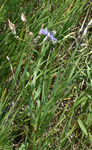
Asteraceae: Lactuca pulchella
Files
Family Name
Asteraceae
Common Name
Blue Lettuce, Wild Blue Lettuce
Native American Name
Lakota: ažúŋtka yazáŋpi, wablúška hiŋšmá iyéčheča
Description
Lactuca pulchella is a deep-rooted, perennial, herbaceous forb that spreads vigorously via an extensive system of creeping, horizontal vertical-and-lateral rhizomes. The plant typically reaches a mature height of 30 to 100 cm. Its central stem is erect, rigid, smooth, unbranched below the inflorescence, often covered in a pale, waxy bloom (glaucous), and exudes a bitter, milky white latex juice when wounded. Leaf insertion along the stem is alternate, supporting simple, sessile leaves that lack petioles. The leaves are bluish-green, linear-to-lanceolate, measuring 5 to 20 cm long and 1 to 3.5 cm wide; the lower leaves are often deeply pinnately dissected with backward-pointing lobes, while the upper leaves are smaller, reduced, and entire. Both the upper and lower surfaces are glabrous and glaucous. Flowering occurs from June through September. The inflorescence consists of a loose, terminal, corymbiform or paniculiform cluster of numerous flower heads, each head measuring 2 to 3 cm across. The flower head features a cylindrical-to-campanulate involucre, 10 to 15 mm high, comprised of overlapping bracts in 3 to 4 unequal series that are green with purplish tips and scarious margins. Each floret has a pappus of numerous, fine, persistent, bright white capillary bristles measuring 8 to 10 mm long. The corolla contains no disk florets; it is composed strictly of 15 to 30 perfect, fertile, strap-shaped ray flowers measuring 10 to 18 mm long, which present a striking blue, lavender, or purple color and end in 5 small apical teeth. Enclosed within each floret are 5 stamens featuring dark blue-to-purple, fused anthers that form a protective cylinder around the style, with free, short, translucent filaments. A single, inferior pistil features a one-celled ovary, a slender style that elongates through the anther tube, and a deeply two-cleft stigma coated in fine hairs. The fruit is a dry, flattened, lanceolate achene (cypsela) measuring 4 to 6 mm in length, which is dark brown to blackish with prominent longitudinal ribs on each face and matures between August and October. The achene tapers into a short, stout beak that connects to the parachute-like white pappus, allowing for rapid wind dispersal. Blue Lettuce is native to South Dakota, where it occurs widely across all counties of the state, thriving in diverse habitats including dry-to-mesic prairies, open woodlands, river valleys, coulees, pastures, and disturbed railway or roadside corridors.
Synonym: Lactuca tatarica var. pulchella
Horticulture Notes
Seed collection: Collect the seed heads from August to October as the flowers fade and yield to puffy, white balls of fluff. Hand-strip or clip the mature seed heads into a paper sack on a dry. Spread the collected material over a screen for 5 to 7 days to air-dry completely, then gently rub the seed heads to detach the dark brown, ribbed achenes from their white, bristly pappus structures.
Seed germination: Seeds germinate readily and do not strictly require cold stratification Sow the tiny seeds shallowly on the soil surface or under a very light dusting of grit (no deeper than 1/8 inch), as they require exposure to ambient light to successfully break dormancy.
Vegetative propagation: Propagate by digging and dividing the vigorous horizontal rhizomes during early spring dormancy or late autumn. Slice the creeping roots into 2- to 4-inch segments, ensuring each piece contains at least one viable growth node or bud, and bury them 2 inches deep.
Soils: Adaptable to a wide range of soil textures including heavy clay, clay-loam, alkaline silt, and sandy soils, with a highly tolerant pH range of 6.0 to 8.5.
Light: Full sun to light partial shade.
Water: Prefers moist, well-drained conditions but is drought resistance once established.
Additional Notes
Blue Lettuce offers distinct ecological value within native ecosystems as a pioneer species that excels at stabilizing highly erodible or disturbed soils due to its deep, binding rhizomatous root structure. The attractive blue-to-purple flower heads serve as an essential mid-summer food source, supplying copious nectar and pollen to native bees, hoverflies, and butterflies. While the bitter, milky latex deters many generalist insect pests, the foliage is readily consumed by native mammalian herbivores, including pronghorn, elk, and mule deer, and the wind-blown seeds are collected by foraging songbirds.