

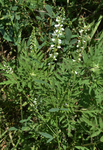
Fabaceae: Melilotus albus
Files
Family Name
Fabaceae
Common Name
White sweetclover, white melilot, honey clover
Description
Melilotus albus is a biennial or occasionally annual, herbaceous forb featuring a robust, deep taproot system. Plants typically reach a height of 50 to 200 cm at maturity, supported by upright, freely branched, glabrous to sparsely short-strigose, and often hollow stems. The leaves have an alternate insertion pattern and are palmately trifoliate, possessing a light to medium green color. Leaflets are generally oblong-lanceolate to obovate, measuring 1 to 3 cm long and 0.5 to 1.5 cm wide, with finely serrated margins along the upper half or more of their length, and smooth, glabrous upper and lower surfaces. A distinct petiole is present, ranging from 1 to 5 cm long, flanked at its base by a pair of linear-subulate, persistent stipules about 5 to 10 mm in length. Flowering occurs primarily from June through September, with individual white flowers tightly arranged along many narrow, elongated, spike-like racemes measuring 5 to 15 cm in length that emerge from the upper leaf axils. Each flower contains a small, persistent green calyx composed of five fused sepals forming a tube roughly 1.5 to 2 mm long with five equal, lanceolate lobes. The corolla features five free, white petals arranged in a classic pea-like structure measuring 3 to 5 mm long: an erect banner, two lateral wings, and two fused bottom petals forming a central keel, with the wings approximately equal to the keel in length. Tucked inside the corolla are 10 stamens containing small, yellow anthers; nine of the stamens are fused together by their filaments while one remains free (diadelphous arrangement). The single pistil consists of a superior, glabrous ovary about 2 mm long containing 1 to 2 ovules, ending in a slender, curved style and a minute, capitate stigma. The fruit develops into a small, ovoid, wrinkled, dark gray to brown legume measuring 3 to 4 mm long that remains mostly indehiscent and reaches full maturity from August through October. White sweetclover is not native to South Dakota; it was introduced from its native range across Europe and temperate Asia and can now be found extensively throughout all counties of South Dakota, thriving in disturbed soils, roadsides, agricultural fields, prairies, and riparian gravel bars.
Additional Notes
White sweetclover is highly valued ecologically as an exceptionally rich source of nectar and pollen for honeybees, bumblebees, and various wild pollinators, serving as a cornerstone species for commercial apiaries. Its ability to host symbiotic Rhizobium bacteria allows it to fix atmospheric nitrogen, making it a useful green manure crop for restoring degraded soils and improving fertility on heavily disturbed sites. However, it is also treated as an invasive weed in natural grasslands and prairies where it can crowd out native plant diversity. For human utility, the plant has been cultivated as a high-protein livestock forage and used in traditional herbal medicine to treat circulatory issues due to its high concentration of coumarin.