

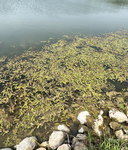
Potamogetonaceae: Potamogeton nodosus
Files
Family Name
Potamogetonaceae
Common Name
American pondweed, Longleaf pondweed
Description
Potamogeton nodosus is a perennial, herbaceous aquatic plant that anchors into the substrate via a fibrous root system arising from creeping, extensively branched rhizomes. The plant reaches a length matching its water depth, typically ranging from 1 to 2 meters, with a round, slender, and highly branched stems. It exhibits distinct heterophylly with two leaf types: floating leaves are alternate, simple, leathery, elliptic to oblong, bright green to brownish, 5 to 13 cm long, and 2 to 5 cm wide, featuring a smooth upper surface and a pale lower surface; submerged leaves are alternate, simple, thin, translucent, linear-lanceolate, 9 to 20 cm long, and 1 to 3 cm wide. Both leaf types possess distinct petioles, with floating leaf petioles measuring up to 15 cm long, while submerged petioles are shorter (2 to 10 cm). Free, prominent, brownish stipules are present in the leaf axils, measuring 3 to 10 cm in length and eventually decaying into fibers. Flowering occurs from June to September, displaying a dense, cylindrical spike inflorescence that measures 2 to 6 cm long and rises above the water surface on a stout peduncle. The flowers have 4 clawed, sepal-like, brownish-green perianth segments (tepals) that are free, about 2 mm long, and rounded. The flowers contain 4 stamens that are sessile, less than 1 mm long, and structurally fused to the base of the tepals, bearing pale yellow anthers. The gynoecium consists of 4 separate pistils, each about 1.5 to 2 mm long, featuring a short, thick style and a capitate, papillose stigma. The fruit is a drupelet measuring 3 to 4 mm long, obovoid, brownish-red to orange-brown, featuring a distinct dorsal keel and a short beak, reaching maturity from August to October. American pondweed is native to South Dakota and can be found statewide in slow-moving streams, rivers, ponds, lakes, and marshes.
Horticulture Notes
Seed collection: Harvest mature, brownish-red drupelets directly from the fruiting spikes in late summer or autumn (August to October) and store them in water-filled containers under refrigeration.
Seed germination: Seeds require a period of wet cold-stratification at 2–4°C for 60 to 90 days, followed by exposure to warm water temperatures and high light intensity to break dormancy.
Vegetative propagation: Harvest rhizome cuttings, winter buds (turions), or stem fragments during the spring and plant them directly into the mud.
Soils: Rich, muddy substrates, or silty loams or sandy or gravelly bottoms in stable aquatic environments.
Light: Full sun to partial shade.
Water: Obligate aquatic plant that requires permanent, fresh, or slightly brackish water up to 2 meters deep.
Additional Notes
American pondweed is a foundational ecological species that offers excellent shelter, spawning grounds, and foraging habitats for a wide variety of native fish, aquatic invertebrates, and amphibians. The nutrient-rich seeds, dense foliage, and starchy rhizomes serve as a primary, high-energy food source for migrating waterfowl, muskrats, and beavers. While it is rarely cultivated for traditional home landscaping due to its aggressive spreading habit, it is frequently utilized in wetland restoration projects, retention pond stabilization, and wildlife mitigation banking to improve water clarity and prevent shoreline erosion.