

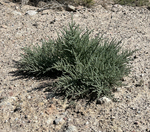
Chenopodiaceae: Halogeton glomeratus
Family Name
Chenopodiaceae (Amaranthaceae)
Common Name
Saltlover, halogeton
Description
Halogeton glomeratus is a winter-to-summer annual succulent forb. It is anchored via a robust, slow-growing taproot reaching depths up to 50 cm, augmented by widespread lateral roots. The plant reaches a height of 5–45 cm, developing a terminal erect main stem and 4 decumbent lateral stems branching extensively from the base that often flush reddish-purple during drought or late maturity. Leaf insertion is alternate along the stems; the leaves are simple, cylindrical, and sausage-like, measuring 3 to 20 mm long and 1 to 2 mm thick. They display a bluish-green hue, smooth succulent upper and lower surfaces, a distinctive terminal bristle or needle-like hair spine at the tip and lack a petiole. Flowering occurs from July to September, featuring an inconspicuous axillary inflorescence consisting of dense glomerules tucked into the leaf axils. The perianth consists of 5 sepals that are free nearly to the base, which differentiate during maturity into a 2–3 mm claw and a 2–4 mm wide fan-shaped blade that is transparent-membranous or winged, and tinted greenish yellow to pinkish red. There are 2 to 5 stamens, which are tiny and bear yellow-to-reddish anthers, and a single compound pistil with a deeply cleft style terminated by 2 slender, papillose stigmas. The fruit is a utricle (bladder-like, one-seeded structure) reaching maturity from August to October; the species is dimorphic, producing small, dull brown, unwinged, dormant fruits early in the season, and larger, shiny black, winged fruits that germinate readily later in the season. Saltlover is not native to South Dakota; it was introduced to North America from its native range in Russia, Central Asia, and northwestern China, and can now be found as an invasive weed in southwestern South Dakota, particularly within the arid, alkaline, and highly disturbed environments of Badlands National Park.
Additional Notes
Halogeton possesses zero horticultural value and is considered a high-threat ecological weed due to its capacity to poison livestock and degrade ecosystems. It contains dangerous concentrations of soluble sodium oxalates, making it highly toxic to grazing animals, particularly sheep and cattle. Ecologically, the plant alters soil composition by pumping salts from deep in the profile and depositing them on the surface via leaf drop, rendering the surrounding soil inhospitable to native vegetation. There are no documented historic or modern beneficial uses of this plant by humans.