

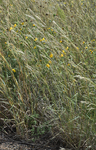
Poaceae: Andropogon hallii
Files
Family Name
Poaceae
Common Name
Sand bluestem, sandhill bluestem
Description
Andropogon hallii is a warm-season perennial, rhizomatous grass that spreads via deep, expansive fibrous roots and elongated, creeping, scaly rhizomes. It reaches a plant height of 90 to 210 cm at maturity. The upright stems are robust, strongly glaucous, and often display yellowish-green coloration near the joints. The leaves have an alternate insertion pattern, featuring simple, linear blades that are blue green to grayish green in color. Individual leaves measure up to 30 cm long and 2 to 10 mm wide. The upper surface is flat to slightly keeled with a prominent midrib and occasional long hairs near the blade base, while the lower surface is smooth and glabrous. Its leaf sheath is open and shorter than the internodes, the collar is distinct and hairless, and the ligule consists of a conspicuous fringed membrane measuring 2 to 4.5 mm long. Flowering occurs from August to October. The inflorescence consists of terminal digitate or panicle-like clustering of spikelets, measuring 4 to 9 cm long and 1.5 to 3 cm wide, comprised of 2 to 3 heavily pubescent branches (rames) with long, dense, yellowish hairs. The flowers are arranged within paired spikelets, each protected by hardened, glaucous glumes that are lanceolate and 7 to 10 millimeters long. The florets contain 3 stamens with distinct linear anthers that change from yellow to reddish-brown as they mature, with a single pistil featuring a superior ovary, 2 distinct styles, and feathery purple stigmas. The fruit is a caryopsis (grain) enclosed within the fertile lemma and palea, displaying an oblong shape, a tan-to-brown color, about 3 to 5 mm long, reaching maturity from late September through October. Sand bluestem is native to South Dakota. It is primarily distributed across the southern and western portions of the state, specifically within the Nebraska Sandhills extension into South Dakota, where it thrives in open sand prairies, sand dunes, and xeric, sandy blowouts.
Horticulture Notes
Seed Collection: Harvest seed heads from late September through October when the inflorescences turn fluffy and tan. The fluffy, bearded awns can make the seed difficult to clean and flow through standard seed drills unless properly conditioned or de-awned.
Seed Germination: Seeds require a period of cold, moist stratification (approximately 30 to 60 days at 4 degrees Celsius) to break dormancy. Sow treated seeds in early spring into a firm seedbed, or fall planting of untreated seeds.
Vegetative Propagation: Can be successfully propagated via rhizome cuttings or division of mature clumps.
Soils: Well-drained, coarse sandy soils, loamy sands, and gravelly substrates
Light: Full sun.
Water: Low water use. Possesses high drought tolerance and xeric adaptation once established.
Additional Notes
Sand bluestem provides highly effective erosion control and dune stabilization in sandy landscapes due to its vigorous, sod-forming rhizomatous root system. Ecologically, it serves as an invaluable food source and nesting habitat for upland songbirds and small mammals, while also acting as a larval host plant for native butterflies and skipper species. It is heavily utilized as a high-quality, palatable summer forage grass for cattle and livestock in rangeland management systems. Horticulturally, it is favored in xeriscaping and low-maintenance native gardens as a striking architectural accent plant due to its distinctive silvery-blue foliage and feathery autumn seed heads.