

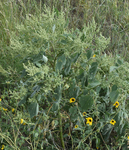
Asteraceae: Cyclachaena xanthiifolia
Files
Family Name
Asteraceae
Common Name
Giant sumpweed, marsh elder, false ragweed
Description
Cyclachaena xanthiifolia is a summer annual herbaceous forb that develops from a distinct taproot. Giant sumpweed typically grows to a height of 30 to 200 cm, featuring a stout, erect, angular stem that is unbranched below but heavily branched within the upper inflorescence. The lower portion of the stem is completely hairless, while the upper sections bear fine, sticky, glandular hairs. Leaf insertion is primarily opposite along the lower stem but can shift to an alternate arrangement near the upper flower clusters. The leaves are simple, broadly ovate to triangular, and sometimes shallowly three-lobed. They exhibit a light grayish green to medium green color, with blades measuring 6 to 12 cm long and 5 to 12 cm wide with coarsely or doubly toothed margins. The upper leaf surface is slightly rough-textured with a sparse covering of straight, stiff, appressed hairs, whereas the lower surface is distinctly paler and silky-soft due to a dense layer of long, soft, appressed hairs. Petioles are present and well-developed, 1 to 7 cm in length. Flowering occurs from July through October. The inflorescence consists of numerous small, drooping, disk-shaped heads arranged in dense, elongated, branching panicles arising from the upper leaf axils and terminal stems. The cup-like involucre at the base of each head measures 1.5 to 3 mm high. It features 5 outer herbaceous phyllaries (bracts) that are broad and covered in fine hairs, and 5 inner scarious to membranous, glabrous phyllaries. A pappus is entirely absent. Staminate (male) central florets feature fused petals forming a white to pale yellow tubular corolla roughly 2 to 2.5 mm long with terminal teeth, while the outer pistillate (female) florets have an obsolete or heavily reduced, tiny whitish corolla tube measuring only 0.1 to 0.5 mm long. Each staminate floret contains 5 stamens with filaments fused into a tube and free, white to pale yellow anthers arranged closely in a ring. The pistil structure consists of a single inferior ovary per pistillate floret, terminating in a style that branches into 2 short, thread-like stigmas, whereas staminate florets retain a single sterile, undivided style. The fruit is a smooth, egg-shaped to triangular cypsela (achene) measuring 2 to 3 mm long, turning dark brown to nearly black as it reaches maturity between August and October. Giant sumpweed is native to South Dakota and is widely distributed across the state, commonly occupying high-moisture or disturbed habitats such as floodplains, bottomlands, riverbanks, roadsides, and fertile agricultural fields.
Synonym: Euphrosyne xanthiifolia
Horticulture Notes
Seed Collection: Collect the dry, dark brown to black fruits in late autumn (September to October) by shaking the mature, dried panicles into a deep container. Seeds remain highly viable in the soil seed bank for up to six years.
Seed Germination: Seeds require moist cold stratification to break dormancy. Fall planting will be very successful.
Vegetative Propagation: Not applicable.
Soils: Best in loose, highly fertile, friable, and nutrient-rich alluvial or sandy soils.
Light Requirements: Full sun to partial shade.
Water: Consistently moist conditions where the soil moisture content remains around 70% to 80.
Additional Notes
Giant sumpweed has virtually no horticultural value and is widely managed as an aggressive weed due to its coarse appearance and high production of lightweight, wind-borne pollen that acts as a severe allergen. However, it provides notable ecological value by forming dense colonies that offer cover for local wildlife and attracting various beetles, flies, and native bees during its long blooming window. The high volume of smooth, nutrient-dense seeds serves as an essential autumn food resource for finches and other seed-eating bird species. The small seeds were historically harvested and consumed as a cultivated grain crop by prehistoric Native American populations before being largely supplanted by maize.