

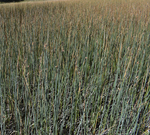
Cyperaceae: Schoenoplectus acutus
Files
Family Name
Cyperaceae
Common Name
Hardstem Bulrush, Hard-stemmed Club-bulrush
Native American Name
Lakota: pšá čhiŋčá
Description
Schoenoplectus acutus is a robust, rhizomatous evergreen perennial herbaceous graminoid that spreads aggressively through a dense network of thick, creeping rhizomes. The plant routinely achieves an height between 1.5 to 3.5 meters. Its erect, unbranched, dark green to gray-green culms (stems) are stout, round in cross-section, exceptionally firm, and filled with a spongy aerenchyma pith. The leaves are alternate, reduced and restricted near the base of the stem. Each culm usually has only 3 to 4 leaves, each with an elongated, open sheath with coarse fibers along the front and frequently red-tinged at the base, ending in a simple, V-shaped or flat leaf blade measuring 3 to 7 mm wide and up to a few centimeters long A tiny ligule is present where the blade meets the sheath. Flowering occurs from June to August, with a terminal, pseudo-lateral inflorescence that spans 5 to 15 cm long. It is composed of a rigid cluster of 3 to 40 ovoid spikelets borne on stiff, ascending branches, subtended by a solitary, erect, leaf-like bract that measures 2 to 10 cm long and acts as a visual continuation of the stem. The perianth is modified into 6 narrow, stable bristles that equal or slightly exceed the length of the fruit body, with retrograde barbs and a dull brown or straw color. The androecium consists of 3 stamens with distinct, linear, pale yellow to light brown anthers. The gynoecium features 1 pistil containing a superior ovary with a 2-fid (occasionally 3-fid) style and 2 plumose stigmas. The resulting fruit is a flattened or elliptic achene measuring 2.5 to 3.5 mm long (including a short apical beak), which transitions from a pale hue to a gray, dark brown, or blackish tone upon reaching full maturity from August through October. Hardstem bulrush is native to South Dakota and can be found distributed broadly across the state's wetland provinces, thriving within native marshlands, fens, mudflats, and the shallow margins of lakes and slow-moving river systems.
Horticulture Notes
Seed Collection: Harvest seed clusters using hand clippers from August through October once the spikelets turn dark brown. Store the harvested seed heads in breathable paper bags to dry completely, then separate the achenes from the hulls via mechanical thrashing or rubbing.
Seed Germination: Seeds exhibit deep dormancy. Seeds should be surface-sown or pressed shallowly (less than 1/4 inch deep) into wet media in the late fall.
Vegetative Propagation: Rhizome division during the spring or early autumn dormancy periods. Rhizome segments should be severed into sections containing at least one healthy bud and planted horizontally 5 to 10 cm deep into saturated substrates.
Soils: Fine to medium-textured soils, including mucks, heavy clays, and silts
Light: Full sun.
Water: Permanently continuous wet conditions. It is highly adapted to growing in saturated mud up to standing water depths of 3 to 5 feet, and it can tolerate seasonal water level fluctuations provided the root zone remains wet.
Additional Notes
Hardstem bulrush possesses tremendous ecological value as a primary stabilizer of shorelines and wetland banks, where its dense, interlocking rhizome mats efficiently trap sediments and suppress wave erosion. It offers critical nesting cover and sanctuary for an array of waterfowl, songbirds, and aquatic mammals, while its abundant seed heads serve as an essential high-energy food source for migrating ducks and geese. In horticultural applications, it is utilized in large-scale wetland restorations, retention ponds, and constructed wastewater treatment wetlands due to its highly efficient bioaccumulation capabilities and capacity to filter out aquatic pollutants. Historically, Indigenous communities have utilized the pliable, pithy stems of this species to weave heavy floor mats, lightweight duck decoys, insulation, baskets, and traditional watercraft.