

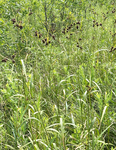
Cyperaceae: Scirpus atrovirens
Files
Family Name
Cyperaceae
Common Name
): Dark-green bulrush, Green bulrush, Black bulrush
Description
Scirpus atrovirens is a long-lived perennial, rush that anchors firmly into mud via a fibrous root system growing from short, stout, and tough underground rhizomes. The plant reaches a mature height of 1 to 1.5 meters, developing erect, unbranched, rigidly three-sided culms that are smooth and filled with pith. The leaves are arranged alternately along the lower half of the culms. They are simple, linear, flat, dark green, measuring up to 30 to 45 cm in length and 1 to 2 cm in width, with parallel venation and prominent cross-partitions on both surfaces. The leaf sheath is light green, closed, glabrous, and strongly septate; the collar is narrow and distinct; the ligule is a short, membrane-like, low-rim border. Flowering occurs from June to August. The inflorescence is a terminal, highly branched compound umbel measuring 5 to 15 cm across, consisting of several unequal rays bearing dense, crowded, spherical clusters of 10 to 30 sessile, ovoid spikelets that measure 3 to 8 mm long. The individual florets within the spikelets have a perianth that is modified into 5 or 6 straight, pale, persistent bristles that are downwardly barbed and roughly equal to or slightly longer than the fruit length. Each floret is subtended by an oval-elliptic, pointed, dark greenish brown to blackish scale measuring 1.2 to 2.1 mm in length. There are 3 stamens with pale yellow or whitish anthers that are less than 1 mm long. The gynoecium features a single, superior pistil with a weakly 3-sided ovary, a slender style, and 3 distinct, feathery stigmas. The fruit is a small, pale brown to creamy-white achene measuring 0.8 to 1.3 mm long and 0.4 to 0.6 mm wide, plumply 3-sided, and elliptic to urn-shaped. It reaches full maturity between July and September. Dark-green bulrush is native to South Dakota and can be found scattered in a few counties in marshes, wet meadows, roadside ditches, pond margins, and sloughs.
Horticulture Notes
Seed collection: Cut mature, dark brown to blackish spikelet heads from late summer through early autumn (August to September), spreading the heads out to dry before shaking out the tiny achenes.
Seed germination: Seeds are tiny and require light to sprout; they must be surface-sown without soil coverage and undergo a minimum of 60 to 90 days of wet-cold stratification. Fall sowing is advised.
Vegetative propagation: In early spring divide established root clumps into individual rhizome sections containing 2–3 active culms.
Soils: Nutrient-rich loams, mucky peats, heavy clays, and fine sands.
Light: Full sun to partial shade.
Water: Consistent moisture to saturated soils; tolerant of permanent shallow standing water.
Additional Notes
Dark-green bulrush is a vital native sedge utilized extensively in habitat stabilization, bioremediation, and rain gardens. The extensive root mats formed by its rhizomes provide exceptional stabilization along shorelines and wetland banks, acting as a natural wind and wave buffer that prevents severe erosion. Ecologically, the abundant, microscopic achenes serve as a high-value food source for numerous species of puddle ducks, rails, and songbirds, while the dense, rigid foliage offers excellent nesting cover and predator protection for amphibians, muskrats, and aquatic insects. Humans historically utilized the tough, fibrous culms and leaves for weaving mats, coarse baskets, and structural thatch.