

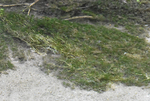
Ranunculaceae: Ranunculus longirostris
Files
Family Name
Ranunculaceae
Common Name
Longbeak buttercup, Long-beaked white water buttercup
Description
Ranunculus longirostris is a perennial, submerged aquatic herb that features a fibrous, adventitious root system capable of anchoring or rooting at the lower stem nodes. The creeping or floating branched stems reach lengths up 90 cm long. Leaves exhibit an alternate insertion pattern, are strictly compound (finely dissected into numerous rigid, thread-like or filiform segments), possess a bright green color, and span roughly 1 to 2.5 cm long and wide. Both upper and lower surface features are structurally identical given their completely submerged nature, though the segmented surfaces can appear lightly tufted or glaucous under close inspection. Petioles are present but typically very short, measuring only 0.4 to 0.6 cm long, and are noticeably dilated at the base into broad stipules that are 1/2 to 3/4 fused to the petiole with acute, free tips. Flowering occurs during the spring and summer months (May through September), with perfect, radially symmetric flowers produced solitary from terminal or axillary pedicels that rise slightly above the water surface. Each flower possesses 5 free, spreading, early deciduous sepals that are lanceolate to elliptic, light green to yellow-green, and measure roughly 2 to 4 mm long and 1 to 2 mm wide. The 5 free petals are obovate to oblanceolate, white with distinct yellow claws or bases featuring a minute basal nectar pit and span 4 to 7 mm long. Surrounding the center are several (usually 8 to 25) yellowish stamens with variable filament lengths and lateral anthers. The compound gynoecium consists of a globose head containing 8 to 25 separate pistils; each pistil features a superior, ovary topped by a short, persistent, straight, thread-like style and a capitate stigma. The resulting fruit is an aggregate head of small achenes reaching maturity between July and October. Individual achenes are transversely wrinkled, lenticular or flattened, dark brown to blackish at full maturity, and roughly 1.5 mm long with a long, characteristic beak. Longbeak buttercup is native to South Dakota, where it can be found throughout the state, including within the Prairie Pothole Region, inhabiting permanent freshwater wetlands, ponds, lakes, ditches, and slow-moving streams.
Horticulture Notes
Seed Collection: Collect the globoid fruit aggregates from July to October when the achenes turn from green to a hard, dark brown color. Because the achenes only float for a few days before sinking to the bottom mud, collection must be timed precisely or captured using fine aquatic nets.
Seed Germination: Seeds exhibit unpredictable germination. For best results, sow seeds immediately after collecting into the surface of an aquatic soil.
Vegetative Propagation: Cut healthy stem segments containing at least two distinct nodes and anchor them directly into moist aquatic substrate or mud; they will quickly produce adventitious roots from the nodes.
Soils: Rich, fine-textured aquatic mud, silty mucks, or specialized clay-based wetland soils.
Light: Full sun to partial shade.
Water: Requires continuous saturation or permanent standing water, thriving in depths up to 3 feet, and can tolerate both stagnant pond water and slow-moving river currents.
Additional Notes
Longbeak buttercup serves as an important ecological component of northern plains wetlands by providing excellent underwater foraging structure and protective cover for small fish, amphibians, and aquatic macroinvertebrates. The seeds and finely divided foliage are regularly consumed by migrating waterfowl, while the emergent blossoms offer accessible nectar to early-season pollinators. Due to its high tolerance for calcium carbonate and wet soil, it has great horticultural potential for stabilization and naturalization projects along the shallow edges of native retention ponds or water gardens.