

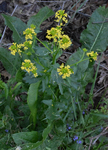
Brassicaceae: Barbarea vulgaris
Files
Family Name
Brassicaceae
Common Name
Yellow rocket, Wintercress
Description
Barbarea vulgaris is an introduced, herbaceous biennial or short-lived perennial that grows from a stout, deep taproot system. In its mature flowering phase, the plant reaches a height of 30 to 90 cm. Its stems are erect, stout, prominently ribbed or angled, glabrous (smooth), light green to reddish-purple, and highly branched toward the upper apex. Leaf insertion is alternate. Basal leaves form a dense wintergreen rosette 7.5 to 15 cm long and 2.5 cm wide, shiny dark green color, with a deeply pinnatifid or lyrate division featuring 1 to 4 pairs of small, oblong lateral lobes, and a significantly larger, rounded or heart-shaped terminal lobe. Basal leaves feature a distinct petiole up to several cm long. The cauline leaves become progressively reduced upward, transitioning from short-petioled to entirely sessile, with their bases developing prominent clasping auricles that wrap tightly around the stem. Both the upper and lower leaf surfaces are completely smooth, hairless, and possess a distinctively waxy sheen. Flowering occurs in the spring and early summer, typically stretching from April through July. The inflorescence forms a terminal, highly concentrated raceme that elongates as fruit development progresses. Each individual flower contains 4 free sepals measuring 2 to 3 mm long and 0.5 to 1 mm wide, shaped oblong to narrowly lanceolate, and displaying a yellowish-green color with smooth, non-fused margins. The corolla consists of 4 free petals arranged in a characteristic cross-like pattern, measuring 4 to 8 mm long, with bright yellow, spatula-shaped blades that spread widely outward. Positioned within the petals are 6 tetradynamous stamens (four long inner stamens and two short outer stamens) measuring roughly 3 to 4 mm long with yellow, prominent anthers. The flower features a single pistil with a superior, narrow ovary, a persistent style measuring 1 to 3 mm, and a singular, capitate stigma. The fruit is an elongated, linear silique (capsule) measuring 10 to 45 mm long and roughly 1 mm wide, turning from a waxy green to a dry, tan-brown hue upon maturity. The siliques open by two valves from the base upward to shed light-brown, tiny, bitter-tasting seeds, reaching full maturity between July and September. Yellow rocket is not native to South Dakota; it is an introduced weed indigenous to Eurasia and North Africa. In South Dakota, it is naturalized across much of the state, concentrated in eastern and western disturbed zones—where it thrives in disturbed habitats such as agricultural crop fields, pastures, roadsides, ditches, and damp waste areas.
Additional Notes
Yellow rocket offers low specialized horticultural value due to its highly invasive and aggressive self-seeding tendencies in managed landscapes. Ecologically, however, it serves as an excellent, vital source of early-season pollen and nectar for native bees, syrphid flies, and emerging butterflies when few other wildflowers are blooming in the spring. For humans, the young, tender wounds ores harvested in late winter or early spring can be eaten raw in salads or boiled as a potherb similar to spinach, offering a sharp, peppery, cress-like flavor rich in vitamin C. Historically, the leaves were crushed and used topically in poultices to treat chronic wounds, or steeped into a medicinal tea that acted as a diuretic and appetite stimulant.