

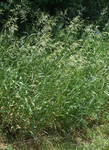
Poaceae: Bromus inermis
Files
Family Name
Poaceae
Common Name
Smooth Brome
Description
Bromus inermis is a long-lived perennial, herbaceous cool-season grass equipped with an aggressive, deeply penetrating fibrous root system coupled with an extensive network of tough, creeping underground rhizomes that form a dense sod. The plant typically reaches a mature height of 60 to 120 cm. Its erect, unbranched, and robust stems (culms) are smooth and completely glabrous, though the nodes may occasionally feature fine, sparse hairs. Leaf insertion is alternate along the culm, bearing simple, flat, linear, and deep green to grayish-green leaf blades that measure 15 to 40 cm in length and 5 to 15 mm in width. The leaf surfaces are primarily smooth and glabrous on both upper and lower faces, though they uniquely exhibit a conspicuous, tactile, "M" or "W"-shaped crinkle or crimp situated near the middle of the blade. Structurally, the leaf sheaths are continuous and closed (fused) for most of their length—a defining characteristic of the genus—and are hairless or nearly so. The collar is a distinct, pale band, while the ligule is a short, truncate, membranous ring measuring 0.5 to 3 mm long with an entire to slightly lacerate margin. Flowering occurs from June through July, giving rise to an open, terminal panicle inflorescence that measures 10 to 20 cm in length. The panicle branches are initially erect and spreading but typically droop or nod slightly to one side at maturity. Each branch holds multi-flowered, elongated, cylindrical spikelets that span 20 to 40 mm long. Two unequal, unawned glumes occur at the base of each spikelet. The lower glume is single-nerved, 4 to 6 mm long, while the upper glume is three-nerved, 6 to 10 mm long; both are lanceolate, free, glabrous, and green with purplish or translucent margins. The lemma is oblong-lanceolate, 9 to 12 mm long, purplish-brown to green, unnotched or slightly notched at the apex, and notably lacks an awn (or bears a minute vestigial awn under 1 mm long). Inside each floret, the androecium contains 3 stamens with prominent, pale yellow to reddish purple anthers measuring 3.5 to 6 mm in length. The gynoecium consists of a single pistil with a superior, 1-celled ovary bearing 2 distinct, feather-like styles and stigmas projecting laterally during anthesis. The fruit is a specialized caryopsis (grain) that is flat, linear-oblong, dark brown to purplish-black, measures 6 to 8 mm long, and tightly adheres to the palea. The grains ripen to full maturity between July and August. Smooth brome is not native to South Dakota; it is an introduced species native to Europe and temperate Asia. Since its introduction, it has spread aggressively throughout the entire state of South Dakota. It is primarily found invading disturbed areas, degraded prairies, old pastures, roadside ditches, and fields where it readily outcompetes native vegetation.
Additional Notes
Smooth Brome holds significant agricultural value as a highly nutritious, palatable forage grass used extensively across North America for livestock grazing and high-yield hay production. Its rapid growth and aggressive rhizomatous nature make it an exceptional tool for heavy engineering, slope stabilization, and initial erosion control along roadside embankments. However, its ecological value in wild settings is profoundly negative. Because it spreads so vigorously via underground runners, it acts as a highly invasive weed that quickly degrades native tallgrass and mixed-grass prairies by forming dense, single-species monocultures. These monocultures severely reduce native plant biodiversity, simplify insect communities, and alter the structural quality of nesting habitats for prairie wildlife.