

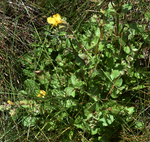
Scrophulariaceae: Mimulus guttatus
Files
Family Name
Scrophulariaceae (Phrymaceae)
Common Name
Seep monkeyflower, common yellow monkeyflower
Description
Mimulus guttatus is an annual or perennial herbaceous forb supported by a fibrous root system that frequently develops creeping stolons or rhizomes. The plant typically reaches a height of 38 up to 76 cm, featuring erect or trailing, hollow, square stems that are glabrous to minutely pubescent. Leaf insertion is opposite along the stem. The leaves are simple, green, ovate-elliptic to suborbicular, measuring 4 to 125 mm long and 1 to 2 times longer than wide. The leaf surfaces are generally glabrous, with margins that range from crenate to coarsely dentate or irregularly small-lobed at the base. Lower leaves feature distinct petioles up to 95 mm long, whereas upper leaves lack petioles and clasp the stem. Flowering occurs from April to September in terminal racemes consisting of 1 to 28 bilaterally symmetrical flowers. The fruiting calyx is an inflated, compressed, campanulate structure measuring 11 to 20 mm long, featuring 5 fused, unequal, green sepals. The corolla is composed of 5 fused, vibrant yellow petals that form a two-lipped funnelform tube 12 to 20 mm long, characterized by a bearded throat adorned with prominent red spots. Inside the corolla are 4 didynamous, glabrous, cream-colored stamens that are included within the tube. The single pistil features a minutely hairy style and a two-lobed stigma that closes upon contact. The fruit is a dry, oval capsule 7 to 12 mm long that matures from mid-summer through autumn, splitting open to release hundreds of microscopic seeds. The seep monkeyflower is native to South Dakota, where it can be found primarily in the western part of the state (Black Hills), thriving in wet meadows, seeps, springs, and stream banks.
Synonym: Erythranthe guttata
Horticulture Notes
Seed Collection: Collect the dry, papery capsules in late summer or autumn as they begin to split open. Carefully shake the capsules over a paper bag to catch the brown, dust-like seeds.
Seed Germination: Surface-sow seeds because they require light to germinate. Sow in fall, stratification improves germination for outdoor spring sowings.
Vegetative Propagation: Propagate easily by dividing dormant rootstocks in fall or early spring.
Soils: Prefers rich, fertile, loamy, or heavy clay soils with a high organic matter content. Tolerates a wide soil pH range from mildly acidic to alkaline.
Light: Best in full sun to partial shade. Protect from intense, hot afternoon sun in dry climates by planting in semi-shaded spots.
Water: Requires constantly moist, saturated, or wet conditions. Possesses zero drought tolerance.
Additional Notes
Seep monkeyflower is highly valued in horticulture for its exceptionally bright, cheerful blooms that perform beautifully in consistently wet garden niches, rain gardens, and pond margins. Ecologically, its nectar-rich flowers serve as a vital food resource for hummingbirds, bees, and butterflies, and it acts as an important host plant for the larvae of the common checkerspot and buckeye butterflies. Humans also utilize the plant; its leaves can be harvested from the wild to be eaten raw or cooked as a slightly bitter salad green or lettuce substitute.