

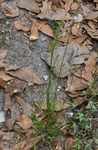
Nuttallanthus canadensis
Files
Family Name
Scrophulariaceae (Plantaginaceae)
Common Name
Blue toadflax, Canada toadflax
Description
Linaria canadensis is a winter annual or biennial, upright, non-woody, herbaceous plant that develops from a shallow, fibrous taproot system. The plant reaches a mature height of 25 to 80 cm. It generates both prostrate, non-flowering basal rosette stems and one to several slender, erect, simple or minimally branched flowering stems that are green to reddish-green, glabrous, and smooth. Leaf insertion varies across the plant, with leaves arranged oppositely or in whorls along the prostrate basal shoots, while shifting to an alternate arrangement on the upright flowering stems. The simple leaves are bright green, linear to oblong-linear, 10 to 35 mm long, and 1 to 3 mm wide with smooth, slightly thickened margins. Both upper and lower leaf surfaces are completely glabrous, and the leaves are sessile. Flowering occurs from mid-spring to mid-summer (typically March to July). The inflorescence is a slender, terminal raceme that spans 5 to 20 cm long. The calyx consists of 5 green, free to minimally fused sepals that are lanceolate to oblong-linear, acute at the apex, glandular-pubescent, and measure roughly 2 to 3 mm long and 1 mm wide. The corolla features 5 fused petals forming a strongly bilateral, two-lipped structure that is pale blue to lavender purple (rarely white) with a distinct white palate on the lower lip. The upper lip is erect and 2-lobed (5 to 6 mm long), while the lower lip is prominent and 3-lobed (about 8 mm long) with a slender, backward-pointing nectar spur measuring 2 to 6 mm long at the base. Contained within the petal tube are 4 didynamous, hairless stamens that are short, white, and capped with small yellow anthers. There is 1 superior, 2-loculed pistil with a short, single style and a small, faintly 2-lobed stigma. The fruit is a smooth, subglobose, two-valved capsule measuring about 3 mm long and 3 mm wide. It matures from green to dark brown between April and September, splitting open at the apex to release hundreds of microscopic, smooth, flattened seeds. Blue toadflax is native to South Dakota, where it is found sparsely across southern and western counties (such as Jackson County) in highly disturbed, dry, open sandy fields, blowouts, and prairie hillsides.
Synonym: Linaria canadensis
Horticulture Notes
Seed Collection: Collect stalks in mid-to-late summer (July–September) as they turn brown. Keep stalks upright to prevent the dust-like, microscopic seeds from spilling out of the open capsule cups.
Seed Germination: Direct-sow seeds on bare soil during autumn or late winter. The seeds require 30 to 60 days of cold, moist stratification to break dormancy naturally.
Vegetative Propagation: Vegetative propagation is generally unsuccessful. It is best to let the colony self-seed naturally.
Soils: Well-drained, nutrient-poor sandy, rocky, or gravelly soils. Avoid heavy organic loams or clay.
Light: Full sun.
Water: Low water requirements. It tolerates severe drought once established but benefits from natural moisture during its early spring vegetative growth phase.
Additional Notes
Blue toadflax serves as a highly resilient pioneer species in native wildflower gardens, particularly valued for its ability to stabilize fragile, erodible sandy soils where little else can compete. Ecologically, its early-spring nectar supports native bees, and the foliage acts as an essential host plant for the caterpillars of the Common Buckeye butterfly (Junonia coenia).