

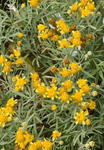
Asteraceae: Picradeniopsis oppositifolia
Files
Family Name
Asteraceae
Common Name
Oppositeleaf bahia, plains bahia
Description
Picradeniopsis oppositifolia is a perennial, herbaceous subshrub that spreads via a well-developed network of creeping underground rhizomes. The plant has a tufted growth habit and stands approximately 5 to 25 cm tall. Its erect to ascending stems branch aggressively from the base and are covered in fine, appressed gray-green hairs. The leaves feature opposite insertion, are gray-green, simple but deeply palmately or trifoliately divided into 3 to 5 linear, fleshy lobes. They measure 1 to 5 cm long and up to 3 cm wide, with both upper and lower surfaces displaying dense, fine pubescence. They are sessile or sit on short petioles up to 5 mm long. Flowering occurs from June through September. The inflorescence consists of terminal, single daisy-like heads measuring 10 to 15 mm in diameter with a bell-shaped involucre 5 to 7 mm tall composed of 2 rows of overlapping, green, oblong bracts. The florets have a pappus consisting of 6 to 8 small, transparent, blunt scales that sit at the crown of the ovary. The flower heads hold 3 to 5 yellow ray flowers that are 2 to 5 mm long, surrounding a central disc of numerous yellow, perfect tube florets. Each floret contains 5 stamens fused by their dark anthers into a cylinder around the style, and a single pistil with a deeply bifid style and distinct, recurved stigmatic branches. The fruit is an elongated, 4-angled, obovoid cypsela (achene) that turns dark brown or black at maturity, typically ripening from late August through October. The oppositeleaf bahia is native to South Dakota, where it is rare and primarily restricted to the western and southwestern regions of the state (such as the Black Hills and Badlands); it thrives in dry meadows, open sandy or gravelly soils, badland clay breaks, and along rocky terraced edges.
Horticulture Notes
Seed Collection: Harvest fruit from September to October when the flower heads turn completely dry and dark brown.
Seed Germination: Germination benefits from mechanical scarification with fine sandpaper, followed by a 24-hour water soak and 30 to 60 days of cold, moist stratification.
Vegetative Propagation: Readily propagated in early spring by digging up and separating clonal rhizome divisions.
Soils: Well-drained, lean, sandy, clay, or gravelly soils; highly tolerant of alkaline and nutrient-poor substrates.
Light: Full, direct sunlight.
Water: Low water requirements once established; highly drought-tolerant but intolerant of waterlogged soils or standing water.
Additional Notes
The oppositeleaf bahia offers specialized horticultural value as an exceptional, tough groundcover for xeric landscaping, rock gardens, and erosion control on poor soils. Ecologically, its late-season yellow flowers serve as a vital nectar and pollen resource for native bees, butterflies, and beneficial insects in arid prairie habitats. It is also remarkably deer-resistant and drought-tolerant due to its extensive underground system.