

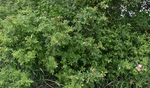
Rosaceae: Rosa blanda
Files
Family Name
Rosaceae
Common Name
Smooth rose, meadow rose, smooth wild rose
Description
Rosa blanda is a perennial, deciduous woody shrub featuring a fibrous root system anchored by a woody taproot and long, spreading underground rhizomes that actively facilitate colony formation. It reaches a mature plant height of 0.7 to 1.8 m. The stem configuration forms a dense, mounded habit of erect, arching branches that are uniquely smooth and largely thornless, though a sparse concentration of fine, bristly prickles frequently populates the dark reddish-brown to purple bases of older stalks. Leaf insertion is alternate along the stems. The leaves are odd-pinnately compound, measuring 6 to 13 centimeters long, and typically comprise 5 to 7 (rarely 9) leaflets. Each leaflet is dull green to dark green on the upper surface and a paler, dull green on the lower surface; they are oval, elliptic, or obovate in shape, measuring 2.5 to 5 cm long and 1.3 to 2.5 cm wide with coarsely serrated margins and blunt or rounded apices. A distinct petiole is present, measuring 1.5 to 3 cm long. Conspicuous, wide, leaf-like stipules are present, which are fused to the base of the petiole and measure 1.5 to 2.5 cm in length with smooth or finely gland-toothed margins. Flowering occurs primarily from June to August. The inflorescence occurs either as solitary blossoms or in small, few-flowered terminal clusters (corymbs) measuring 5 to 8 cm across. The sepals consist of 5 lanceolate, entire segments that are free, measuring 1.5 to 2.5 cm long and 3 to 5 mm wide, green in color, and prominently persistent, remaining upright on the developing fruit long after blooming. The petals consist of 5 free, broad, obovate segments that are fragrant and pale pink to deep rose (occasionally white), measuring 2 to 4 cm long and wide. There are numerous (typically 50 to 100) stamens arranged around the center, measuring 4 to 6 mm long with fine yellow filaments and bright yellow anther heads. The pistils are numerous, clustered within a deeply concave receptacle (hypanthium), with short, distinct styles forming a dense, flattened head of stigmas at the mouth of the flask-like structure. The fruit is a fleshy, berry-like, globose to pear-shaped hypanthium or "rose hip" measuring 8 to 12 mm in diameter; it changes from green to a glossy, bright red or orange-red color upon reaching maturity between late August and October, frequently persisting into the winter months. The smooth rose is native to South Dakota, appearing frequently across the eastern and northern regions of the state where it can be found in open prairies, dry or mesic woodland edges, thickets, fence rows, roadsides, and sandy lakeshores.
Horticulture Notes
Seed collection: Gather the bright red, fleshy hips by hand directly from the shrubs from September through November; extract the hard achenes mechanically by macerating the fruit in water, allowing the lightweight pulp to rise and separating the viable seeds via flotation.
Seed germination: Seeds possess a deep mechanical and chemical embryo dormancy requiring a cold-moist stratification process at 2°C to 4°C for 90 to 120 days prior to spring sowing, or immediate outdoor sowing in autumn to let natural winter cycles break the seed coat.
Vegetative propagation: Separate and transplant established root suckers or divide clonal root masses during early spring or late fall dormancy; alternatively, root 10- to 15-centimeter softwood cuttings with a heel in early summer, treating them with a mild rooting hormone under high humidity.
Soils: Sandy soils, rocky gravels, heavy loams, and lean clays; prefers well-drained, acidic to neutral pH levels but displays notable tolerance for nutrient-poor soils.
Light: Full sun for optimal flower presentation and dense canopy architecture. Tolerates partial shade conditions well.
Water: Low to medium moisture once established; features outstanding drought resistance and adapts seamlessly to dry conditions.
Additional Notes
Smooth rose is highly valued in horticulture for its dense, mounded habit and near-thornless stems, making it an excellent choices for naturalizing large slopes, stabilizing soils, and integrating into low-maintenance wildlife gardens. Ecologically, the flowers serve as a vital pollen source for native bees, butterflies, and beetles, while the dense branch infrastructure offers superb nesting sites and protective cover for songbirds. The persistent, bright red rose hips provide an essential survival food during late fall and winter for game birds, small mammals, and deer. Beyond ecological systems, humans harvest the nutrient-dense hips, which are exceptionally rich in Vitamin C, to brew herbal teas, or cook down into syrups or jellies.