

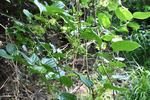
Smilacaceae: Smilax rotundifolia
Files
Family Name
Smilacaceae
Common Name
Common greenbrier, roundleaf greenbrier
Description
Smilax rotundifolia is a perennial, woody climbing vine that develops from a extensive, branching rhizomatous rootstock. The vine frequently achieves climbing heights of 3 to 12 m, supported by a fast-growing, highly branched, round to weakly 4-angled stem that is armed with stout, scattered, green prickles with distinct dark or blackish tips. Leaf insertion is alternate along the stem, and the leaves are simple, globally orbicular, ovate, or broadly heart shaped. The blades display a lustrous bright to medium-green color on both sides and are 5 to 13 cm long and 4 to 12 cm wide. Both the upper and lower leaf surfaces are glabrous and smooth, while petioles are present, measuring 0.5 to 1.5 cm long and notable for producing a pair of coiling, stipular tendrils near their base that aid in climbing. Flowering occurs from April through June, arranged in axillary, spherical umbel inflorescences on peduncles that measure up to 1.5 cm in length. Because this species is dioecious, individual plants bear either staminate (male) or pistillate (female) flowers. The perianth consists of 6 distinct tepals arranged in two whorls the 3 outer are 3 to 5 mm long, oblong, free, and yellowish green to bronze. The 3 inner are nearly identical in size, free, matching in color, and slightly narrower, with all tepals spreading outward or recurving at peak bloom. In staminate flowers, there are 6 free stamens that measure roughly 2 to 3 mm long, with white or pale yellow filaments and oblong, unilocular anthers. In pistillate flowers, a single superior pistil is present with a globose, 3-celled ovary, lacking a defined style but bearing 3 short, spreading, recurved stigmas. The fruit is a small, globose, fleshy berry measuring 5 to 8 mm in diameter, which transitions from green to a glaucous blue-black or solid black color as it reaches maturity between September and November and often persist on the vine through the winter. Common greenbrier is native to South Dakota, occurring primarily in the eastern half of the state within moist-to-dry bottomland forests, wooded ravines, riparian borders, and thickets.
Horticulture Notes
Seed collection: Harvest the fleshy, blue-black berries in late autumn or early winter when they are fully ripe. Extract the reddish seeds by soaking and mashing the pulp, then thoroughly washing away any remaining germination-inhibiting fruit residue.
Seed germination: Seeds exhibit double dormancy and require sequential periods of warm stratification followed by cold stratification to breach the seed coat. Light is often required for the final emergence. Sow seeds in the late fall, making surface-sowing on top of the substrate ideal. Germination will occur over the next 2 years.
Vegetative propagation: Plants can be propagated reliably by lifting and dividing pieces of the subterranean rhizomatous rootstock.
Soils: Adaptable to a broad spectrum of soil types, including poor sandy substrates, fertile loams, and heavy compacted clays.
Light: Best in partial to full shade under a woodland canopy, though it tolerates full sunlight if soil moisture remains consistent
Water: Prefers consistently moist, well-drained conditions but displays high tolerance for seasonal flooding, damp wetlands, and periodic periods of dry drought once its root system is established.
Additional Notes
Common greenbrier holds very low horticultural value because its aggressive, thorny growth quickly forms impassable, tangled thickets that are difficult to manage in managed landscapes. Ecologically, however, it provides immense value to forest ecosystems by offering crucial protective nesting cover and thermal shelter for small mammals and birds, while its persistent winter berries and woody twigs serve as a critical food source for ruffed grouse, songbirds, rabbits, and white-tailed deer.