

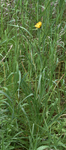
Asteraceae: Tragopogon pratensis
Files
Family Name
Asteraceae
Common Name
Meadow Salsify, Yellow Goat's Beard
Description
Tragopogon pratensis is a biennial or short-lived perennial, lactiferous herbaceous forb that develops a stout, fleshy, deep-penetrating taproot. Mature plants typically range from 30 to 100 cm in height, supported by erect, round, smooth, hollow stems that are simple or sparsely branched, glabrous, and notably unswollen or only weakly inflated beneath the flowering heads. Leaves are arranged alternately along the stem, featuring a simple, narrow, linear-lanceolate shape resembling grass blades. The leaves are bluish green to pale green, measuring 10 to 30 cm long and 0.5 to 2 cm wide, possessing completely glabrous and smooth upper and lower surfaces, distinct parallel venation, a keeled midrib, and a tapering apex that often curls downward. They lack a petiole, instead becoming sessile and strongly clasping the stem at the base. Flowering occurs from May through August, characterized by solitary, terminal flower head measuring 3 to 5 cm across, which typically open in early morning sunlight and close by midday. The inflorescence is subtended by a single series of 8 (rarely up to 13) equal, linear-lanceolate, green involucral bracts (phyllaries) that are roughly equal to or noticeably shorter than the golden-yellow florets. Each floret has a white to tawny pappus composed of numerous plumose bristles fused into a ring at the base. The petals are completely fused into perfect, fertile, golden-yellow ligulate (ray-like) corollas that are 5-toothed at the apex, with the outer florets measuring 15 to 25 mm long. Each floret features 5 stamens with dark brown to purplish filaments and anthers fused into a prominent cylindrical tube surrounding the style. A single inferior pistil is present per floret, terminating in a slender, yellow style and a deeply two-lobed, coiled, yellow stigma. The fruit is a dry, slender, single-seeded achene measuring 15 to 25 mm long, which is dull pale-brown, rough, longitudinally ribbed, and ends in a long, slender beak that carries the parachute-like plumose pappus. Fruits achieve maturity from June to September. Meadow salsify is not native to South Dakota; it is an introduced species native to Europe and western Asia that has fully naturalized throughout the state. It is commonly found across all regions of South Dakota in disturbed habitats, including roadside ditches, pastures, old fields, railway lines, and vacant urban ground. Although it is less common than T. dubius. It can be distinguished from T. dubius because its green floral bracts are equal to or shorter than the yellow petals rather than extending past them.
Additional Notes
Though considered a weed, meadow salsify offers valuable ecological support by providing nectar and pollen for generalist insect pollinators, including native bees, hoverflies, and butterflies during the peak of summer. The large, nutrient-rich seeds are sought after by small granivorous rodents and various songbird species. For humans, the thick, young taproots can be harvested in their first autumn, boiled, and consumed as a root vegetable with a flavor frequently compared to oysters or parsnips. Additionally, the young spring shoots and leaves can be eaten raw in fresh salads or cooked as a potherb