

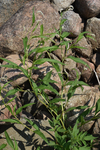
Polygonaceae: Polygonum lapathifolium
Files
Family Name
Polygonaceae
Common Name
Pale smartweed, curlytop knotweed, nodding smartweed
Native American Name
Lakota: áku šašála hú wíŋyela
Description
Persicaria lapathifolia is a terrestrial or semi-aquatic annual, herbaceous forb supported by a shallow, fibrous taproot system. Plants grow to a height of 30 to 180 cm, with erect, ascending, or sometimes decumbent, heavily branched stems that feature noticeably swollen nodes and are glabrous to sparsely pubescent, frequently exhibiting reddish-purple pigmentation. The leaves have an alternate insertion pattern along the stem and are simple, narrowly lanceolate, elliptic, or ovate-lanceolate, displaying a dull green to pale green color and often bearing a dark, crescent-shaped smudge or "chevron" near the center. Leaf blades measure 6 to 20 cm long and 1 to 5 cm wide, featuring rough, forward-pointing short hairs along the margins, glabrous to moderately appressed-pubescent upper surfaces, and lower surfaces often covered in tiny yellow glands or woolly white hairs. Short petioles ranging from 0.5 to 2.5 cm long are present, anchored at the base by a persistent tubular stipule called an ocrea that is scarious, brownish, 1 to 2 cm long, truncate, and notably devoid of prominent bristle-like fringes along its top margin. Flowering occurs from June through October, with the inflorescence structured as multiple dense, spike-like terminal and axillary racemes measuring 3 to 8 cm long that uniquely droop or arch downward under their own weight. The perianth consists of 4 or 5 fused, petal-like tepals measuring 2 to 3 mm long, ranging in color from greenish-white to pale pink, which are structurally distinguished by their strong, anchor-like veins that branch and curve backward at the tips. Tucked inside the tepals are usually 6 stamens (varying from 5 to 8) featuring tiny, white-to-pink anthers. The single pistil consists of a superior, compressed ovary and 2 (rarely 3) mostly separate, curved styles terminated by small, capitate stigmas. The fruit is a small, flattened, disc-shaped or lenticular achene measuring 2 to 3 mm long with concave faces, featuring a glossy, dark brown to black color, which reaches full maturity between August and October. Pale smartweed is native to South Dakota. It is widely distributed across almost every county in the state, thriving in wet, sun-exposed habitats including mudflats, riverbanks, lake margins, irrigation ditches, marshes, and disturbed agricultural fields.
Synonym: Persicaria lapathifolia
Horticulture Notes
Seed collection: Pick dark brown or black, matured seed spikes by hand from August through late October; spread collected spikes on shallow trays to dry, then rub through wire mesh screens to detach the smooth, flat achenes from the dried tepals.
Seed germination: Seeds possess an physiological dormancy that requires 60 to 90 days of cold, moist stratification. Fall planting is advised.
Vegetative propagation: Vegetative propagation is generally unsuccessful.
Soils: Moist to saturated, fine-textured soils, prefers fertile muds, coarse clay loams, and sandy alluvial sediments with a neutral to slightly acidic pH.
Light: Full sun to partial shade.
Water: Requires consistently wet, saturated, or flooded conditions to survive.
Additional Notes
Pale smartweed offers valuable ecological utility as its prolific, seed-heavy nodding spikes provide an exceptional food source for waterfowl, upland game birds, and small mammals, while its small blossoms attract diverse native bees, hoverflies, and predatory wasps. Due to its aggressive, weed-like annual growth habit in moist agricultural setups, it lacks ornamental horticultural value and is rarely cultivated intentionally. The fresh young leaves can be eaten raw or cooked in small quantities, and the high-amino-acid seeds can be processed into flour or meal, though the plant should be consumed in moderation due to high concentrations of oxalates.