

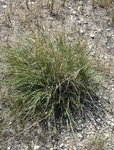
Poaceae: Sporobolus airoides
Files
Family Name
Poaceae
Common Name
Alkali sacaton, Alkali dropseed, Alkali sakaton
Description
Sporobolus airoides is a warm-season, long-lived perennial grass that forms densely tufted, robust bunchgrass structures or large tussocks supported by a deep, coarse, and glossy fibrous root system. The plant relies on basal tillering to form broad clumps that reach a total height of 35 to 120 cm (or up to 150 cm under optimal conditions). The flowering stems (culms) are erect to spreading or decumbent at the base, round, smooth, hollow, and notably stout and solid near the crown. Leaf insertion along the culm is alternate and two-ranked. The simple, unlobed leaves feature a distinct, shiny, and smooth sheath that is open along its margins and sparingly pilose with a tuft of long hairs (up to 6 mm) at the throat. The leaf collar is distinct, and the ligule is reduced to a minute line of short, stiff hairs measuring 0.1 to 0.3 mm long. Leaf blades are stiffly fibrous, flat to strongly involute (rolled inward towards the margins), tapering to a sharp, fine point; they are gray green to silvery-green, 5 to 35 cm long, and 1 to 5 mm wide, with smooth to slightly roughened upper and lower surfaces. Flowering occurs from early summer to autumn (June to October). The inflorescence is a massive, diffuse, and open pyramidal panicle measuring 10 to 45 cm long and 15 to 25 cm wide; its lower portion is initially enclosed in the uppermost leaf sheath before expanding fully into a cloudy haze of fine branches. Each floret contains a single-flowered spikelet. The outer bracts (the glumes) are unequal, 1-veined, acute, glabrous, and range in color from pale green to purple, with the lower glume measuring 1.5 to 1.8 mm long and the upper glume measuring 1.1 to 2.8 mm long. The lemma is membranous, veinless or 1-veined, acute, awnless, and 1.2 to 2.5 mm long, tightly matching the palea in texture and length. Inside these bracts sit 3 stamens with distinct, slender filaments bearing prominent, pale to reddish-purple anthers that are 1.1 to 1.8 mm long. The single compound pistil features a superior ovary with 2 distinct, highly plumose (feathery) styles and receptive stigmas. The fruit is a minute, reddish-brown, obovate to globose caryopsis-like achene (grain) measuring 1 to 1.4 mm long. It reaches maturity from late summer through fall (August to October), separating from the lemma and palea to drop freely or expand out of the drying seed husk. Alkali sacaton is native to South Dakota, occurring primarily in the western and central portions of the state within saline or alkaline flats, claypan prairies, seasonally wet meadows, and low-lying alluvial floodplains.
Horticulture Notes
Seed Collection: Harvest the open panicles in late summer or autumn (August to October) once the tiny, reddish-brown grains begin to separate from their hulls. Clip the entire seed, then dry thoroughly before running through a fine screen mesh to separate the dense seeds.
Seed Germination: Seeds exhibit high viability and germinate quickly within 5 to 10 days under warm, moist conditions.
Vegetative Propagation: Propagate easily by dividing the dense crown or root clumps in early spring just as new growth emerges.
Soils: Tolerant of a wide array of problematic substrates, including heavy clay, coarse gravel, sands, caliche, and highly saline or alkaline soils.
Light: Full sun.
Water: Requires dry to average moisture levels and displays legendary drought resistance once its deep roots are anchored. It also tolerates seasonal, brief periods of flooding.
Additional Notes
Alkali sacaton is highly valued as an adaptable and architectural ornamental grass that brings graceful movement, fine texture, and changing color palettes to the landscape. Its dense foliage mounds and tall, airy seed heads create a soft, cloudy haze that transitions from summer silvery-green to striking golden-orange in autumn and a light bronze hue in winter. Ecologically, this tough bunchgrass provides critical shelter and nesting materials for native birds and insects, while its abundant seed crop serves as an invaluable food source for small wildlife. Its deep, aggressive, and highly penetrating fibrous root system renders it a premier choice for stabilizing eroding shorelines, reclaiming disturbed clay soils, and managing dust on saline-alkaline flats. It offers fair-to-good seasonal forage for livestock during its period of active spring and summer growth.