

-
This site is dedicated to Mrs. Dorothy Gill, a Dakota Elder, a mentor and friend.

-
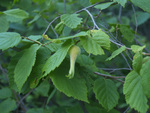
Betulaceae : Corylus cornuta
R. Neil Reese
Corylus cornuta is a perennial, monoecious shrub that grows, from rhizomes to a height of roughly 2.5- 5 m with a crown spread of 3- 4.5 m. Plants are usually multi-stemmed with long branches that produce a dense spreading shape and forming thickets by sending up suckers from the underground rhizomes. The young twigs are usually smooth, sometimes sparsely hairy, but lacking glands. The petiolate leaves are simple, alternate, the blades ovate, pointed at the tip and rounded or heart shaped at the base, 4-10 cm long, doubly toothed and hairy underneath. Male flowers present in the winter and bloom very early in the spring in long (4-8 cm) cylindrical, sessile, whitish catkins having numerous crowded flowers, each having a pair of bracts and 4 stamens. The female flowers emerge before the leaves in ovoid brownish catkins of few flowers, with the red styles becoming visible. The fruit are nuts that are solitary or clustered, each enveloped in bristly bracts, partially connate and forming a long beak. Beaked hazelnut grows in upland forests and thickets in western and northeastern South Dakota.
-
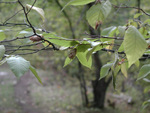
Betulaceae Ostrya virginiana
R Neil Reese
Ostrya virginiana is a small deciduous, monoecious, understory tree growing to 15 m in height. The older bark is brown to gray-brown, scaly, rough or shaggy. The younger twigs and branches are smoother and gray, with small lenticels. The leaves have a short hairy petiole, the blades are oblong to ovate with a sharp tip, 5–13 cm long and 4–6 cm wide, with a doubly toothed margin. The upper surface is mostly hairless, while the lower surface is sparsely to moderately hairy. The inflorescence consists of male and female catkins. The male catkins are pendulous, 2–5 cm long and the female catkins are 8–15 mm containing 10–30 flowers. The fruit are small nutlets 3–5 mm long and enclosed in a greenish, papery bracts 10–18 mm long and 8–10 mm wide, resembling hops, that turn brown at maturity. Hop-hornbeam blooms in April and May, with fruit maturing in early summer, growing in upland forests of the Black Hills, and southern and eastern South Dakota.
-
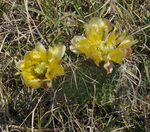
Cactaceae : Opuntia polyacantha
R. Neil Reese
Opuntia polyacantha is a prostrate, clump-forming perennial, evergreen shrub, rising only to the height of one stem segment (pad). Each stem segment is orbicular, flattened, bluish green to gray, growing to about 12 cm in diameter. The areoles are crowded, generally < 1 cm apart, with 1-10 spines, 2-5 cm long, and various numbers of glochids on each. The upper areoles have more spines than the lower. The flowers develop along the upper edge of the pads, each 4-7 cm wide with numerous tepals, 25–35 mm long, yellow, pink or red. The fruit is globose to ovoid, 2-4 cm long, dry and spiny. The seeds are tan to white and discoid. Prairie pricklypear blooms in May and June (rarely again in September) on dry plains and pastures, especially in sandy soils, in western South Dakota.
-
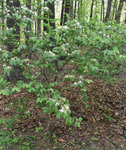
Caprifoliaceae: Lonicera maackii
R. Neil Reese
Lonicera maackii is a long-lived, multi-stemmed, deciduous, upright, woody shrub that develops from a shallow, wide-spreading, fibrous root system. The plant reaches a mature height of 2 to 6 meters. It possesses robust, arching, grayish-brown twigs and stems with a hollow, dark brown pith. When new branches and twigs first emerge, they are moderately to densely covered in short, fine, and sometimes tangled hairs. The older bark characteristically splits into long, thin, shaggy vertical strips. Leaf insertion along the twigs is opposite. The simple leaves are dark green, ovate to broadly elliptic with a distinct, sharply tapered acuminate tip, measuring 40 to 90 mm long and 20 to 45 mm wide with entire, smooth margins. The upper leaf surface is dull green and mostly glabrous, while the lower leaf surface features fine, soft hairs distributed primarily along the main veins. The leaf possesses a short, pubescent petiole measuring 2 to 8 mm long. Flowering occurs from mid-spring to early summer (typically May to June). The inflorescence consists of paired, axillary flowers borne along the upper twigs on short peduncles measuring 1 to 3 mm long. The calyx contains 5 small, green, fused sepals forming a short, cup-like rim that is roughly 1 to 2 mm long with triangular teeth. The corolla features 5 fused petals forming a strongly bilateral, two-lipped tube that opens pristine white and ages to a deep creamy yellow, measuring 15 to 25 mm long. The upper lip is broad and 4-lobed, while the lower lip consists of a single, narrow, downward-curving lobe, all releasing a powerful, sweet fragrance. Contained within the petal tube are 5 free stamens with slender, pale green filaments and yellow anthers that exert well past the corolla rim. There is 1 inferior, 3-loculed pistil topped with a single, elongated style and a capitate, green stigma. The fruit is a smooth, glossy, globose berry measuring 6 to 8 mm in diameter. It matures to a brilliant, translucent red color between September and November, remaining tightly clustered along the branches through winter and housing several small, dark brown seeds. Amur honeysuckle is introduced to South Dakota; it is native to temperate regions of China, Japan, Korea, and southeastern Russia. In South Dakota, it escapes cultivation primarily in southeastern and southern counties, aggressively invading disturbed woodlands, urban forest edges, floodplains, and riparian corridors.
-
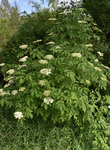
Caprifoliaceae: Sambucus nigra ssp. canadensis
R. Neil Reese
Sambucus nigra ssp. canadensis is a deciduous shrub or small tree growing 2 to 6 meters tall from a stout root system with furrowed grayish bark on older stems. The plant flowers from May through July. Leaves are opposite and pinnately compound with 5 to 9 ovate to lanceolate leaflets, 7 to 15 cm long and 3 to 6 cm wide, serrated margins, dark green and glabrous above, paler and slightly hairy beneath. The inflorescence is a large, aromatic, flat-topped to slightly rounded cyme or panicle 10 to 20 cm wide, with many small creamy-white flowers approximately 5 to 7 mm in diameter. Each flower has five small, greenish, free sepals that are ovate and about 1 to 2 mm long, and five white, rounded, free petals measuring about 4 to 6 mm long. There are typically 20 to 30 stamens per flower with filaments 3 to 4 mm long inserted around the floral receptacle and yellow anthers 1 to 2 mm long. The pistil is forming a compound ovary with 2 to 3 locules, about 2 to 3 mm long, a slender style approximately 1.5 to 2 mm long, and a small, capitate stigma. The fruit is a round, dark purple to black berry about 5 to 8 mm in diameter that ripens from August to September. American elderberry is native to South Dakota, where it occurs primarily in moist woods, thickets, and along stream banks, scattered throughout the eastern and central parts of the state.
Synonym: Sambucus canadensis
-
Caprifoliaceae : Sambucus racemosa
R. Neil Reese
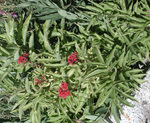
Sambucus racemosa is a deciduous, perennial shrub with a fibrous root system and occasionally spreading rhizomes, forming dense thickets. Mature plants typically reach 1–4 meters in height. Stems are erect, stout, and gray brown with smooth bark on young shoots that becomes ridged or furrowed with age. Leaves are opposite, pinnately compound, 15–30 cm long, with 5–9 ovate to lanceolate leaflets, each 5–12 cm long and 2–6 cm wide, serrated margins, and pointed tips. Upper leaf surfaces are medium to dark green and glabrous or sparsely hairy, while lower surfaces are paler with fine hairs along the veins. Petioles are 5–10 cm long. Flowering occurs from May to July, with inflorescences forming dense, erect to spreading panicles 10–20 cm long, bearing numerous small, creamy-white, five-petaled flowers. The calyx has five small, green, ovate sepals, about 1–2 mm long, free and persistent. Petals are five, white, obovate to round, 3–5 mm long, free and spreading. Each flower has five stamens with yellow anthers about 1 mm long. The pistil consists of a single ovary with a slender style and capitate stigma. The fruit is a bright red, spherical drupe, 5–8 mm in diameter, maturing from August to September and persisting into winter. Red elderberry is native to South Dakota and is found the Black Hills in moist woodlands, forest edges, stream banks, and thickets, favoring rich, moist, well-drained soils under partial shade.
-
Caprifoliaceae : Viburnum lentago
R. Neil Reese
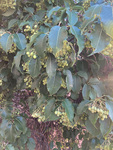
Viburnum lentago is a perennial, multi-stemmed tall shrub or small tree, 2-5 m tall and forming colonies from root suckers. Young stems usually have smooth, gray to reddish brown bark, and on older stems the bark becomes dark gray with deeply checkered furrows. The simple, opposite leaves have long winged petioles (10-30 mm) with stellate reddish-brown hairs at the base. The blades are ovate to broadly elliptic, 5-9 cm long and 3-6 cm wide, the tips pointed, the margins finely toothed, the upper surface dark green and shiny and the lower surface paler. The umbel-like inflorescences are 5-12 cm across sessile at the ends of 1-year old branches. Each flower has a tubular calyx with 5 short lobes and a white, bell to saucer shaped, 5-lobed corolla that is 2.5-3.5 mm long. The 5 stamens are exserted from the corolla. The fruit are dark blue-black, flattened, globose drupes, 10-14 mm long, pulpy with a whitish, waxy coating, each containing a large, flat, yellowish seed. Nannyberry blooms in May and June in open woods, along streambanks and occasionally in ditches in the eastern and western counties of South Dakota.
-
Caprifoliaceae: Viburnum opulus var. americanum
R. Neil Reese
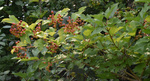
Viburnum opulus var. americanum is a deciduous, perennial shrub with a fibrous root system. Mature plants typically reach 2–4 meters in height. Stems are erect, woody, and gray brown with smooth bark on young shoots that becomes ridged with age. Leaves are opposite, simple, and broadly ovate to round, 5–15 cm long and wide, with three to five lobes and sharply serrated margins. The upper leaf surface is dark green and glabrous, while the lower surface is lighter green and finely hairy along the veins. Petioles are present, 2–6 cm long. Flowering occurs from May to June, with inflorescences forming large, flat-topped cymes 5–15 cm across, composed of both showy sterile flowers around the edge and numerous small, fertile flowers in the center. Sterile flowers have five white petals, 10–15 mm long and wide; fertile flowers have smaller, 4–6 mm long petals. Stamens number five per fertile flower, with yellow anthers approximately 1 mm long. The pistil consists of a single ovary with a slender style and capitate stigma. The fruit is a bright red, globose drupe, 8–12 mm in diameter, maturing from September to October. American cranberrybush is native to South Dakota and Viburnum opulus var. opulus, the European cranberrybush, that is native to Europe and parts of Asia, is also naturalized in the state. Both occur in moist woods, thickets, wetlands, and along streams, preferring rich, moist, well-drained soils with partial shade. The two varieties are very similar; they can be distinguished by the glands at the tip of the leaf stalk near the blade. Those of the European variety are typically shorter than wide, oval-elliptic, and bowl or cup shaped with a distinct rim. The native variety has glands that are taller than wide, round to oval, flat or rounded at the tip, and lack a distinct rim.
-
Celastraceae : Celastrus scandens
R. Neil Reese
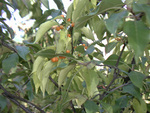
Celastrus scandens is a perennial climbing woody vine with twisting stems that reach up to 18 m long. The plants are dioecious, being either male or female, and spread vegetatively by root suckers. The simple, alternate leaves have petioles 1-3 cm long with short stipules (~1 mm). The blades are elliptic to ovate-oblong 3-10 cm long with a pointed tip and the margins are finely toothed. The greenish, unisexual flowers are borne in narrow racemes or panicles which are 3-8 cm long. The flowers are 5-merous with a cup-shaped calyx, 2-3 mm long, united at the base and spreading petals that are 3-6 mm long. Male flowers have 5 stamens, while female flowers have a single 3-parted ovary. Fruit is an orange or yellowish 3-valved capsule, 8-12 mm in diameter, that splits to expose the fleshy bright orange to red aril-covered seeds. There are 1-2 reddish brown seeds in each locule, elliptical in shape and 5-6 mm long. Bittersweet blooms from May to July in woodlands, thickets and along fence rows in much of South Dakota.
-
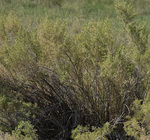
Chenopodiaceae: Sarcobatus vermiculatus
R. Neil Reese
Sarcobatus vermiculatus is a deciduous shrub with spiny branches, growing 1 to 3 meters tall, from an extensive, fibrous root system, adapted to saline and alkaline soils, producing root sprouts and rhizomes, allowing it to form dense clonal thickets. The plant blooms from May through July. Leaves are alternate, simple, fleshy, and scale-like, 1 to 3 cm long, narrowly ovate to linear, green to gray green in color. The inflorescence consists of dense, spike-like clusters of small, inconspicuous flowers 3 to 5 mm long. Each flower has no true petals or sepals; instead, it is subtended by small, free bracts. Male and female flowers are borne on separate plants (dioecious). Male flowers contain several stamens—typically 5 to 8—with filaments inserted opposite the bracts; anthers are small, about 1 mm long. Female flowers have a single pistil with one carpel, a sessile ovary approximately 1 to 2 mm long, a short style, and a small stigma. The fruit is a small, hard, winged achene about 3 to 4 mm in diameter that matures from August to September. This plant is native to South Dakota, occurring primarily in saline and alkaline flats, playas, and desert shrublands, mostly in the western parts of the state.
-
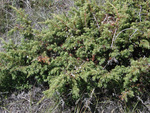
Cupressaceae: Juniperus communis
R Neil Reese
Juniperus communis is a low, spreading evergreen shrub, growing to 1.5 m high, often forming clumps. The young twigs are yellowish and 3-angled and older stems becoming grayish and finally reddish brown with shredding papery bark. The leaves are needle-shaped, waxy, 10-18 mm long, up to 1.5 mm wide, in whorls of 3 and curved sharply just above the base. The plants are dioecious with axillary, sessile pollen-bearing cones that are and mostly single, 3-5 mm long and 1-2 mm wide being produce on male plants. Female plants produce seed cones that are fleshy, dark blue with a waxy bloom, globose, 5-10 mm in diameter, maturing in the second year and contain 1-3 brown seeds. New cones are pollinated in May and June, usually on wooded hillsides in western South Dakota.
-
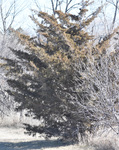
Cupressaceae : Juniperus virginiana
R. Neil Reese
Juniperus virginiana is a perennial, non-flowering, coniferous evergreen tree with a pyramidal or subcylindrical shaped crown, growing 5–20 m in height. The bark is reddish-brown to gray, fibrous and shredding as it ages. The younger branches are usually red. The adult leaves are green to blue green, tightly adpressed and scale-like, 2–4 mm long, 0.8-1.5 mm wide, arranged in opposite decussate pairs or occasionally whorls of three and overlapping the leaves above. Juvenile leaves are needle shaped, 5–11 mm long and are present on young trees and new branches. Red cedar is usually dioecious with male plants having yellowish-brown, sessile, solitary ovoid cones, 2.5-4 mm long, 1-2 mm in diameter, attached to the ends of branchlets. Female trees produce solitary, berry-like seed cones that are 3–7 mm in diameter, dark purplish-blue with a white waxy covering. These cones mature during the first year and contain 1-3 yellowish seeds. Cones shed pollen and are fertilized in April and May. Eastern red cedar is native to southern South Dakota, being found on pastures, prairie hillsides and disturbed ground. Because of its wide use in shelter belts, it has escaped and is naturalized throughout SD.
-
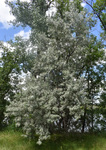
Elaeagnaceae: Elaeagnus angustifolia
R Neil Reese
Elaeagnus angustifolia is a perennial large shrub or small tree growing to 5 m tall. The trunk and mature branches have a scaly gray-brown bark, with young branches being covered with silvery gray hairs. The small branches often end in sharp spines. The alternate, simple, petiolate leaves are covered with silvery scales are star-shaped hairs. The blades are up to 10 cm long and usually less than 18 mm wide. The inflorescence consists of axillary groups of 1 to 3 short-stalked flowers on the young branches. The fragrant flowers are funnel-shaped, ~12 mm long and wide, with 4 spreading, yellow petal-like sepals that are silvery on the outer side. They are fused at the base and form an angled tube about as long as the lobes. There are 4 yellow stamens and a style. The fruit are edible, but mealy drupe-like achenes. Russian olive flower in May and June ad the fruit ripen in August through October. This species was introduced as a windbreak species and has become naturalized throughout the US. Although still planted for game improvement in some states, it is considered an invasive species in South Dakota.
-
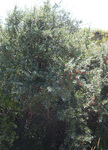
Elaeagnaceae : Shepherdia argentea
R. Neil Reese
Shepherdia argentea is an erect, perennial, deciduous shrub or small tree, growing 2m to 6m in height and forming thickets by root suckers. Young stems are covered in scaley or stellate hairs giving them a white-mealy appearance, becoming gray with age, and 2–3-year-old twigs often end in spines. The simple leaves are opposite, oblong to oblanceolate, 2-5 cm long, 7-12 mm wide, gray green on both the upper and lower surfaces due to a covering of hairs. The margins are entire, the tip blunt and the blade narrowed at the base with a petiole of 3-6 mm. Buffaloberry is dioecious, the flowers in small clusters on 1 year old twigs. Male flowers have 4 sepals fused to a 8-lobed, shallow disk and have 8 stamens, their filament free. The female flowers have 4 sepals fused to a hairy disk that nearly encloses the pistil. The fruit is an ovoid, drupe-like achene, red, juicy and 5–7 mm long. Buffaloberry blooms in May and June and the fruits remain attached into the fall. They grow throughout South Dakota along streambanks, on hillsides and in ravines.
-
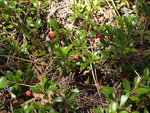
Ericaceae : Arctostaphylos uva-ursi
R. Neil Reese
Arctostaphylos uva-ursi is a perennial low shrub, with trailing flexible stems which form mats 1-2 m in diameter. The bark is reddish on younger stems and light colored and exfoliating on older stems. The leaves are alternate with a short petiole. The blades are entire, spatulate to obovate, evergreen and 1-3 cm long. The upper surface of the leaves is leathery and shiny. The flowers are arranged in terminal racemes or panicles and are often pendulous. The 5 sepals are 1-1.5 mm long, pink to white and persisting in fruit. The corolla is urceolate, white to pink, 4-8 mm long and the lobes are reflexed. There are 10n stamens that are shorter than the petals and a the ovary is 5-celled. The fruit is a fleshy drupe, red, 4-10 mm in diameter containing 5 boney 1-seeded nutlets, Bearberry blooms from May to July and grows in wooded areas on rocky to sandy sights in western South Dakota. This species is commonly found on much of the norther and mountainous regions of North America.
-
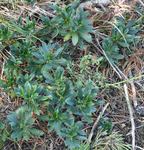
Ericaceae: Chimaphila umbellata
R. Neil Reese
Taxonomic Description
Chimaphila umbellata is a slow-growing perennial subshrub or evergreen shrub that spreads via an extensive system of creeping underground rhizomes. The plant reaches a height of 10 to 35 cm, featuring woody, unbranched or sparsely branched, trailing vegetative stems. The leaves display a pseudo-whorled or sub-opposite leaf insertion along the stem. Each leaf is simple, sharply serrate or dentate along the margins, and oblanceolate to narrowly elliptic in shape. They exhibit a lustrous, dark green color on the upper surface and a noticeably paler green shade underneath. The blades range from 3 to 7 cm long and 0.5 to 2.5 cm wide, supported by short petioles measuring 3 to 10 mm in length. Flowering occurs in late summer, typically between June and August, via a terminal, nodding, umbel-like corymbose inflorescence that spans 2 to 5 cm across and bears 3 to 10 flowers. The flowers possess 5 free, persistent sepals that are broadly ovate to orbicular, roughly 1.5 to 2.5 mm long and wide, light green to pinkish, and have slightly erose margins. The 5 free, spreading to reflexed petals are orbicular, concave, about 5 to 7 mm long and wide, and are white to rosy-pink. Situated inside are 10 stamens, 2.5 to 3.5 mm long, with bi-poricidal violet-pink anthers and filaments that are distinctly dilated and hairy at their bases. The single, superior pistil features a large, globose, bright green ovary topped by a virtually nonexistent style and a broad, five-lobed, shield-shaped stigma. The resulting fruit is a dry, globose, 5-valved dehiscent capsule measuring 5 to 7 mm in diameter, which shifts from green to a dark brown color as it reaches maturity between August and October. Pipsissewa is native to South Dakota, where it is restricted to the western part of the state within the Black Hills region, specifically thriving in the deep shade and acidic organic litter of cool, dry coniferous forests.
-
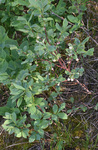
Ericaceae: Vaccinium membranaceum
R. Neil Reese
Vaccinium membranaceum is a perennial, deciduous shrub with a shallow, fibrous root system. Mature plants typically reach 30–90 cm in height. Stems are slender, erect to spreading, and covered with smooth bark that becomes reddish-brown with age. Leaves are alternate, simple, broadly ovate to elliptic, 1–5 cm long and 0.5–3 cm wide, with finely serrated margins and an acute tip. The upper leaf surface is dark green and glabrous or sparsely hairy, while the lower surface is paler and often glaucous or slightly hairy. Petioles are short, 2–5 mm long. Flowering occurs from May to July, with inflorescences forming short racemes or clusters of 3–10 nodding, bell-shaped flowers 5–10 mm long. Flowers have five fused sepals forming a small green calyx 1.5–2 mm long, and five fused petals forming a white to pale pink, urn-shaped corolla 4–7 mm long with a slightly flared mouth. Stamens number ten, with filaments often hairy near the base and anthers with terminal pores releasing pollen via vibration (buzz-pollination). The pistil consists of a single ovary with a slender style and a small stigma. The fruit is a round, juicy berry, 6–12 mm in diameter, dark blue to nearly black with a smooth, glossy skin, maturing from August to September. Mountain huckleberry is native to South Dakota's Black Hills and western regions, typically found in montane forests, subalpine meadows, and rocky slopes, preferring acidic, well-drained soils under partial shade.
-
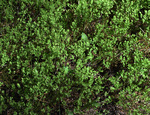
Ericaceae: Vaccinium scoparium
R. Neil Reese
Vaccinium scoparium is a perennial, deciduous shrub with a shallow, fibrous root system and no rhizomes or tubers. Mature plants typically reach 10–60 cm in height. Stems are slender, erect to spreading, often forming dense, low mats or thickets. Leaves are alternate, simple, broadly ovate to elliptical, 0.5–2 cm long and 0.3–1 cm wide, with finely serrated margins and an acute tip. The upper leaf surface is dark green and glabrous or sparsely hairy, while the lower surface is paler and sometimes glaucous. Petioles are short, 1–3 mm long. Flowering occurs from May to July, with inflorescences forming small clusters or solitary nodding, bell-shaped flowers 4–7 mm long. Flowers have five fused sepals forming a small green calyx 1–1.5 mm long, and five fused petals forming a white to pale pink, urn-shaped corolla 3–6 mm long with a slightly flared mouth. Stamens number ten, with filaments often hairy near the base and anthers with terminal pores for buzz-pollination. The pistil consists of a single ovary with a slender style and small stigma. The fruit is a round, fleshy berry, 5–8 mm in diameter, dark blue to black with a smooth, glossy skin, maturing from July to September. Grouse whortleberry is native to South Dakota’s Black Hills and western regions, typically found in montane forests, subalpine meadows, and rocky slopes, favoring acidic, well-drained soils under partial shade.
-
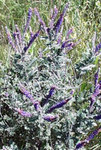
Fabaceae: Amorpha canescens
R. Neil Reese
Amorpha canescens is a small perennial deciduous shrub or subshrub, which grows 30 cm to 1.2 m in height from a deep, rhizomatous root system. Main stems are brown and woody with the few branching stems being green to gray-white. The grey-green leaves are alternate odd-pinnate and appear leaden due to their dense hairiness Leaves contain 29-41 leaflets, are subsessile with the petiole 0.5-1.0 mm long. The rachis is 8-13 cm long, the petiole and rachis densely are pubescent with short whitish to gray woolly hairs. Leaflets are 9-17 mm long and 4-8 mm wide, ovate-oblong to elliptical. The margins are entire. The flowers bloom from May to August and have a 5-lobed fused calyx 1.5-2.0 mm long, with free lobes 1.5-2.0 mm long. Corollas are not papilionaceous, forming a bluish-purple tube that is 4-5 mm long and 2.0-2.5 mm wide. Ten stamens are exserted from the tube, the free portion of the filaments 4-5 mm long with bright yellow anthers. The superior ovary is 1.0-1.5 mm long and densely hairy, with the style 2-3 mm long and having a 3-lobed stigma. The fruits are small (3-4mm) modified 1-seeded legumes. This plant can be found growing in well-drained soils of prairies, bluffs, and open woodlands.
-
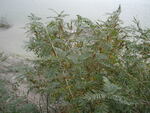
Fabaceae : Amorpha fruticosa
R. Neil Reese
Amorpha fruticosa is a deciduous perennial shrub, which has 1 to several stems growing from 1 m to 3.5 m in height, often branched, forming a bushy top. The alternate, pinnately compound leaves are stipulate (caduceus, narrowly linear 2-4 mm in length) 10 – 30 cm long with 4 – 15 pairs of emarginate leaflets. The inflorescences are solitary to clusters of densely flowered racemes 5-20 cm in length that bloom from June to August. The 5-merous calyx is fused forming a tube 2-3 mm long with broadly rounded to triangular lobes extending about 0.5 mm. The reddish-purple petals form a tube 5-6 mm long that encloses the stamens and pistil. There are 10 stamens 6-8 mm long and united at the base, with bright yellow anthers. The single pistil matures into a legume 5-7 mm by 2-3 mm. False indigo is commonly found along moist stream banks, in the open or in open woods.
-
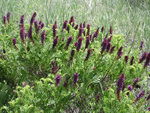
Fabaceae : Amorpha nana
R. Neil Reese
Amorpha nana is deciduous perennial shrub, which grows 30 cm to 60 cm in height. The stems are branched above, often covered with short hairs when young. The alternate, compound odd-pinnate leaves are 3-10 cm long with 3-10 cm long petioles having associated stipules that are 3-5 mm long. The broadly oblong leaflets are arranged in 6-15 pairs with a single terminal leaflet and are 6-13 mm long by 3-6 mm wide. Dwarf indigo flowers are borne in densely flowered terminal racemes, 3-9 cm long. The dark, purple-colored flowers appear from May to June. The sepals form a short turbinate tube 2-3 mm long with 1-2 mm long triangular lobes. The corolla is composed of petals fused into a tube, 5-6 mm long, with a slender claw, and encloses the stamens and pistil. There are 10 stamens fused at the base and a single pistil. The fruit is a legume, 4.5-5.5 mm long by 2-3 mm wide. This species is commonly found on dry prairies and rocky or sandy hillsides.
-
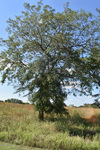
Fabaceae: Gleditsia triacanthos
R. Neil Reese
Gleditsia triacanthos is a deciduous tree known for its rapid growth, thorny branches, and distinctive compound leaves. It typically grows 15–25 meters tall, sometimes reaching up to 30 meters and has a broad, open crown. The bark is gray-brown and deeply furrowed. Branches bear large, branched thorns up to 20 cm long, though thornless cultivars exist. Leaves are pinnately or bipinnately compound, 20–40 cm long, with numerous small, ovate to lanceolate leaflets about 2–5 cm long and 1–2 cm wide. The tree is deciduous, shedding leaves in late fall. Flowering occurs in late spring (May–June). The flowers are small, greenish-yellow, and fragrant, arranged in loose, open racemes. Each flower is typically about 5–7 mm long. Each flower has four sepals and four petals. The sepals are small, green, and fused at the base, about 2–3 mm long, with lanceolate lobes. The petals are also small, about 3–5 mm long, yellow-green, and somewhat irregular in shape. The tree produces long, flattened pods 15–30 cm in length, containing several hard, brown seeds. Pods mature in fall and persist through winter. Honey locust is native to eastern South Dakota and the central United States. It is commonly used in landscaping and is widely naturalized throughout South Dakota, often found in floodplains, open woodlands, and along rivers.
-
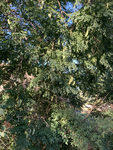
Fabaceae: Gymnocladus dioicus
R Neil Reese
Gymnocladus dioicus is a large, deciduous, perennial tree with rough bark and growing to 23 m tall. The young twigs are brown, hairless with light brown to orange lenticels. The large leaves are alternate, bipinnate, 30-90 cm long, 30-60 cm wide, with each leaf having 3-7 pairs of pinnae (branches), the branches up to 10 cm long and having 4-7 pairs of leaflets on each branch. The leaflets are 4-7 cm long, 2-3 cm wide, rounded at the base, pointed at the tip with entire margins. The inflorescence consists of terminal racemes or panicles, 5-30 cm long. the flowers have a tubular-obconic hypanthium 6-10 mm long, with 5 oblong sepals, 3-5 petals 4-5 mm long, 10 stamens with those opposite the petals slightly longer than those opposite the sepals. The trees generally produce either male or female flowers,but usually also produce some perfect flowers.The fruit is a flattened, oblong, indehiscent legume 5-15cm long and 3-5 cm wide, containing dark seeds, 15-20 mm in diameter. The fruit is green in the summer and turns purplish-brown as it dries. Kentucky coffee blooms in May and June in woodlands along streams and on open hillsides in southeastern South Dakota. This species has been planted in windbreaks and urban landscapes throughout SD and can be found in many regions as an introduced species.
-
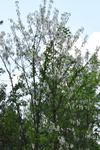
Fabaceae: Robinia pseudoacacia
R. Neil Reese
Robinia pseudoacacia is a perennial, deciduous hardwood tree featuring a wide-spreading fibrous root system characterized by a shallow taproot and extensive lateral roots that aggressively produce root suckers. It reaches a mature plant height of 9 to 21 m. The stem is a relatively straight trunk with an open, irregular crown of crooked, brittle branches; the twigs are zigzag, angular, and red brown with prominent lenticels. The bark on older wood is thick, dark reddish-brown to blackish-gray, and deeply furrowed into heavily ridged rope-like patterns. Leaf insertion is alternate along the twigs. The leaves are odd-pinnately compound and 15 to 36 cm long, composed of 7 to 29 leaflets. Each leaflet is dark blue green on the upper surface and lighter green below; they are oval to ovate oblong in shape, 2.5 to 5 cm long, and 1.3 to 2 cm wide with entire margins and rounded, obtuse apices. A distinct petiole is present, measuring 2.5 to 5 cm long. Paired, heavily lignified stipules modify into sharp, stout spines measuring 0.6 to 1.3 cm long at each leaf scar on young shoots and juvenile wood, though they are frequently absent on older, slower-growing branches. Flowering occurs from April to June for a brief duration of approximately 10 days. The inflorescence is a dense, pendulous, unbranched raceme measuring 10 to 20 cm in length. The sepals form a campanulate, 5-lobed calyx tube that is fused, short about 5 to 7 mm long and wide, dark reddish green to purple, and covered in fine hairs. The petals comprise a showy papilionaceous corolla that is creamy white with a distinct yellow spot on the standard petal; the individual petals are free (except for the partially fused keel petals), intensely fragrant, and measure 15 to 20 mm long. There are 10 stamens total, arranged in a diadelphous configuration where 9 filaments are fused into a tube and 1 remains free; they are about 15 mm long with white filaments and small yellow anther heads. The single superior pistil is about 15 to 18 mm long with a linear, green ovary, a curved, slender style, and a small, terminal, capitate stigma. The fruit is a flat, linear-oblong, dehiscent leguminous pod measuring 5 to 10 cm long and 1.3 mm wide. It turns from green to a smooth, dark reddish-brown color upon reaching maturity between September and October, frequently persisting on the naked branches through the winter months. The black locust is not native to South Dakota; it is native to the southeastern United States, primarily the southern and central Appalachian Mountains and the Interior Highlands. It has been widely introduced and naturalized across eastern and central South Dakota, where it is commonly found in disturbed woodlands, degraded forest edges, old fields, fence rows, and along sunny roadcuts.
-
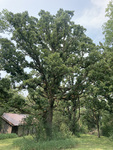
Fagaceae : Quercus macrocarpa
R. Neil Reese
Quercus macrocarpa is a deciduous coarse shrub to large tree, with deeply furrowed bark, growing up to 30 m in height and with the trunk more than 1 m in diameter. The simple, alternate leaves are obovate, pinnately lobed, 10-25 cm long and 5-15 cm wide. The leaves are usually shiny green on the upper surface and silvery due to star-shaped hairs on the lower surface and can vary greatly in size and shape depending on location and climate. Burr oak is monoecious, the green male flowers develop in pendulous catkins, each flower with a 5-lobed calyx and 5-10 stamens. The green female flowers are solitary or in small clusters in the axils of new growth, have 6 sepals and an ovary embedded in the surrounding tissues, with styles exerted. The fruit is a nut (acorn) surrounded by a deep cup, the margins and sides often fringed, that envelops half or more of the ovoid nut that is up to 4 cm long and 4 cm wide. Burr oak flowers in April and May in upland forests and along lake shores in much of South Dakota.