

-
This site is dedicated to Mrs. Dorothy Gill, a Dakota Elder, a mentor and friend.

-
Urticaceae : Urtica dioica ssp. gracilis
R. Neil Reese
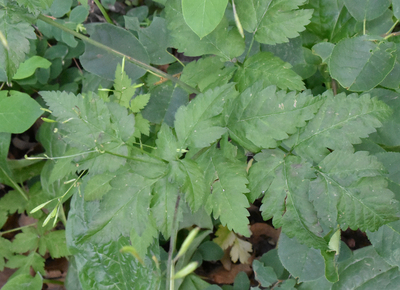
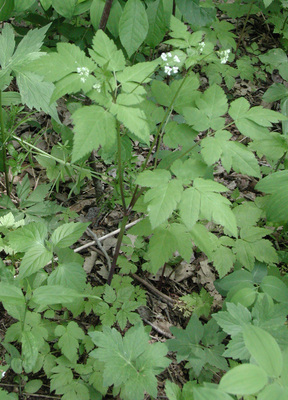
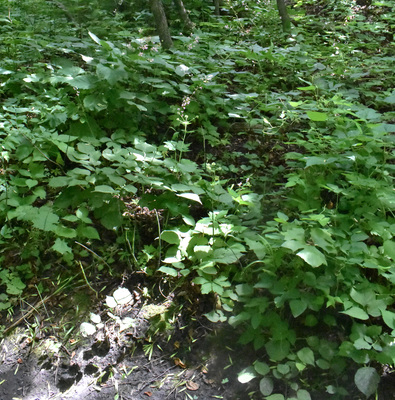
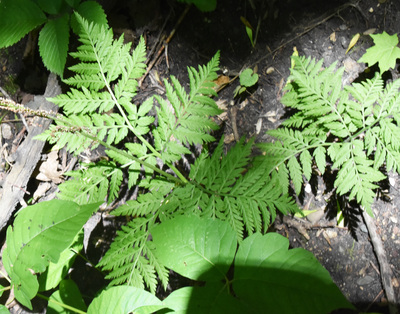
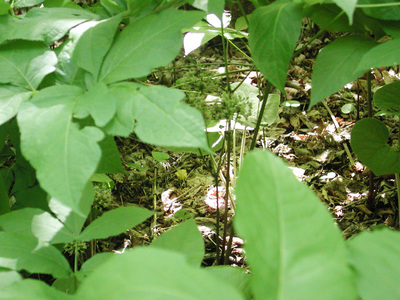
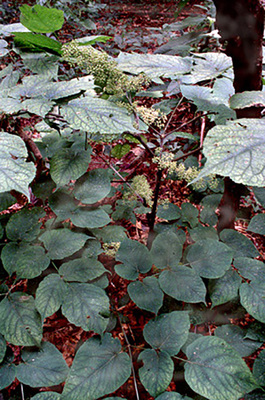
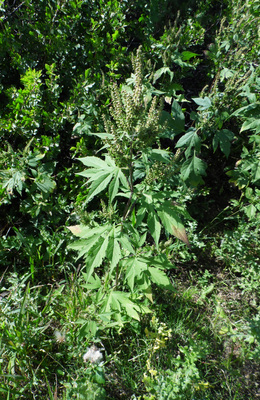
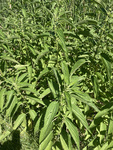
Urtica dioica ssp. gracilis is a rhizomatous perennial herb with simple, erect, squarish stems, growing up to 3 m in height, with few to many stinging hairs on the stems. The alternate leaves are petiolate, the petioles equal to or shorter than the blades, with a sparse covering of stinging hairs and a pair of stipules at the base. The blades are larger and ovate toward the base, 1-6 cm long, 1-4 cm wide, and smaller, ovate to lanceolate towards the top, often somewhat folded lengthwise, the edges sharply toothed, the veins sunken on the upper surface and raised below. The upper surface of the leaf blades are typically hairless, with the lower surface being smooth, sometimes having a few tiny hairs, or stinging hairs. The plants are monoecious with clusters of male or female flowers in axillary panicles or sometimes in long string-like strands, usually in pairs, the inflorescence longer than the subtending leaf petiole. Both male and female flowers are 4-merous, tiny and indistinct, creamy green to pinkish in color. The fruit are ovate, tan to brown achenes about 1.5 mm long and < 1 mm wide. Stinging nettle blooms from June into September in moist woods, along streams, lakes and ditches throughout South Dakota.
Synonym: Urtica gracilis ssp. gracilis
-
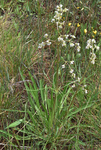
Valerianaceae: Valeriana edulis
R. Neil Reese
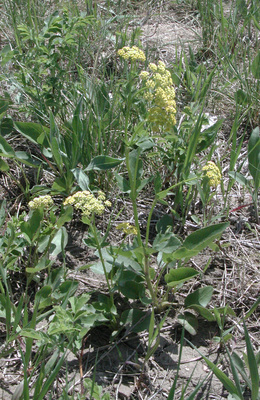
Valeriana edulis is a long-lived, dioecious perennial herbaceous forb that develops a stout, deeply penetrating, fleshy taproot extending from a short, branched woody crown. The plant reaches an overall height of 30 to 120 cm, supported by single or multiple erect, thick, succulent, hollow stems that are generally glabrous except at the slightly swollen nodes. Leaf insertion is primarily basal, forming a dense rosette, with none to a few opposite pairs distributed along the upper stem. The basal leaves are simple, light to medium green, thick, narrowly oblanceolate to linear-oblanceolate, measuring 10 to 30 cm long and less than 2.5 cm wide, with nearly parallel venation, a smooth margin densely fringed with short, stiff, white cilia, and a short, winged petiole. In contrast, the upper cauline leaves are sessile, much shorter, and pinnately compound or deeply cleft into 3 to 9 irregular, narrow, finger-like linear segments. Flowering occurs from May through August depending on elevation, featuring a dense, terminal, panicle-like cyme that measures 10 to 30 centimeters long, which elongates and becomes more open as the season advances. The sepals are highly modified, minute, and fused to the top of the inferior ovary during bloom, later unrolling into 10 to 20 free, plumose, feather-like bristles that expand up to 5 mm long to aid in wind dispersal. The petals are small, white to pinkish-white, 2 to 4 m long, and fused at the base into a short, funnelform corolla tube with 5 spreading, unequal, lobes. Staminate flowers possess 3 separate, long-exserted stamens featuring white filaments and yellow anthers, while pistillate flowers lack functional stamens. The single pistil consists of an inferior, 3-celled ovary (with only one fertile ovule) topped by a single slender style and a short, 3-lobed stigma. The fruit is a dry, 1-seeded achene (oval-oblong, 3 to 5 mm long, glabrous, straw-colored to light brown) that reaches full maturity from late July through September. Edible valerian is native to South Dakota, where it is restricted to three western counties within the Black Hills region, inhabiting moist subalpine meadows, grasslands, and calcareous mountain wetlands.
-
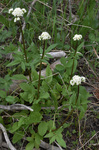
Valerianaceae: Valeriana occidentalis
R. Neil Reese
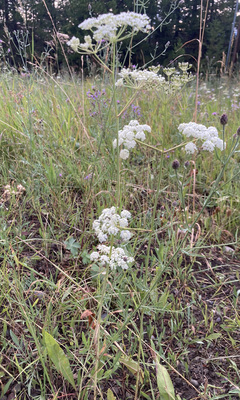
Valeriana occidentalis is a perennial, herbaceous plant with a fibrous root system and short, thick rhizomes, forming loose clumps. Mature plants typically reach 30–90 cm in height. Stems are erect, branched or unbranched, round, and smooth to sparsely hairy. Leaves are opposite or whorled, compound, ternate to pinnate, with leaflets ovate to lanceolate, 2–8 cm long and 1–3 cm wide, with serrated margins and pointed tips. Leaf surfaces are medium green, with both surfaces glabrous or sparsely hairy. Petioles are present and range from 2–8 cm in length. Flowering occurs from June to August, with inflorescences forming dense, compound cymes up to 10 cm wide, bearing numerous small, tubular, funnel-shaped flowers about 5–8 mm long. Flowers have five greenish-white sepals, 1–2 mm long, free and lanceolate, and five fused petals forming a corolla tube 4–7 mm long with five spreading lobes. Stamens number five, inserted on the corolla tube, with yellow anthers approximately 1 mm long. The pistil consists of a single ovary with a slender style and a capitate stigma. The fruit is a small, dry, ribbed achene, 2–3 mm long, maturing from July to September. Western valerian is native to South Dakota, occurring mainly the Black Hills in montane meadows, open forests, and moist slopes, favoring well-drained, moderately rich soils under full sun to partial shade.
-
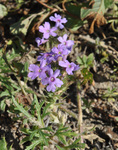
Verbenaceae : Glandularia bipinnatifida
R. Neil Reese
Glandularia bipinnatifida is a prostrate to ascending, mat-forming, short-lived perennial herb growing from a somewhat woody, branched base, with stems up to 60 cm long, moderately to densely covered with bristly hairs. The stems occasionally rooting from the lower nodes. The petiolate leaves are opposite, 1-6 cm long, 3-parted to compound bipinnate, with stiff appressed hairs on both surfaces and rolled margins. The inflorescence consists of flattened spikes 1-20 cm long, on peduncles originating at the ends of branches. The tubular calyx is green, 7-10 mm long, with 5 unequal lobes, 1-4 mm long. The pink to purple corolla tube is about 1.5 times the length of the calyx, covered with hairs on the outside, with reflexed, notched limbs, 7-10 mm wide. The fruit are nutlets, 4-seeded, 2-3 mm long. Dakota mock vervain blooms from May into October on dry plains, prairies and along roadsides in the southern counties in South Dakota.
Synonym: Verbena bipinnatifida
-
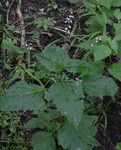
Verbenaceae: Phryma leptostachya
R. Neil Reese
Taxonomic Description:
Phryma leptostachya is a perennial herb growing 30 to 90 cm tall from a fibrous root system. The roots are slender and moderately deep, anchoring the plant in well-drained soils. The stems are slender, erect and unbranched or sparsely branched, often with fine, soft hairs giving them a somewhat rough texture. Leaves are opposite or whorled near the base, ovate to lanceolate, 5 to 12 cm long, 2 to 5 cm wide, with serrate margins, a rough texture, and petioles 1–3 cm long. The flowers are small and tubular, clustered in slender, spike-like racemes at the top of the stems, blooming from July through September. The calyx consists of five narrow, green to reddish sepals, each about 3 to 5 mm long, with pointed tips and often faintly hairy margins. Each flower has a tubular corolla about 8 to 12 mm long, with a two-lipped structure; the upper lip is hooded, and the lower lip is three-lobed. Flowers have four didynamous (two long and two short) stamens and a single pistil with a superior ovary. Fruits develop from August through October, maturing into small, two-chambered capsules, 6–10 mm long, that split open to release seeds. American lopseed is native to South Dakota and typically found in rich, moist woodlands, shaded slopes, and along stream banks, mostly in the eastern part of the state.
-
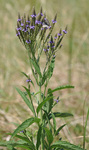
Verbenaceae : Verbena hastata
R. Neil Reese
Verbena hastata is a short-lived, perennial herb with square, green to reddish stems, usually branched above, with short, rough hairs, growing 0.5-2.5 m tall. The simple, opposite, petiolate, lanceolate to lance-ovate leaves are 4-18 cm long, toothed, pointed at the tip and often 3-lobed at the base. The lower leaf surface is hairy, the upper smooth to sparsely hairy and the veins appearing sunken. The inflorescence consists of stiff, terminal, many-flowered spikes. The flowers are subtended by small bracts. The calyx is 2.5-3 mm long, tubular and 5-toothed and hairy on the outer surface. The blue to purplish corolla tube is about twice as long as the calyx, with 5 reflexed lobes, 2-3 mm long. the fruit are 4 nutlets enclosed in the persistent calyx. Blue vervain blooms from June to October in moist meadows and woodland, along streams and springs in all but the NW corner of South Dakota.
-
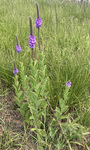
Verbenaceae : Verbena stricta
R. Neil Reese
Verbena stricta is a short-lived, perennial herb with erect stems, usually branched above, with a dense covering of hairs, growing 20-120 cm in height. The simple, opposite, erect to spreading, ovate to orbicular leaves are 3-7 cm long, sessile or nearly so, toothed, broadly pointed at the tip. The lower leaf surface is densely covered in hairs with prominent veins, the upper is hairy and wrinkled. The inflorescence consists of 1-several stiff, terminal, many-flowered spikes on each branch. The flowers are subtended by small bracts about the size of the calyx. The calyx is 4-5 mm long, tubular and 5-toothed, and densely covered with hairs. The blue to purple, rarely white, hairy corolla tube is about slightly longer than the calyx, with 5 reflexed lobes that create a disk 8-9 mm across. The petal lobes are slightly unequal in size, the 2 lateral lobes largest and the lower lobe notched at the tip. The fruit are 4 nutlets, 2.5-3 mm long, enclosed in the persistent calyx. Hoary vervain blooms from May to September in pastures, prairies, along roadsides and in wastelands throughout South Dakota.
-
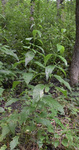
Verbenaceae: Verbena urticifolia
R. Neil Reese
Verbena urticifolia is a perennial, herbaceous plant with a fibrous root system and short rhizomes, forming loose clumps. Mature plants typically reach 30–90 cm in height. Stems are erect, slender, square in cross-section, branched, and covered with spreading, rough hairs. Leaves are opposite, simple, ovate to lanceolate, 5–12 cm long and 2–5 cm wide, with serrated margins and pointed tips; both leaf surfaces are rough-hairy, especially along the veins. Petioles are present, 1–4 cm long. Flowering occurs from July to September, with inflorescences forming slender, spike-like racemes 5–15 cm long, bearing many small, white to pale lavender flowers. Each flower has a calyx with five green, lanceolate sepals about 3–5 mm long, fused at the base, and a corolla with five fused petals forming a tubular, two-lipped flower about 5–7 mm long. Stamens number four, didynamous (two long and two short), with white filaments and yellow anthers. The pistil consists of a single ovary with a slender style and bifid stigma. The fruit is a four-lobed schizocarp that splits into four one-seeded nutlets, each about 2 to 3 mm long, maturing from August to October. White vervain is native to South Dakota , found in eastern and southern counties. in moist to mesic woodlands, thickets, roadsides, and shaded areas, often in rich, well-drained soils under partial to full shade.
-
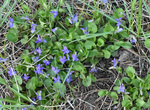
Violaceae: Viola adunca
R. Neil Reese
Viola adunca is a perennial, herbaceous plant with a fibrous root system and short rhizomes, forming loose clumps or patches. Mature plants typically reach 10–30 cm in height. Stems are slender, erect or ascending, and mostly leafless, with a few basal and cauline leaves. Leaves are alternate, simple, and mostly basal, with ovate to lanceolate blades 2–8 cm long and 1–4 cm wide, with crenate to serrate margins and an acute to rounded tip. Leaf surfaces are medium green and glabrous or sparsely hairy on both sides; petioles are slender and 3–10 cm long. Stipules are present, ovate to lanceolate, 5–10 mm long, often toothed or fringed. Flowering occurs from May to July, with solitary, showy, zygomorphic flowers borne on slender peduncles rising above the foliage. Flowers are 15–25 mm wide with five petals: the lower petal is spurred, 10–15 mm long and 3 to 6 mm wid. The upper four petals are violet to blue purple with darker veining; petals are free and spreading. Sepals number five, are narrow, lanceolate, green, 6 to 10 mm long and 1.5 to 2.5 mm wide, free and spreading. Stamens number five, with yellow anthers bearing nectar spurs. The pistil is single, with a superior ovary, slender style, and capitate stigma. The fruit is a small, ovoid capsule, 5–7 mm long, maturing from July to August, containing numerous tiny seeds equipped with elaiosomes that encourage ant dispersal. Early blue violet is native to South Dakota and occurs in moist meadows, open forests, stream banks, and grasslands, preferring well-drained to moist, sandy or loamy soils under full sun to partial shade.
-
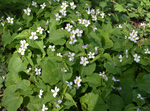
Violaceae: Viola canadensis
R. Neil Reese
Viola canadensis var. rugulosa is a caulescent, colony-forming, perennial herb, spreading by stolons, with 1-several stems growing 20-40 cm in height. The leaves are simple, green to grayish green, heart-shaped, shallowly toothed and hairy, especially along veins on the underside. There are 3-5 basal leaves with long petioles, the blades up to 10 cm wide, usually not quite as long, the edges scalloped and with pointed tips. The alternate cauline leaves are similar but generally more ovate, with membranous stipules 8-15 mm long. The flowers arise singly on a peduncle from the axils of the upper leaves. The 5 green sepals are 4-6 mm long, often with a few short hairs. The corolla is irregular with 5 petals, white on the inside, with a yellow base, and purplish on the outside. The spurred lower petal and the 2 lateral petals have purple lines toward the base, and the lateral petals are bearded (have tufts of hairs), and the upper 2 petals are usually hairless. There are 5 stamens surrounding the pistil and the style is usually bearded. The fruit is a capsule 6-10 mm long. Canada white violet blooms from May through August in woodlands in eastern and northwestern South Dakota.
-
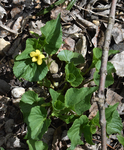
Violaceae: Viola eriocarpa
R. Neil Reese
Viola eriocarpa is a long-lived perennial, caulescent herbaceous forb that arises from a short, thick, horizontally creeping underground rhizome supported by a fibrous root system. The plant typically reaches a mature height of 15 to 35 cm. It usually develops two to several weak, smooth, light green stems from a single cluster; these stems are often slightly decumbent near the base before growing erect. The leaves exhibit an alternate insertion pattern along the upper stem while also forming a distinct basal rosette of 1 to 5 leaves. The leaf type is simple. The blades are a vibrant medium-green color, measuring 5 to 10 cm in length and width, and are broadly ovate-cordate to orbicular-cordate (heart-shaped) with finely toothed margins. The upper and lower leaf surfaces are mostly smooth or glabrous, though sparse hairs may occasionally occur along the primary veins on the underside. Long, smooth petioles are present, measuring 5 to 15 cm in length on basal leaves and shortening significantly as they ascend the stem. Prominent green, leaf-like stipules are present at the bases of the stem leaves, featuring a broadly ovate to lanceolate shape with entire to irregularly erose margins. Flowering occurs from April through June. The inflorescence consists of solitary, open-pollinated flowers borne on slender, axillary peduncles that rise slightly above or level with the leaves. Each flower features 5 free, light green sepals that are narrowly lanceolate to linear, measuring 4 to 6 mm long and 1 to 1.5 mm wide, with smooth margins and sharp, pointed tips. The 5 free petals are bright yellow, measuring 10 to 15 mm long and 6 to 10 mm wide; the three lower petals feature distinct, dark purple-brown nectar guides on their inner throat, and the side petals are visibly bearded with short white hairs near the base. Tucked inside the corolla throat are 5 distinct stamens measuring 1 to 2 mm long; they are pale cream to white with orange-tipped anthers that form a tight ring around the pistil. The single pistil contains a superior, 1-celled ovary measuring about 2 mm long, capped by a single club-shaped style and a slightly curved, knobby stigma. The fruit is an oval, 3-valved capsule measuring 10 to 12 mm long that varies from densely woolly-pubescent to completely hairless. It turns a tan or light brown color at maturity between June and August, violently exploding open to eject its seeds. Smooth Yellow Violet is native to South Dakota, where it occurs primarily within the moist, deciduous woodlands, river valleys, and shaded rich slopes of the eastern and far western regions of the state. Distinguishing Viola eriocarpa (Smooth Yellow Violet) from Viola pubescens (Downy Yellow Violet) can be exceptionally challenging due to their close historical relationship. V. eriocarpa have distinct basal leaves arising directly from the rootstock. And glabrous foliage. V. pubescens lacks basal leaves and is densely fuzzy or velvety.
-
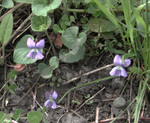
Violaceae: Viola nephrophylla
R. Neil Reese
Viola nephrophylla is an acaulescent perennial herb growing from a branching caudex. The basal leaves have petioles 5-20 cm long with lanceolate stipules. The blades are simple, green, heart-shaped, smooth or occasionally having a few short hairs, the margins with shallow rounded teeth. The flowers develop on a peduncle that is as tall or taller than the leaves. The 5 green sepals are 5-7 mm long and usually hairless. The corolla is irregular, with 5 blue petals that are 10-20 mm long. The lower petal has a short spur, and it and the 2 lateral petals have a whitish base, are bearded (have tufts of hairs), and the upper 2 petals are usually hairless. Additionally, there are cleistogamous flowers (small flowers that don’t open) on erect to prostrate peduncles. The fruit is a smooth capsule 6-8 mm long. Northern bog violet blooms in May and June in moist prairies and along streams and lakes in all but the central region of South Dakota.
-
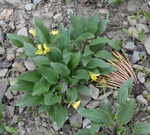
Violaceae: Viola nuttallii
R. Neil Reese
Viola nuttallii is a perennial, herbaceous, caulescent plant developing from a thick, vertical, woody rhizome that anchors a deep taproot system suited for arid prairie environments. The plant reaches a height of 2 to 27 cm and produces 1 to 6 ascending to erect stems that are characteristically about half-subterranean and covered in fine, short hairs. Leaf insertion is both basal (forming a minor rosette of 1 to 6 leaves) and cauline (alternate along the stems). The leaf type is simple, deeply green, measuring 2 to 10 cm in length and 0.5 to 3 cm in width, with a distinct lanceolate, elliptic, or narrowly ovate shape featuring an entire to finely irregular margin and lacking a notched base. Both the upper and lower leaf surfaces are typically glabrous to minutely puberulent, and the leaves are borne on long, minutely puberulent petioles measuring 2 to 17 cm long. Stipules are present and prominently adnate to the petiole, forming two linear-lanceolate wings with entire margins and free, acute, few-toothed apex tips. Flowering occurs early in the season, typically from April through July, with solitary, flowers arising from the upper leaf axils. The calyx consists of 5 free, green, lanceolate to linear-lanceolate sepals measuring 4 to 8 mm long and 1 to 2.5 mm wide, characterized by prominent, short basal auricles. The corolla is composed of 5 free petals that are deep yellow on the inside face but often tinged with brownish purple on the back; the two lateral petals are distinctly bearded with internal hairs, and the lowest three petals exhibit prominent brownish-purple nectar lines. The reproductive structures include 5 distinct stamens that are small, cream-colored, and tightly surrounding the ovary, with prominent dorsal appendages. The single pistil consists of a superior, 3-carpelled ovary topped by a curved style with a characteristically hairy, capitate style tip and an unspurred stigma opening. The fruit is an erect, dry, 3-valved, subglobose capsule measuring 6 to 9 mm long, which changes from pale green to tan or light brown upon reaching maturity between late June and August. The yellow prairie violet is native to South Dakota, where it can be found primarily across the western and central portions of the state, colonizing dry, open grasslands, sagebrush-steppe lands, and exposed bluffs.
-
Violaceae: Viola pedatifida
R. Neil Reese
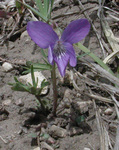
Viola pedatifida is an acaulescent perennial herb growing from an erect, ascending and sometimes branching caudex. The green basal leaves are up to 55 mm long by 87 mm wide, usually palmately 3-parted, with each part divided into linear lobes that are divided again, the margins with fine hair. The petioles are up to 15 cm long having narrowly lanceolate stipules. The flowers develop on a peduncle that is usually taller than the leaves. The 5 green sepals are 6-8 mm long and usually with small hairs. The corolla is irregular, with 5 violet to red violet petals that are 10-20 mm long. The lower petals are white at the base with dark violet veins, with a beard (tufts of hairs), and the upper 2 petals are usually hairless. Additionally, there are cleistogamous flowers (small flowers that don’t open) on erect to prostrate peduncles. The fruit is a smooth yellow green capsule 8-12 mm long. Prairie violet blooms from April to June in prairies and open woodlands in all but the central region of South Dakota.
-
Violaceae : Viola pubescens
R. Neil Reese
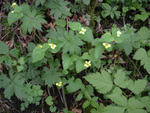
Viola pubescens is a caulescent perennial herb growing from an erect to horizontal rhizome, with 1-several erect to decumbent stems growing 10 to 40 cm in length and covered with a few to many spreading hairs. The leaves are alternate on the upper portion of the stem, broadly heart-shaped, blunt to rounded at the tip, 4-10 cm long and about as wide or wider. The surfaces are smooth to hairy, the margins have rounded teeth fringed with short hairs. The petioles can be shorter to longer than the blades, hairy with leafy stipules. Solitary flowers develop in the axils of leaves, with a peduncle that is shorter to longer than the leaf. The 5 green sepals are 6-10 mm long, pointed and with narrow white margins. The corolla is irregular, with 5 yellow petals that are 8-12 mm long. The lower petals have darker, purplish brown veins, the lower most swollen, the lateral pair of petals with a beard (tufts of hairs), and the upper 2 petals are usually hairless. Additionally, there are cleistogamous flowers (small flowers that don’t open) that develop in the upper axils. The fruit is a tan to brown ovoid capsule 8-12 mm long, wooly to sparsely hairy. Downy yellow violet blooms from March to June in woodlands, along streambanks and in thickets along the eastern and western borders of South Dakota.
-
Violaceae: Viola sororia
R. Neil Reese
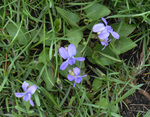
Viola sororia is a perennial, herbaceous plant with a fibrous root system and short, creeping rhizomes, often forming dense patches. Mature plants typically reach 10–30 cm in height. Stems are slender, erect or ascending, and mostly leafless except near the base. Leaves are alternate, simple, heart-shaped to ovate, 3–10 cm long and wide, with crenate to serrate margins and an acute to rounded tip. The upper leaf surface is medium green and glabrous or sparsely hairy, while the lower surface is paler and sometimes hairy. Petioles are long, 5–15 cm, often hairy. Stipules are present, ovate to lanceolate, 5–15 mm long, often toothed or fringed. Flowering occurs from April to June, with solitary, showy, zygomorphic flowers, 15–25 mm wide, born on slender peduncles rising above the foliage. The flowers have five petals; the lower petal is usually spurred and about 8 to 15 mm long and 3 to 6 mm wide, while the lateral petals measure 7 to 12 mm long and 4 to 7 mm wide, often with bearded bases. Sepals are lanceolate, green, generally 6 to 10 millimeters long and 1.5 to 3 millimeters wide. There are five stamens with yellow anthers arranged around the pistil, with filament bases forming nectar-producing spurs near the ovary. The pistil has a single, slender style ending in a capitate stigma. The fruit is a small, ovoid capsule, 5–12 mm long, splitting open at maturity from, June to August, to release numerous small seeds often equipped with elaiosomes encouraging ant dispersal. containing numerous tiny seeds, maturing. Common blue violet is native to South Dakota and occurs in moist woodlands, meadows, lawns, and shaded disturbed areas, preferring well-drained to moist, loamy soils under partial to full shade.
-
Acoraceae: Acorus americanus
R. Neil Reese
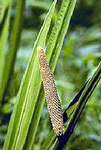
Acorus americanus is a grass-like perennial herb, which grows 90-150 cm in height. The plant is strongly rhizomatous. The leaves are entire, sword shaped and erect. Sweet flag has a spadix that is 4-9 cm long with light brown greenish-brown perfect flowers that are enclosed by a leaf-like spathe. The perianth has 6 short segments, there are 6 stamens, and the pistil contains 2-3 locules. The fruit is a small capsule containing 2-3 seeds. Flowering occurs from May to July. This species is commonly found in swamps and marshes throughout South Dakota.
-

Cyperaceae: Carex brevior
R. Neil Reese
Carex brevior is a perennial sedge in the Cyperaceae family. It grows from a dense, fibrous root system with short rhizomes, sometimes forming small clumps but not extensive sods. The stems (culms) are upright, slender, triangular in cross-section, and usually 30–70 cm tall, smooth or minutely rough below the inflorescence. Leaves are mostly basal, grass-like, flat, and 2–5 mm wide, with sheathing bases and rough margins. Cauline leaves are few, shorter than the culms, and often drooping. Flowering occurs from late spring to early summer (May–July). Inflorescences are terminal, composed of 2–5 short, dense, cylindrical spikes. The terminal spike is usually staminate (male), while the lower spikes are pistillate (female), but sometimes spikes are androgynous. Each spike is 1–3 cm long and 5–7 mm wide. Each pistillate flower is enclosed in a sac-like perigynium, which is green to brown, inflated, and beaked. The perigynia are 3–5 mm long and 1–2 mm wide, with a short, thick beak. The achene (seed) is lens-shaped, brown, and 1.5–2 mm long, maturing in early to midsummer. Shortbeak sedge is native to South Dakota, occurring in dry to mesic prairies, open woodlands, roadsides, and disturbed soils, and is found statewide, especially in upland prairies and open meadows.
-

Cyperaceae: Carex hoodii
R. Neil Reese
Carex hoodii is a perennial sedge in the Cyperaceae family. It grows from a dense, fibrous root system with short rhizomes, forming loose tufts or small clumps rather than extensive sods. Stems (culms) are upright, slender, sharply three-angled, and range from 20–60 cm tall, smooth below but often rough near the inflorescence. Leaves are mostly basal, narrow, flat or slightly folded, 1–3 mm wide, and shorter than the culms, with rough margins and tight basal sheaths. Flowering occurs from late spring to mid-summer (May–July). Inflorescences are terminal and consist of 2–4 short, narrow spikes (each 1–2.5 cm long). The terminal spike is commonly staminate (male), while the lower spikes are pistillate (female), though some spikes may be androgynous. Pistillate flowers are enclosed in a sac-like perigynium, which is green to brown, ovoid to ellipsoid, 2.5–4 mm long and 1–1.5 mm wide, with a short, straight beak. The achene (seed) is lens-shaped, brown, and about 1.5 mm long, maturing in early to mid-summer. Hood’s sedge is native to South Dakota, typically found in dry to mesic prairies, open pine woods, rocky slopes, and sandy soils, and is most frequent in the Black Hills, Coteau des Prairies, and northern and western uplands.
-

Cyperaceae: Carex muehlenbergii
R. Neil Reese
Carex muehlenbergii is a perennial sedge growing from a fibrous root system with slender, short rhizomes, forming loose tufts but not dense sods. Stems (culms) are upright, sharply three-angled, and range from 20–60 cm tall, usually smooth or sometimes slightly rough near the inflorescence. Leaves are mostly basal, narrow (1–3 mm wide), flat or slightly folded, and shorter than or about equal to the culms, with rough margins and sheathing bases. The ligule is a thin, translucent band about 1 to 2 millimeters high, often acute and sometimes with frayed edges. Flowering occurs from late spring to early summer (May–July). The terminal inflorescence consists of 2–5 short, cylindrical spikes, with the top (terminal) spike usually staminate (male) and lower spikes pistillate (female), though some may be androgynous. Each flower has scale-like bracts subtending small florets. Stamens number three with slender filaments and pollen-bearing anthers; the pistil has a single ovary with one style and two branching stigmas. Pistillate flowers are enclosed in a sac-like perigynium, which is green to brown, ovoid, 2.5–4 mm long and about 1 mm wide, with a short, straight beak. The achene (seed) is lens-shaped, brown, and about 1.5 mm long, maturing in early to midsummer. Sand sedge is native to South Dakota, most commonly found in dry, sandy prairies, open woodlands, sand dunes, and disturbed sandy soils, and is widespread but especially abundant in sandy uplands and the central and western parts of the state.
-

Cyperaceae: Carex praegracilis
R. Neil Reese
Carex praegracilis is a perennial sedge in the Cyperaceae family. It grows from a dense, fibrous root system with long, creeping rhizomes, forming loose to dense sods and spreading readily by vegetative means. Stems (culms) are upright, slender, sharply three-angled, usually 20–70 cm tall, and smooth or slightly rough near the inflorescence. Leaves arise mostly from the base, with sheathing leaf bases that are smooth and light brown to tan and may be tinged reddish-brown. Leaf blades are narrow and flat, typically 2 to 4 mm wide often shorter than the culms, with rough margins. The ligule is a short, membranous, translucent structure about 1 to 2 millimeters long, often acute or truncate with smooth or slightly jagged edges, located at the junction of leaf blade and sheath. Flowering occurs from late spring to early summer (May–July). Inflorescences are terminal, composed of 2–5 short, cylindrical spikes, slender, erect, bearing numerous small spikelets clustered at the top of the stems. The species is usually monoecious, with staminate (male) flowers in terminal spikelets and pistillate (female) flowers in lateral or lower spikes, though some may be androgynous. Floral scales subtend florets with three stamens in male flowers and a single ovary with one style (dividing into two stigmas) in female flowers. Pistillate flowers are enclosed in a sac-like perigynium, which is green to brown, 2.5–4 mm long, and about 1 mm wide, with a short, straight beak. The achene (seed) is lenticular, brown, and about 1–1.5 mm long, maturing from early to midsummer. Clustered field sedge is native to South Dakota, commonly found in moist to wet meadows, prairies, roadside ditches, alkaline flats, and disturbed soils. It is distributed statewide but is especially abundant in low, moist sites and along roadsides.
-

Cyperaceae: Cyperus odoratus
R. Neil Reese
Cyperus odoratus is an annual or short-lived perennial sedge with a fibrous root system and sometimes tuberous rhizomes, allowing moderate vegetative spread. The erect stems (culms) are slender, triangular in cross-section, and range from 10 to 80 cm tall. Leaves are grass-like, alternate, linear, and smooth to rough, typically 5–30 cm long and 2–5 mm wide, with rough margins and sheathing bases that wrap closely around the stem base. The ligule is short and inconspicuous, often appearing as a small fringe of hairs or a thin membrane. Flowering occurs from summer through fall (June–October). Inflorescences are compound umbels with multiple rays, each bearing clusters of small spikelets. Spikelets are lanceolate to ovate, 2–5 mm long and consist of many brown to purplish-brown flowers covered by overlapping scales. Flowers have three stamens and a pistil with three stigmas. The fruit is a small, lens-shaped achene, about 1–2 mm long, brown at maturity, ripening from late summer into fall. Fragrant flatsedge is native to South Dakota, occurring in wetlands, marshes, ditches, riverbanks, and moist disturbed soils statewide, with higher concentrations in eastern and central regions.
-

Cyperaceae: Eleocharis compressa
R. Neil Reese
Eleocharis compressa is an annual to perennial herbaceous sedge from a fibrous root system. Stems (culms) are erect, slender, and usually laterally compressed (flattened) in cross-section, ranging from 10–50 cm tall. Leaves are reduced to narrow sheaths at the base of the stem, with no true leaf blades. The ligule is typically absent or represented by a small membrane or fringe of hairs at the junction of sheath and stem. Flowering occurs from summer to early fall (July–September). The inflorescence consists of a single terminal spikelet about 5–15 mm long, narrow and cylindrical, containing numerous tiny flowers. Each flower is subtended by a scale (a modified bract) about 2–3 mm long, ovate to lanceolate in shape, greenish to brownish in color. Flowers have no petals or sepals but possess three stamens and a single pistil. The fruit is a small, lens-shaped achene, about 1–2 mm long, brown at maturity, ripening late summer into fall. Flat-stem spike-rush is native to South Dakota, commonly occupying wetlands, shallow ponds, marshes, and wet meadows statewide, especially in the eastern and central regions.
-
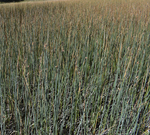
Cyperaceae: Schoenoplectus acutus
R. Neil Reese
Schoenoplectus acutus is a robust, rhizomatous evergreen perennial herbaceous graminoid that spreads aggressively through a dense network of thick, creeping rhizomes. The plant routinely achieves an height between 1.5 to 3.5 meters. Its erect, unbranched, dark green to gray-green culms (stems) are stout, round in cross-section, exceptionally firm, and filled with a spongy aerenchyma pith. The leaves are alternate, reduced and restricted near the base of the stem. Each culm usually has only 3 to 4 leaves, each with an elongated, open sheath with coarse fibers along the front and frequently red-tinged at the base, ending in a simple, V-shaped or flat leaf blade measuring 3 to 7 mm wide and up to a few centimeters long A tiny ligule is present where the blade meets the sheath. Flowering occurs from June to August, with a terminal, pseudo-lateral inflorescence that spans 5 to 15 cm long. It is composed of a rigid cluster of 3 to 40 ovoid spikelets borne on stiff, ascending branches, subtended by a solitary, erect, leaf-like bract that measures 2 to 10 cm long and acts as a visual continuation of the stem. The perianth is modified into 6 narrow, stable bristles that equal or slightly exceed the length of the fruit body, with retrograde barbs and a dull brown or straw color. The androecium consists of 3 stamens with distinct, linear, pale yellow to light brown anthers. The gynoecium features 1 pistil containing a superior ovary with a 2-fid (occasionally 3-fid) style and 2 plumose stigmas. The resulting fruit is a flattened or elliptic achene measuring 2.5 to 3.5 mm long (including a short apical beak), which transitions from a pale hue to a gray, dark brown, or blackish tone upon reaching full maturity from August through October. Hardstem bulrush is native to South Dakota and can be found distributed broadly across the state's wetland provinces, thriving within native marshlands, fens, mudflats, and the shallow margins of lakes and slow-moving river systems.
-
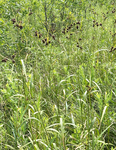
Cyperaceae: Scirpus atrovirens
R. Neil Reese
Scirpus atrovirens is a long-lived perennial, rush that anchors firmly into mud via a fibrous root system growing from short, stout, and tough underground rhizomes. The plant reaches a mature height of 1 to 1.5 meters, developing erect, unbranched, rigidly three-sided culms that are smooth and filled with pith. The leaves are arranged alternately along the lower half of the culms. They are simple, linear, flat, dark green, measuring up to 30 to 45 cm in length and 1 to 2 cm in width, with parallel venation and prominent cross-partitions on both surfaces. The leaf sheath is light green, closed, glabrous, and strongly septate; the collar is narrow and distinct; the ligule is a short, membrane-like, low-rim border. Flowering occurs from June to August. The inflorescence is a terminal, highly branched compound umbel measuring 5 to 15 cm across, consisting of several unequal rays bearing dense, crowded, spherical clusters of 10 to 30 sessile, ovoid spikelets that measure 3 to 8 mm long. The individual florets within the spikelets have a perianth that is modified into 5 or 6 straight, pale, persistent bristles that are downwardly barbed and roughly equal to or slightly longer than the fruit length. Each floret is subtended by an oval-elliptic, pointed, dark greenish brown to blackish scale measuring 1.2 to 2.1 mm in length. There are 3 stamens with pale yellow or whitish anthers that are less than 1 mm long. The gynoecium features a single, superior pistil with a weakly 3-sided ovary, a slender style, and 3 distinct, feathery stigmas. The fruit is a small, pale brown to creamy-white achene measuring 0.8 to 1.3 mm long and 0.4 to 0.6 mm wide, plumply 3-sided, and elliptic to urn-shaped. It reaches full maturity between July and September. Dark-green bulrush is native to South Dakota and can be found scattered in a few counties in marshes, wet meadows, roadside ditches, pond margins, and sloughs.