

-
This site is dedicated to Mrs. Dorothy Gill, a Dakota Elder, a mentor and friend.

-
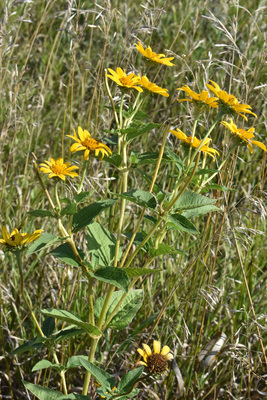
Rosaceae: Potentilla arguta
R. Neil Reese
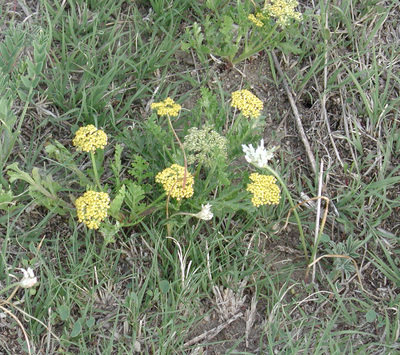
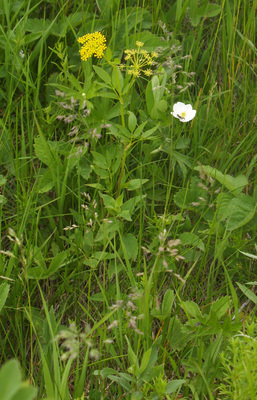
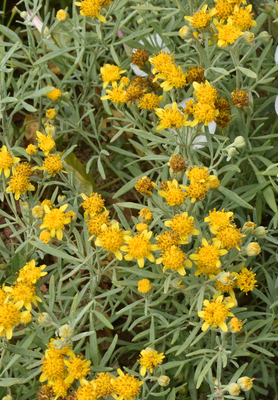
Potentilla arguta is a perennial herbaceous plant growing 30 to 90 cm tall from a fibrous root system. Stems are erect, slender, and often smooth or slightly hairy. The medium green leaves are compound, usually with five to seven leaflets arranged palmately. Leaflets are ovate to lanceolate, 2 to 6 cm long and 1 to 3 cm wide, with finely serrated margins and pointed tips. The texture is generally smooth to slightly hairy. Flowers are 1.5 to 3 cm wide and bloom June through August. Each flower has a calyx of five lanceolate sepals, 5 to 8 mm long and 2 to 3 mm wide, often with fine hairs on the edges and pointed tips that curve slightly outward; five bright yellow, broadly ovate to rounded petals, 8 to 15 mm long and 6 to 12 mm wide, with slightly notched tips. Numerous stamens surround the pistils; each stamen is slender, 4 to 6 mm long, with bright yellow anthers. The pistils are clustered centrally, each about 3 to 5 mm long, with slender styles topped by small, rounded stigmas. After fertilization, the pistils develop into a dense cluster of small achenes, each 2 to 3 mm long. Tall cinquefoil commonly grows in open woods, prairies, and along stream banks, favoring well-drained soils and sunny to partly shaded locations, mainly in the eastern and central parts of in South Dakota.
Synonym: Drymocallis arguta
-
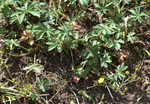
Rosaceae: Potentilla gracilis
R. Neil Reese
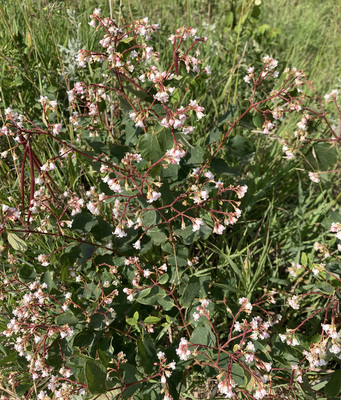
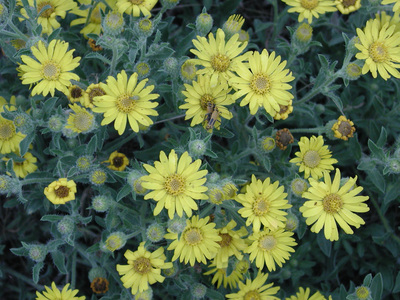
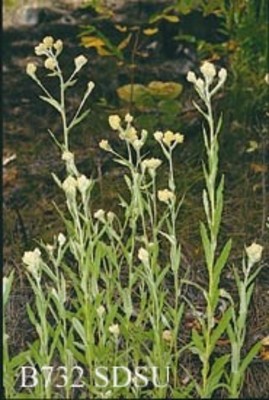
Potentilla gracilis is a perennial herbaceous plant growing 20 to 80 cm tall from a fibrous root system with slender, erect, and often slightly hairy, sometimes branched stems. The compound leaves typically have three to five slender, lanceolate to ovate leaflets, each 1.5 to 5 cm long and 0.5 to 2 cm wide, with finely serrated margins and petioles 1–5 cm long. The upper leaflet surface is medium to dark green with a smooth to slightly hairy texture, giving it a somewhat glossy appearance. The lower surface is lighter green, often paler or grayish-green, and usually has a more noticeable covering of fine hairs, giving it a soft, slightly fuzzy texture. The inflorescence is a loose cluster (cyme) of several bright yellow flowers blooming from June through August. The calyx consists of five lanceolate sepals, 4 to 7 mm long and 1.5 to 3 mm wide, often hairy along the edges with pointed tips that curve slightly outward, enclosing the flower before it opens. The flowers have five broadly ovate petals about 7 to 14 mm long and 5 to 10 mm wide. Numerous stamens with slender filaments approximately 3 to 5 mm long and bright yellow anthers surround the 20 to 40 pistils, which are clustered centrally, each 3 to 4 mm long with slender styles and small rounded stigmas. Fruit matures from August through September as an aggregate of small achenes, 2 to 3 mm long, tightly clustered after fertilization. Native to South Dakota, slender cinquefoil is commonly found in moist meadows, open woods, and along stream banks, especially in the central and western parts of the state.
-
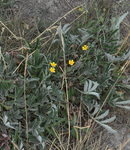
Rosaceae: Potentilla hippiana
R. Neil Reese
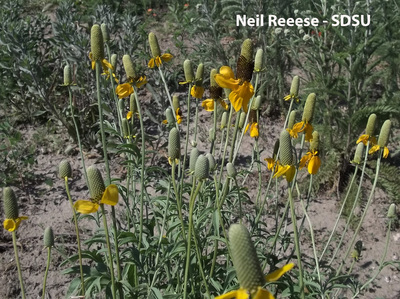
Potentilla hippiana is a perennial herbaceous plant growing 15 to 60 cm tall growing from a thick, woody rootstock. Its slender, erect stems are often hairy. The alternate, compound leaves typically have five to seven ovate to lanceolate leaflets, each 1.5 to 4 cm long and 0.5 to 2 cm wide, with finely serrated margins and a petiole 2 to 6 cm long. The upper leaf surface is medium green, mostly smooth to slightly hairy, while the lower surface is paler and covered with fine hairs, giving it a soft texture. The inflorescence is a loose cyme of bright yellow flowers that bloom from June through August. The calyx consists of five lanceolate sepals, 4 to 7 mm long and 1.5 to 3 mm wide, often hairy along the edges with pointed tips that curve slightly outward, enclosing the flower before it opens. Each flower has five broadly ovate petals, about 8 to 15 mm long and 5 to 12 mm wide. Numerous stamens with slender filaments, 3 to 5 mm long, and bright yellow anthers surround the pistils, which number around 20 to 40 per flower, each 3 to 4 mm long with slender styles and small rounded stigmas. Fruit matures from August through September as an aggregate of small achenes, 2 to 3 mm long, tightly clustered after fertilization. Native to South Dakota, Hipp's cinquefoil is commonly found in dry prairies, open rocky slopes, and well-drained soils, especially in the western and central parts of the state.
-
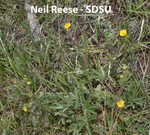
Rosaceae: Potentilla pulcherrima
R. Neil Reese
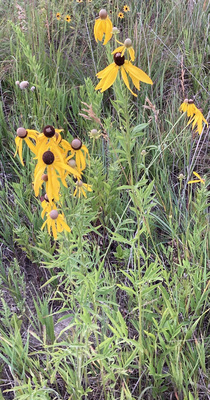
Potentilla pulcherrima is a perennial, herbaceous forb that arises from a thick, woody caudex or short branched rhizomes anchored by a sturdy taproot. The plant reaches a mature height of 20 to 76 cm and with erect to ascending, often reclining stems covered in dense, soft, spreading or appressed white hairs. The leaves display alternate and predominantly basal insertion; they are palmately or sometimes subpalmate-pinnately compound with 5 to 7 leaflets. Each leaflet is oblong to oblanceolate, 2 to 7 cm long, and explicitly characterized by coarsely toothed margins. The leaflets are a contrasting deep glabrous green on the upper surface and a starkly distinct, densely tomentose white or silvery-hairy color on the lower surface. Basal leaves possess long petioles measuring 5 to 15 cm in length, whereas the reduced upper stem leaves are nearly sessile; conspicuous, leaf-like, lanceolate stipules are consistently present at the base of the petioles. Flowering occurs from June through August. The inflorescence is a loose, terminal, cyme-like cluster holding several radially symmetrical flowers that span roughly 1.5 to 2 cm in diameter. The flowers are subtended by a calyx of 5 free sepals that are lanceolate, 4 to 7 mm long, green with white pubescence, and alternate with 5 slightly narrower bractlets . The corolla consists of 5 free petals that are obovate, slightly notched at the apex, bright yellow in color, and measures 6 to 10 mm long, comfortably exceeding the sepals. Inside the petals are 15 to 20 stamens that are short, yellow, and tightly arranged around the base of the receptacle. The pistils are numerous (often 20 to 40), small, separate, and contain a smooth ovary with a slender, filiform style and simple stigma attached near the middle of the ovary wall. The fruit is a cluster of smooth, dry, teardrop-shaped achenes that measure about 1.5 mm long, turning tan to dark brown at maturity between August and September. The beautiful cinquefoil is native to South Dakota, where it is found primarily in the western portion of the state within the Black Hills and high plains, thriving in moist mountain meadows, open forest clearings, and grassy montane valleys.
-
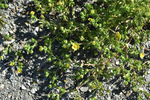
Rosaceae: Potentilla supina ssp. paradoxa
R. Neil Reese
Potentilla supina is an annual, biennial, or short-lived perennial herbaceous forb that develops from a slender taproot with sparse lateral roots. The plant typically reaches a height of 10 to 50 cm, producing multiple spreading, prostrate, reclining, or ascending stems from the base that are dichotomously branched and moderately to densely covered in fine, spreading hairs. Leaf insertion is alternate, featuring odd-pinnately compound leaves. The green leaves are composed of 2 to 5 pairs of leaflets; basal leaves are situated on long petioles up to 6 cm long, while cauline leaves feature highly reduced petioles or are nearly sessile. Individual leaflets are elliptic, oblong, or obovate, measuring 1 to 3 cm long and 0.5 to 1.5 cm wide, with deeply incised-serrate or pinnatifid margins. The upper and lower leaf surfaces are light to medium green and sparsely to moderately pubescent with short hairs, lacking any dense white-tomentose coating on the lower side. Membranous, ovate to lanceolate stipules are present at the base of the petioles, featuring entire to slightly dentate margins. Flowering occurs from May through September. The inflorescence is a much-branched, leafy, terminal cyme where small, solitary flowers arise from the forks of the branching stems on long, hairy peduncles. The calyx consists of 5 free, green, ovate-lanceolate sepals measuring 3 to 5 mm long and 1.5 to 2.5 mm wide, alternating with 5 prominent bractlets (epicalyx segments) that are similar in shape and often slightly longer or equal to the sepals. There are 5 free, obovate, yellow petals that measure approximately 2.5 to 4 mm long, typically shorter than or equal to the surrounding sepals. Within the corolla reside 10 to 20 small stamens featuring short, yellow filaments and yellow anthers. The pistil collection is numerous and tightly clustered on a central receptacle, featuring tiny ovaries, a smooth, terminal style that equals the ovary in length, and a simple, slightly widened stigma. The fruit structure consists of a dense head of small, asymmetrical, smooth or slightly ridged achenes measuring roughly 1 mm in length. These achenes transition from green to a yellowish-brown or tan color at maturity, which occurs from July through October, and are uniquely distinguished by a conspicuous, corky, swollen appendage on the inner margin. Bushy cinquefoil is native to South Dakota, where it is broadly distributed across the state, heavily concentrated along the sandy shoals, reservoirs, and floodplains of the Missouri River, as well as on wet sandy shores, sandbars, and mudflats.
Synonym: Potentilla paradoxa
-
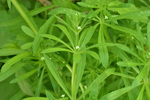
Rubiaceae: Galium aparine
R. Neil Reese
Galium aparine is an annual or biennial herbaceous plant growing from a fibrous root system and characterized by sprawling, weakly erect, square stems that can reach 30–100 cm in length. The stems and leaves are covered in tiny, hooked hairs, giving the plant a sticky or velcro-like feel, which helps it cling to other plants and surfaces for support. Leaves are arranged in whorls of six to eight, linear to lanceolate, 1–3 cm long and 2–5 mm wide, with rough margins. Flowering occurs from late spring through summer (May–August). Flowers are small and contain four sepals and petals. The sepals are green, small, triangular to lanceolate in shape, about 0.5 to 1 millimeter long. They form a tiny calyx cup at the base of the flower and often have fine hairs on their edges. The petals are white to greenish-white, and arranged like narrow, pointed stars. Each petal is about 1.5 to 3 millimeters long and about 2–3 mm wide, with a slightly notched or toothed tip, contributing to the star-like appearance of the flower. Flowers are bisexual, with four stamens and a pistil. Fruits are small schizocarps that separate into two mericarps covered with hooked hairs that stick to animals, clothing, and fur, aiding in seed dispersal. Cleavers are widespread in South Dakota in disturbed soils, woods, gardens, and along fences and roadsides.
-
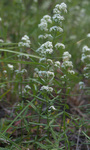
Rubiaceae : Galium boreale
R. Neil Reese
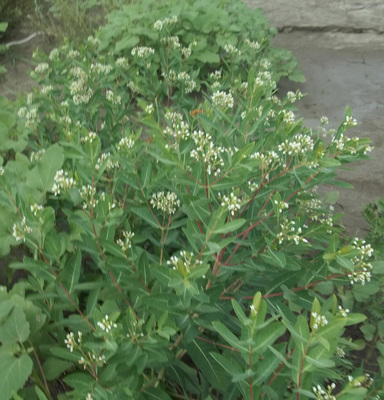
Galium boreale is a perennial herb growing from a creeping rhizome with numerous, erect, often branched stems, 20-70 cm tall, that have clusters of hairs below the nodes. The sessile, simple, linear to lanceolate leaves are in whorls of 4, 3-4 cm long, often with fascicles of smaller leaves in their axils. The inflorescence consists of showy, terminal cymose panicles. The flowers have a small tubular calyx, the corolla is wheel-like, 3.5-7 mm wide, with 4 white to occasionally yellowish, reflexed lobes. There are 4 stamens and a 2-carpled pistil with 2 styles. The fruit is dry, globose, 2 mm long schizocarp the spits into 2 seed-like parts. Northern bedstraw blooms from June into September in prairies, woodlands, hillsides and roadways, often forming large colonies, in the Black Hills, the Coteau des Prairies and norther counties of South Dakota.
-
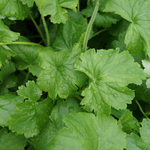
Saxifragaceae : Heuchera richardsonii
R. Neil Reese
Heuchera richardsonii is a perennial herb from a stout, branched caudex with 1 or a few softly hairy stems, 15-70 cm tall. The leaves are basal with long petioles, the blades are heart to kidney shaped, 3-8 cm wide with 5-7 rounded lobes, smooth and green on top and lighter with hairs on the lower surface. The inflorescence is a raceme to narrow panicle, with glandular hairs, 5-20 cm long, the flowers in clusters of 2-6. The flowers have a green, well-developed, irregular, tubular hypanthium with 5 rounded lobes and short glandular hairs on the outer surface. The 5 stamens have orange anthers and are exerted from the floral tube. The 2 upper lobes of the tube are longest and tend to drape over the stamens. Although the flower color is usually green, it can becomes yellowish brown or reddish in sunnier locations. The 2-carpeled, partially inferior pistil is tapered into 2 styles up to 2.5 mm long. Prairie alumroot blooms in June and July in open woodlands and prairies in counties scattered throughout South Dakota.
-
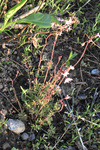
Saxifragaceae: Lithophragma glabrum
R. Neil Reese
Lithophragma glabrum is a perennial, herbaceous wildflower growing from a slender rhizome. Stems are slender, erect or ascending, and generally 15–50 cm tall. Leaves are alternate or basal, deeply lobed into 3 to 7 narrow segments, each leaflet about 1–3 cm long and 0.5–1.5 cm wide, with entire margins. The leaves are petiolate, with delicate stalks attaching them to the stem. Flowering occurs in late spring to early summer (May–July). Flowers have five separate, ovate to lanceolate sepals approximately 5 to 10 mm long and 1.5 to 3 mm wide, which are smooth and glabrous. The five petals are also separate, about 10 to 20 mm long and 3 to 7 mm wide, deeply lobed or divided into narrow linear segments, and white to pale pink in color. Flowers have ten stamens and a superior ovary with a style and stigma. The fruit is a capsule that splits open to release numerous tiny seeds. In South Dakota, Smooth woodland star is native and found in dry open woods, rocky slopes, and foothills, particularly in the Black Hills region.
-

Scrophulariaceae: Castilleja angustifolia var. dubia
R. Neil Reese
Castilleja angustifolia var. dubia is a perennial herb growing from a woody, branching taproot and may form small clumps. Stems are erect, simple or occasionally branched near the base, typically 10–40 cm tall, and covered with short, soft, grayish or white hairs (pubescent). Leaves are alternate, narrow, linear to lanceolate, 2–6 cm long and 1–5 mm wide, entire or with a few shallow lobes, and are also softly hairy. Only cauline leaves are present; there is no basal rosette. Flowering occurs from late spring to early summer (May–July). Inflorescences are terminal, forming dense, spike-like clusters of brightly colored bracts and small, tubular flowers. Bracts are bright red to orange-red (sometimes yellow), 1–2.5 cm long, and often deeply divided at the tip. The actual flowers are inconspicuous, tubular, greenish to yellowish, 2-lipped, and about 1.5–2.5 cm long, partly hidden among the bracts. Each flower has a calyx with four lobes, a tubular corolla, four stamens, and a single style. The fruit is a small, oval capsule (8–12 mm) containing numerous tiny, brown, dust-like seeds, maturing in midsummer. Narrowleaf Indian paintbrush is native to South Dakota, particularly in dry prairies, sagebrush flats, rocky hillsides, and open pine woodlands. It is most commonly found in the western part of the state, including the Black Hills and Badlands.
Synonym: Castilleja chromosa
-
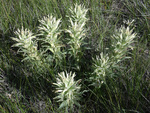
Scrophulariaceae : Castilleja sessiliflora
R. Neil Reese
Castilleja sessiliflora is a perennial herb with simple, hairy, ascending to erect stems, 10-30 cm tall, growing from a woody crown. The simple, sessile, alternate, linear leaves are entire, or with the upper most having divergent lobes. The inflorescence is a spike with the flowers subtended by hairy, leafy bracts, shorter than the flowers, that become reduced and are often pink tipped toward the top. The calyx tube is 25-40 mm long, with primary lobes 12-20 mm long and the final with linear segments, 8-14 mm long. The corolla is purplish to yellow to cream colored, 35-55 mm long, forming a curved tube, with a prominent lower lip and conspicuously exerted beyond the bracts. The fruit is an ovate capsule. Downy paintbrush blooms from early May into July on dry plains and hillsides throughout South Dakota.
-
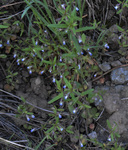
Scrophulariaceae: Collinsia parviflora
R. Neil Reese
Collinsia parviflora is an annual or annual-biennial herb growing from a fibrous root system. The plant usually reaches 10–40 cm in height, with slender, erect, and often branched stems that can be smooth or sparsely hairy. Leaves are opposite, simple, ovate to lanceolate, typically 1–4 cm long and 0.5–1.5 cm wide, with entire or slightly toothed margins and a slightly hairy surface. Flowering occurs from late spring through summer (May–August). Inflorescences are dense terminal racemes or spikes with small, two-lipped flowers about 5–8 mm long. Flowers are typically pale blue to lavender, sometimes with darker markings or white areas on the lower lip. The sepals are fused into a tubular calyx approximately 3–5 mm long and 1.5–2 mm wide at the widest part. The calyx ends in five narrow, pointed lobes each about 1–2 mm long. The is tubular corolla has 5 lobes forming the two distinct lips, measuring about 6–10 mm long and approximately 3–5 mm wide at the expanded lower lip. The upper lip is divided into two small lobes about 1–2 mm long, while the lower lip has three broader lobes approximately 2–4 mm long and 2–3 mm wide. There are 2 stamens and a single pistil. The fruit is a small, round capsule (2–3 mm), maturing in midsummer, containing several tiny seeds. Small-flowered blue-eyed Mary is native to South Dakota and commonly found in open woodlands, grasslands, dry slopes, and disturbed areas, especially in upland and foothill regions statewide.
-
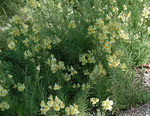
Scrophulariaceae : Linaria vulgaris
R. Neil Reese
Linaria vulgaris is a perennial from a taproot, with 1-several, simple or branched, ascending to erect stems, 30-60 cm tall. The simple, linear leaves are 2.5-5 cm long, 2-6 mm wide, with a pointed end and tapering to a petiolate base. The inflorescence is a crowded, terminal, bracteate raceme. The calyx is deeply 5-parted, the segments unequal, lanceolate and ~ 3 mm long. The yellow corolla is strongly bilabiate and spurred. The upper lip is 8-12 mm long, the lower lip has an orange, hairy palate that is 6-9 mm long, with a straight spur 8-14 mm long. there are 2 short and 2 long stamens, a single pistil with a 2-lobed stigma. The fruit is a globose capsule, 5-9 mm long. Butter and eggs blooms from June into August in disturbed places throughout South Dakota.
-
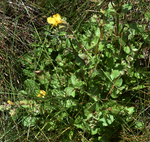
Scrophulariaceae: Mimulus guttatus
R. Neil Reese
Mimulus guttatus is an annual or perennial herbaceous forb supported by a fibrous root system that frequently develops creeping stolons or rhizomes. The plant typically reaches a height of 38 up to 76 cm, featuring erect or trailing, hollow, square stems that are glabrous to minutely pubescent. Leaf insertion is opposite along the stem. The leaves are simple, green, ovate-elliptic to suborbicular, measuring 4 to 125 mm long and 1 to 2 times longer than wide. The leaf surfaces are generally glabrous, with margins that range from crenate to coarsely dentate or irregularly small-lobed at the base. Lower leaves feature distinct petioles up to 95 mm long, whereas upper leaves lack petioles and clasp the stem. Flowering occurs from April to September in terminal racemes consisting of 1 to 28 bilaterally symmetrical flowers. The fruiting calyx is an inflated, compressed, campanulate structure measuring 11 to 20 mm long, featuring 5 fused, unequal, green sepals. The corolla is composed of 5 fused, vibrant yellow petals that form a two-lipped funnelform tube 12 to 20 mm long, characterized by a bearded throat adorned with prominent red spots. Inside the corolla are 4 didynamous, glabrous, cream-colored stamens that are included within the tube. The single pistil features a minutely hairy style and a two-lobed stigma that closes upon contact. The fruit is a dry, oval capsule 7 to 12 mm long that matures from mid-summer through autumn, splitting open to release hundreds of microscopic seeds. The seep monkeyflower is native to South Dakota, where it can be found primarily in the western part of the state (Black Hills), thriving in wet meadows, seeps, springs, and stream banks.
Synonym: Erythranthe guttata
-
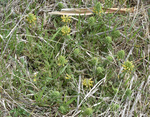
Scrophulariaceae: Pedicularis canadensis
R. Neil Reese
Pedicularis canadensis is a perennial herb growing 15 to 50 cm tall from a fibrous root system, sometimes stoloniferous. The leaves are chiefly basal and petiolate, with petioles 5 to 15 cm long. Each leaf is pinnately compound with 7 to 15 lanceolate to oblong leaflets, each 2 to 5 cm long and 0.5 to 1.5 cm wide, with serrate margins and a slightly hairy surface. The upper leaves are progressively reduced, becoming nearly sessile. The erect flowering stems bear dense spikes of tubular, bilaterally symmetrical flowers blooming from May through July. Each flower has five green, lanceolate sepals about 5 to 7 mm long and 1.5 to 2.5 mm wide. The corolla is creamy white to pale yellow, about 15 to 20 mm long and 6 to 8 mm wide, with an upper curved lip forming a hood and a lower lip with three lobes. The flower contains four stamens with two long and two short filaments, and the anthers are fused into a tube surrounding the style. The pistil has a superior ovary with a style about 7 to 9 mm long, ending in a bifid stigma. Fruits develop from June through August, maturing into ovoid capsules 8 to 12 mm long and 3 to 5 mm wide, which split open to release numerous small seeds. Canadian lousewort is native to South Dakota, found primarily in the eastern and central parts of the state growing in prairies, open woodlands, and sandy or rocky soils.
-
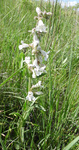
Scrophulariaceae : Penstemon albidus
R. Neil Reese
Penstemon albidus is a perennial herb arising from a short-branched caudex, with 1-5 hairy, ascending to erect stems, 15-50 cm tall. The basal leaves are petiolate, lanceolate to obovate, 2-10 cm long and 7-20 mm wide, the margins entire to finely toothed. The cauline leaves are simple, sessile, opposite, lanceolate to lance-ovate, 2.5-6.5 cm long and 7-20 mm wide, the tips pointed with entire to finely toothed margins. The inflorescence consist of 3-10 opposite pairs of flower clusters on short, peduncles arising from leaf axils in the upper plant, each cluster with 2 to 7 short-pedicellate flowers. The calyx is covered with glandular hairs, with 5 lobes, 4-7 mm long. the weakly bilabiate corolla is white to light pink, funnel-shaped, 6-8 mm wide with red-purple nectar guides on the inside. The lower lip has 3 nearly equal, downward pointing lobes, the upper lip is erect, with 2 lobes only slightly smaller than the lower lobes. There are 4-fertile (2-short, 2-Long) stamen and a sterile staminode. The fruit is an ovoid capsule 8-12 mm long. White beardtongue blooms from April into July on open prairies and hillsides throughout South Dakota.
-
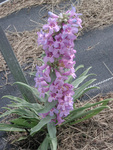
Scrophulariaceae : Penstemon angustifolius
R. Neil Reese
Penstemon angustifolius is a perennial herb arising from a short-branched caudex, with 1-10, ascending to erect stems, 15-50 cm tall, often with a waxy coating. The basal thick leaves are sessile to having a short, winged petiole, linear to oblanceolate, 4-9 cm long and 2-18 mm wide, the margins entire. The cauline leaves are simple, sessile, clasping, opposite, linear to lanceolate, 3-11 cm long and 2-24 mm wide, the tips pointed with entire margins. All of the leaves are generally covered with a blue waxy coating. The inflorescence consist of 5-15 opposite pairs of flower clusters on short, peduncles arising from leaf axils in the upper plant, each cluster with 4 to 8 short-pedicellate flowers. The calyx is smooth and waxy, sometimes with a few short hairs, with 5 lobes, 4-8 mm long. The bilabiate corolla is white to lavender to blue, tubular, 14-20 mm long, 4-6 mm wide with violet to red-purple nectar guides on the inside. The 3 lobes of the lower lip and 2 lobes of the upper lip are slightly reflexed with a few white hairs on the inside of the lower lip. There are 4-fertile (2-short, 2-Long) stamen and a sterile staminode, that is bearded with yellow hairs. The fruit is an ovoid capsule 9-14 mm long. Narrowleaf beardtongue blooms in May and June on open prairies and sandhills in western South Dakota.
-
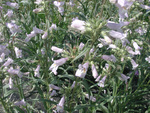
Scrophulariaceae: Penstemon gracilis
R. Neil Reese
Penstemon gracilis is a perennial herb with 1-several erect stems growing from a woody caudex, generally 20-50 cm tall and often reddish colored with glandular hairs toward the top. The simple basal leaves have a short, winged petiole, the lanceolate to ovate blade 2.5-7.5 cm long and 4-15 mm wide, with a few to many teeth. The linear to lanceolate cauline leaves are opposite, clasping the stem, 2.5=9 cm long and 2-15 mm wide, with similarly toothed margins. The leaves are smooth to sparsely hairy. The inflorescence is a panicle, 5-21 cm long, of 2-6 flowered axillary cymes. The 5 calyx lobes are 4-6 mm long and up to 2 mm wide, with glandular hairs. The corolla is bilabiate, 15-22 mm long, pale lavender to pink externally and lighter colored within. The slender corolla tube has glandular hairs, the throat is 4-6 mm wide, with darker lines inside and a beard of whitish hairs going back about halfway. The upper lip is reflexed, and the lower lip extended. The 4 black-tipped stamens hug the upper surface, and a sterile lower stamen forms a beard of yellow hairs. The fruit is a 6-8 mm long capsule. Slender beardtongue blooms from May to August on sandy or gravelly soil in prairies, valleys, and at lower elevations in mountains throughout much of South Dakota.
-
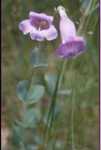
Scrophulariaceae : Penstemon grandiflorus
R. Neil Reese
Penstemon grandiflorus is a weakly perennial herb with 1-3 erect, smooth, waxy stems arising from a woody caudex growing up to about 1 m tall. The blue-green leaves are both basal and cauline, thick (succulent) and often covered in a waxy bloom, with entire margins. The basal and lower most stem leaves are shortly petiolate, spatula-shaped to orbicular, 3 to 16 cm long, 1-5 cm wide, rounded to pointed at the tip and tapering at the base. The sessile, opposite, ascending cauline leaves are 2- 9 cm long, 1.5-5 cm wide, more broadly egg-shaped, clasping at the base and reduced to bracts on the upper stem. The inflorescence consists of 3-9 clusters of flowers, with peduncles arising in the axils of the upper leaves, each cluster having 2-4 flowers on short pedicels. The green calyx has 5 lobes, 7-11 mm long. The bilabiate corolla is 35-48 mm long, abruptly inflated, lavender to bluish purple in color, the throat 15-18 mm wide, with magenta nectar guides on the inside. The lobes of the upper lip are spreading to reflexed, the lower lips spreading. The style and 4 stamens with black anthers hug the upper part of the tube and a white sterile stamen with a few yellow hairs on its tip is contained within the tube. The fruit is an ovoid capsule, 16-25 mm long containing several black to brown seeds up to 4 mm long. Large-flowered beardtongue blooms in May and June on prairies scattered throughout South Dakota.
-
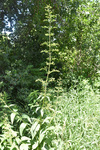
Scrophulariaceae : Scrophularia lanceolata
R. Neil Reese
Scrophularia lanceolata is a perennial herb growing 30 to 90 cm tall from a fibrous root system. The stems are erect, square in cross-section, and slightly hairy to glabrous. Leaves are opposite, simple, and lanceolate to ovate-lanceolate, 5 to 12 cm long and 2 to 5 cm wide, with serrated margins and a pointed tip, dark green above and lighter beneath. The plant flowers from June through August. The inflorescence is a terminal or axillary cyme with small tubular flowers about 10 to 15 mm long. Each flower has five free, greenish sepals that are ovate and about 2 to 3 mm long, and five free, reddish to purplish petals fused at the base forming a tubular bilabiate, corolla with spreading lobes. The upper lip 2-lobed and the lower lip shorter with 3 lobes. There are four stamens per flower, with filaments about 6 to 8 mm long inserted inside the corolla tube and yellow anthers approximately 2 to 3 mm long. The pistil is single with one locule, about 5 to 7 mm long, a style 3 to 4 mm long, and a bilobed stigma. The fruit is a dry, ovoid capsule about 8 to 12 mm long that ripens in late summer and splits open to release numerous small seeds. Lanceleaf figwort is native to South Dakota, occurring in open woods, prairies, and along roadsides throughout much of the state.
-
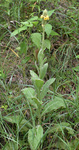
Scrophulariaceae: Verbascum thapsus
R. Neil Reese
Verbascum thapsus is a biennial herbaceous plant with a deep taproot. In the first year, it forms a dense basal rosette of large, soft, woolly leaves; in the second year, it produces a tall, erect flowering stem reaching 1–2.5 meters in height. Stems are stout, covered densely with soft, woolly hairs, giving a silvery-gray appearance. Leaves are alternate, simple, broadly ovate to lanceolate, 10–40 cm long and 5–20 cm wide, with entire or slightly wavy margins and acute to rounded tips. Both leaf surfaces are densely covered with soft, velvety hairs. Petioles are short or absent in basal leaves and longer in stem leaves. Flowering occurs from June to September, with inflorescences forming a large, dense, spike-like raceme up to 60 cm long, bearing numerous yellow, five-petaled flowers. The calyx consists of five green, ovate sepals, 7–10 mm long, free and slightly hairy. The corolla has five bright yellow petals, 15–25 mm long and 10–15 mm wide, fused at the base and spreading widely. Each flower has five stamens with filaments covered in purple glandular hairs and yellow anthers about 3–5 mm long. The pistil is single, with a superior ovary, slender style, and bifid stigma. The fruit is a small, ovoid to ellipsoid capsule, 4–6 mm long, containing numerous tiny seeds, maturing from August to October. Common mullein is introduced in South Dakota, native to Europe and Asia, and commonly found in disturbed sites, roadsides, fields, and waste areas, thriving in well-drained, sandy to loamy soils under full sun.
-
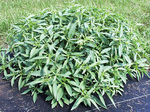
Solanaceae : Physalis longifolia
R. Neil Reese
Physalis longifolia is a perennial herb from a deep caudex and spreading by shoots from lateral roots. The erect stems are erect, often branching, and typically covered with fine hairs, giving them a somewhat rough texture, 30-100 cm tall, often purplish, with a few sparse hairs, especially on younger shoots. The simple, alternate leaves have petioles 1-6 cm long and the blades are lanceolate to lance-linear or occasionally rounder approaching ovate, 3-13 cm long and 1-7 cm wide. The margins vary greatly from entire to wavey to unevenly toothed. Flowering occurs from late spring to late summer (May–August). The flowers are usually single on a slender pedicel, 5-15 mm long that increases as fruit develop. Flowers are axillary, solitary, nodding, about 1–2 cm wide. At flowering, the calyx consists of five green sepals 7-12 mm long, that are fused at the base with free lobes about half of the length, pointed at the tips and have fine hairs along their margins, giving the calyx a slightly fuzzy texture. The calyx forms a bell-shaped structure that surrounding the base of the corolla. The corolla has five yellow petals, 10-15 mm long, marked with brownish purple spots near the center. The petals are fused at the base forming a bell shape. There are 5 stamens with yellow anthers, the filaments flattened and nearly as wide as the anthers. The fruit is a globose berry, maturing from August through October, yellow when ripe, 8-15 mm in diameter, surrounded by the papery calyx that extends to 2-3 cm in length. Longleaf ground cherry is native to South Dakota and commonly found in dry, open habitats such as prairies, sandy soils, roadsides, and disturbed areas, mainly in the central and western parts of the state.
-
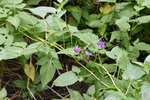
Solanaceae: Solanum dulcamara
R. Neil Reese
Solanum dulcamara is a perennial, woody, semi-climbing vine or scrambling shrub that can reach lengths up to 3 meters. The stems are slender, flexible, and covered with fine hairs, giving a slightly rough texture. Leaves are alternate and simple, broadly ovate to lanceolate with 2 to 5 deep lobes, measuring 3 to 9 cm long and 2 to 7 cm wide. The upper leaf surface is smooth and dark green, while the lower surface is lighter and may have fine hairs. Petioles are slender and typically 1 to 5 cm long. . The plant flowers from May through September. The inflorescence is a terminal or axillary cluster of star-shaped, purple to violet flowers about 15 to 25 mm in diameter. Each flower has five free, pointed green sepals about 5 to 8 mm long and 2 to 3 mm wide. The petals are fused at the base, forming a shallow star shape with five lobes, each petal is 10 to 15 mm long and 5 to 8 mm wide, with wavy or slightly curled margins. There are five stamens per flower with yellow anthers about 3 to 5 mm long, which release pollen by pores (poricidal dehiscence). The pistil has a single ovary with two fused carpels forming two locules, a style about 5 to 7 mm long, and a small stigma. The fruit is a bright red, oval berry about 10 to 15 mm long that ripens from July to October, containing numerous small seeds. Bittersweet nightshade is native to Europe and Asia but is naturalized and considered invasive in South Dakota, where it grows in wetlands, along streams, roadsides, and disturbed sites.
-
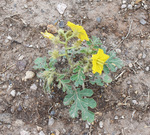
Solanaceae: Solanum rostratum
R. Neil Reese
Solanum rostratum is an annual, herbaceous plant with a taproot system. It typically grows 30–100 cm tall. The stems are erect or spreading, densely covered with yellow prickles and stellate hairs, giving them a rough texture. Leaves are alternate, simple, and deeply pinnatifid, measuring 5–15 cm long and 3–10 cm wide, with oblong to ovate lobes. Both upper and lower surfaces are green and densely pubescent with star-shaped hairs; petioles are present, 2–8 cm long, and also prickly. Flowering occurs from June to September, with solitary or few-flowered inflorescences (cymes) arising in the leaf axils, each flower about 2–3 cm in diameter. The calyx has five sepals, 8–15 mm long and 3–6 mm wide, lanceolate, green, fused at the base, and armed with prominent yellow spines. The corolla consists of five bright yellow petals, 18–25 mm long and 10–18 mm wide, fused at the base and forming a star shape. There are five stamens, markedly unequal in size; one is much longer than the others, with anthers 6–10 mm long, yellow, and prominently projecting from the flower. This stamen arrangement is a key distinguishing feature, with one larger anther adapted for attracting pollinators and the others for pollen transfer. The pistil is single, with an ovary about 3–4 mm in diameter; the style is slender, 7–10 mm long, and the stigma is slightly capitate and greenish, just above the level of the anthers. The fruit is a globose berry, 1–1.5 cm in diameter, green when immature and turning yellow at maturity, enclosed in a spiny calyx; fruits mature from August to October. Buffalo bur is native to South Dakota, it occurs in disturbed habitats such as roadsides, fields, and overgrazed pastures, establishing readily in sandy or gravelly soils.
-
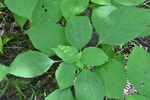
Urticaceae: Laportea canadensis
R Neil Reese
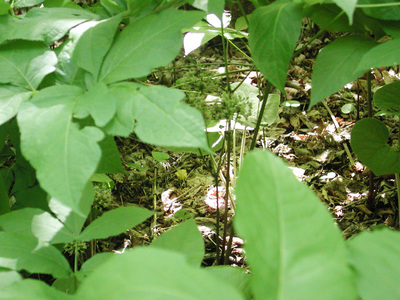
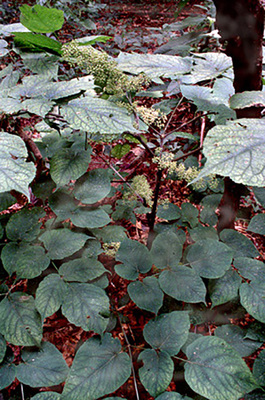
Laportea canadensis is an unbranched, rhizomatous, perennial herb growing 40-100 cm tall. The stems, petioles, inflorescence branches and sometimes the leaf midribs are sparsely to densely covered with stinging hairs. The simple, alternate, petiolate leaves have ovate to elliptic blades, 8-20 cm long and 5-13 cm wide, rounded at the base and pointed at the tip, with petioles 3-11 cm long. The blade margins are toothed and the surfaces are smooth to covered in short bristly hairs. The plants are monoecious with the flowers in clusters in the upper leaf axils, female flowers above, reaching above the leaves and the male flowers below, not exceeding the leaves. The minute male flowers have 5 sepals and 5 stamens and the female flowers have 4 sepals, the inner pair larger than the outer pair which often abort. The fruit is an achene enclosed by the inner sepals. Wood nettle blooms from July into September in moist woods in eastern South Dakota.