

-
This site is dedicated to Mrs. Dorothy Gill, a Dakota Elder, a mentor and friend.

-
Portulacaceae : Lewisia pygmaea
R. Neil Reese
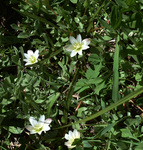
Lewisia pygmaea is a small perennial herbaceous plant forming low mats or small rosettes typically 2 to 10 cm tall. It has a fleshy, thickened taproot (caudex). The stems are short and mostly absent or very reduced, often hidden among the leaves. Leaves are basal, simple, fleshy, and linear to spatulate, measuring about 1 to 4 cm long and 2 to 5 mm wide. Leaf margins are entire, and surfaces are smooth and succulent. The inflorescence is a solitary flower or small cluster of flowers on short stalks, flowering from late spring to early summer (May–July). Flowers are star-shaped with 5 to 9 petals, each petal about 5 to 12 mm long and 3 to 6 mm wide, broadly ovate to spatulate, and typically white to pale pink with darker pink or reddish veins. The calyx consists of 5 to 7 sepals that are narrow and lanceolate, about 3 to 6 mm long, often reddish or greenish. The flowers have numerous stamens and a superior ovary. The fruit is a capsule that releases many small seeds. In South Dakota, Alpine bitterroot is native and found in alpine and subalpine rocky outcrops and well-drained mountainous soils in the Black Hills region.
-
Potamogetonaceae: Potamogeton nodosus
R. Neil Reese
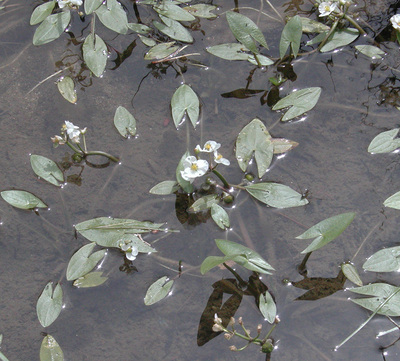
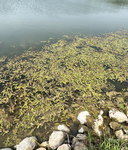
Potamogeton nodosus is a perennial, herbaceous aquatic plant that anchors into the substrate via a fibrous root system arising from creeping, extensively branched rhizomes. The plant reaches a length matching its water depth, typically ranging from 1 to 2 meters, with a round, slender, and highly branched stems. It exhibits distinct heterophylly with two leaf types: floating leaves are alternate, simple, leathery, elliptic to oblong, bright green to brownish, 5 to 13 cm long, and 2 to 5 cm wide, featuring a smooth upper surface and a pale lower surface; submerged leaves are alternate, simple, thin, translucent, linear-lanceolate, 9 to 20 cm long, and 1 to 3 cm wide. Both leaf types possess distinct petioles, with floating leaf petioles measuring up to 15 cm long, while submerged petioles are shorter (2 to 10 cm). Free, prominent, brownish stipules are present in the leaf axils, measuring 3 to 10 cm in length and eventually decaying into fibers. Flowering occurs from June to September, displaying a dense, cylindrical spike inflorescence that measures 2 to 6 cm long and rises above the water surface on a stout peduncle. The flowers have 4 clawed, sepal-like, brownish-green perianth segments (tepals) that are free, about 2 mm long, and rounded. The flowers contain 4 stamens that are sessile, less than 1 mm long, and structurally fused to the base of the tepals, bearing pale yellow anthers. The gynoecium consists of 4 separate pistils, each about 1.5 to 2 mm long, featuring a short, thick style and a capitate, papillose stigma. The fruit is a drupelet measuring 3 to 4 mm long, obovoid, brownish-red to orange-brown, featuring a distinct dorsal keel and a short beak, reaching maturity from August to October. American pondweed is native to South Dakota and can be found statewide in slow-moving streams, rivers, ponds, lakes, and marshes.
-
Primulaceae : Dodecatheon pulchellum
R. Neil Reese
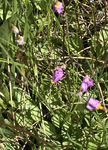
Dodecatheon pulchellum is a perennial herb growing from white, fibrous roots and having erect flowering stems (scapes) that reach up to 50 cm in height. The simple leaves arise from a woody caudex, forming a basal rosette. The oblanceolate to spatulate leaf blades are gradually tapered into a petiole, 4-25 cm long including the petiole, 1-6 cm wide, with entire margins. The inflorescence is a few to many flowered umbel, subtended by a few bracts < 1.5 cm long, with pedicels 1-5 cm long at flowering. The calyx tube is 2-4 mm long with pointed lobes 2-6 mm long. the yellow and red corolla tube has magenta to lavender, reflexed lobes that are 9-20 mm long. the yellow stamens are inserted opposite the corolla lobes, fully protruding and surrounding the style. The fruit is a many-seeded cylindric to ovoid capsule, 7-17 mm long and 4-7 mm wide. Shootingstars bloom in May and June in moist prairie meadows and open woodlands in western South Dakota.
Synonym: Primula pauciflora
-
Ranunculaceae: Aconitum columbianum
R. Neil Reese
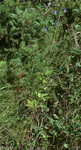
Aconitum columbianum is a perennial herbaceous plant typically growing 30 to 100 centimeters tall with erect, unbranched to sparsely branched stems. Leaves are alternate, deeply palmately lobed, usually with 3 to 5 broad, pointed lobes, 5 to 12 centimeters long excluding petioles, which range from 3 to 8 centimeters long and are slender. Flowering occurs from midsummer to early fall, producing several large, showy flowers arranged in terminal racemes. Each flower measures about 3 to 5 centimeters long, with five sepals—the upper sepal forming a distinctive hood or “helmet” 2 to 3 centimeters long that is typically dark purple to blue, while the lateral sepals are smaller and petal-like, approximately 1 to 1.5 centimeters long. Petals are nectar-producing and hidden within the sepals, generally two petals having elongated nectaries curved beneath the hood, about 1 to 2 centimeters long. The flower contains numerous stamens with slender filaments and small anthers clustered around a superior ovary. The pistil consists of multiple free carpels (apocarpous), each with a single ovule, a short style, and stigma. Fruits develop as a cluster of follicles, each follicle 2 to 3 centimeters long and elongate, opening to release numerous small seeds by late summer. Columbian Monkshood favors moist, shady sites—streambanks, wet meadows, montane forests—at mid to high elevations across western North America, including the Black Hills of South Dakota.
-
Ranunculaceae: Actaea rubra
R Neil Reese PhD
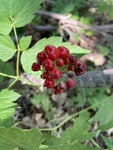
Actaea rubra is a perennial herb 50-90 cm tall with a somewhat woody base. Stems usually unbranched, glabrous below and puberulent above. There are 1-3 alternate cauline leaves, pinnate to triternate-pinnate, the largest with a long petiole up to 16 cm long. The leaf blades are 15-35 cm long, the ultimate leaflets are broad and irregularly toothed. The inflorescence is a terminal raceme, 1-3 cm long in flower and up to 10 cm in fruit. The small flowers have 3-5 sepals, 2.4-3.7 mm long and 3-5 (10) white, spatulate petals, < 3.5 mm long, both rapidly lost after the flowers open. Baneberry has numerous stamens and a single pistil. The fruit are red or white 9-16 seeded berries, 7-13 mm in diameter. They bloom in May and June in moist soils in wooded areas along the western and easter borders of South Dakota.
-
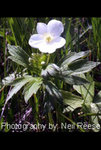
Ranunculaceae: Anemone canadensis
R. Neil Reese
Anemone canadensis is a perennial herb, which grows 10 cm to 60 cm in height, growing from ascending caudices on long, thin rhizomes. The leaves are basal and mostly long-petioled with 3 to 5 lobes which are sharply toothed. The flowers have 5 (4-6) white, petal-like sepals which are obovate 10–20 mm long by 5–15 mm wide. There are 80-100 yellow stamens surrounding a cluster of pistils. The fruiting body is a cluster of achenes 9-16 mm long by 12-19 mm wide. Meadow anemone blooms from May to July in moist prairies, woodlands and meadows throughout much of South Dakota.
-
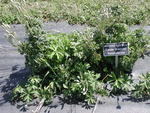
Ranunculaceae: Anemone cylindrica
R. Neil Reese
Anemone cylindrica is a perennial herbaceous forb that grows from a stout caudex forming clumps. The pubescent stems are upright growing 30–70 cm tall. The leaves cauline are 3-7 lobed 2.5 – 6.5 cm long with petioles from 1-5 cm long. The leaf lobes are jaggedly toothed and pubescent, especially on the bottom. The basal leaves are similarly shaped, 5-14 cm wide with petioles that reach 21 cm in length. The flowers are 1-7 in number 1.5-2 cm in diameter, with 4-6 white sepals and bloom in June and July. There are numerous stamens and a cylindrical arrangement of pistils. In fruit te achenes are arrayed on a cylinder 1.5-3.5 cm long and 7-11 mm wide. The achenes are covered by a wooly white pubescence. Candle anemone can be found throughout South Dakota growing in open prairies and pastures.
-
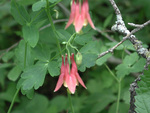
Ranunculaceae : Aquilegia canadensis
R Neil Reese
Aquilegia canadensis is a perennial herb growing 30 to 100 cm tall from a stout caudex. The stems are hollow, smooth to covered with small glandular hairs towards the tops. Stems come from clusters of ternate basal leave and have alternate biternate (occasionally triternate) leaves on the flowering stems. The individual lobes are wedge-shaped and shallowly to deeply lobed. The showy flowers are nodding, regular, 2-5 cm long from tips of the stamens to the ends of the spurs and 1.7-4.3 cm wide. Five rose to dull red colored sepals, 0.9-2 cm long alternate with 5 petals, that are red toward the base and yellowish on the upper parts. The base is formed into a narrow spur that is slightly enlarged at the tip and measure 2-3.6 cm long from the end of the spur to the opening at the upper end. The stamens are numerous and exerted from the corolla. There are 5 carpels that mature into 5 follicles, 1.2-3 cm long with a styler beak that is 0.9-1.8 cm in length and contain several small black seeds. Flowers bloom from April to June. The plants grow in moist soils in wooded areas in several eastern and western counties in South Dakota.
-
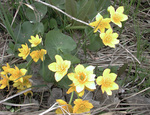
Ranunculaceae: Caltha palustris
R. Neil Reese
Caltha palustris is a fleshy perennial herb with a fibrous root system and hollow stems that grow from 20 to 80 cm in height. This species has both basal and alternate cauline leaves. The blades are nearly round with a chordate base and toothed margins, 3-12 cm long and 4-15 cm wide, with petioles that can reach 30 cm in length and form a stipule-like sheath at the node. The showy flowers are terminal and axillary, with usually 5-6 yellow petal-like sepals, 1-2.3 cm long. There are no petals, numerous stamens and 5-10 pistils. The fruit are recurved and divergent follicles, 8-17 mm long cand contain many small seeds ~ 2mm in diameter. Marsh marigolds bloom in April and May in wet woods, marshes and bogs, often in standing water, in eastern South Dakota.
-
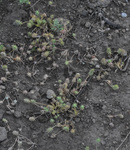
Ranunculaceae: Ceratocephala testiculata
R. Neil Reese
Ceratocephala testiculata is a small annual herb growing from a slender, often shallow, fibrous root system. The entire plant is usually less than 5–10 cm tall. Stems are typically branched at the base, sparsely hairy to nearly glabrous, and not woody. Leaves are all basal, forming a loose rosette, deeply divided into narrow linear to lobed segments. Basal leaves can reach up to about 6–12 cm long, though each leaflet segment is quite narrow, usually 1–3 mm wide. The leaves are covered with short, stiff hairs. Flowering occurs very early in the spring (often March–April). Flowers are solitary or in small clusters, each about 5–10 mm across. Each flower has 5 yellow, shiny, oblong petals, rounded to slightly obovate in shape, about 5–8 mm long and 3–5 mm wide, giving the flower a compact appearance and 5 shorter, green sepals, typically about 3–5 mm long and approximately 1.5–2 mm wide. The sepals are somewhat ovate to lanceolate in shape and slightly pointed at the tip. Flowers contain numerous stamens and several pistils. The fruit is a small, spiny bur composed of a cluster of nutlets—each nutlet is ovoid, 3–5 mm long, armed with hooked or curved projections. Bur buttercup matures and sets seed rapidly—often by late spring or early summer. Seeds are small, yellowish or brown, and equipped for dispersal by animals via the hooked spines. Bur buttercup is an introduced species and is now a widespread weed in South Dakota, most common in dry, disturbed grasslands, roadsides, overgrazed pastures, sandy sites, and compacted soils, especially in the western part of the state.
-
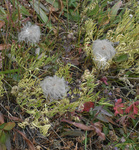
Ranunculaceae: Clematis hirsutissima
R. Neil Reese
Clematis hirsutissima is a perennial herbaceous plant (subshrub) in the Ranunculaceae family. It grows from a deep, woody, branching taproot and sometimes a short, thick rhizome, but does not spread aggressively by vegetative means. Stems are simple to sparsely branched, erect or arching, 15–40 cm tall, and densely covered with stiff, spreading hairs (hirsute). Leaves are opposite and compound or deeply divided, with 3 (up to 9) linear to narrowly lanceolate segments per leaf, with each leaflet being ovate to lanceolate, 3–7 cm long and 1–3 cm wide, with entire to slightly toothed margins and densely hairy surfaces. The basal leaves may be larger and more numerous in a clump. Flowering occurs from May to July. Each plant produces one to several solitary, nodding, urn-shaped flowers atop long, hairy stalks. The flowers are bisexual, with 4 blue to purple, sometimes pink-tinged, thick, leathery sepals (petaloid in appearance), with four thick, petal-like sepals (clematis flowers do not have true petals) that are lavender to pale blue or purple with darker veins and covered with fine hairs on both surfaces. The sepals are broadly ovate to lanceolate, measuring approximately 2.5–4 cm long and 1–2 cm wide, sometimes slightly reflexed at the tips. Flowers contain numerous stamens (yellowish filaments with white anthers) and many separate pistils. The fruit is a cluster of numerous achenes, each bearing a long, plumose, feathery tail (up to 3 cm), initially silvery and maturing to tan, aiding in wind dispersal. Seeds ripen from midsummer to early fall. Sugarbowl is native to South Dakota, especially common in western parts of the state—the Black Hills, Pine Ridge, and rocky uplands. It occurs in dry hillsides, open pine woodlands, prairie bluffs, and rocky outcrops.
-
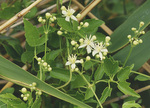
Ranunculaceae: Clematis ligusticifolia
R. Neil Reese
Clematis ligusticifolia is a perennial, somewhat woody vine with smooth to hairy stems that grow several meters in length. The opposite, compound pinnate leaves are petiolate, with 3-7 leaflets that are coarsely toothed, ovate, and 2–6 cm long. The inflorescence consists of many-flowered, axillary panicles, with 4 white, petal-like sepals, 5-13 mm long, lacking petals. The plants are dioecious, with the male (staminate) flowers having numerous stamens, but lacking pistils. The female plants (pistilate) flowers have similar sepals, numerous, full size sterile stamens and multiple pistils. The fruit are hairy achenes, 2-4.5 mm long with plumose styles up to 6 cm long. Western virgin’s bower blooms in July and August and can be found climbing of trees, shrubs and rocks in western South Dakota.
-
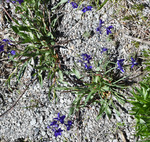
Ranunculaceae: Delphinium bicolor
R. Neil Reese
Delphinium bicolor is a perennial herb typically growing from a fleshy, branching rootstock, stems are mostly smooth, 30 to 90 centimeters tall, erect and branched. Leaves are alternate, 4 to 12 cm long, palmately divided with 3 to 5 deeply cleft lobes. Each leaflet is ovate to lanceolate, typically 3–7 cm long and 2–5 cm wide, with coarsely toothed margins, a smooth texture, and a petiole 3 to 7 cm long. Flowering occurs from May to July, producing tall racemes of striking bicolored flowers, usually deep blue to violet with white centers. Flowers have five sepals; the posterior sepal is enlarged, forming a prominent backward-pointing spur about 1–1.5 cm long and 3–4 mm wide at the base, the lateral sepals are smaller and differently shaped. The petals number five, with two often highly modified. The upper two petals are typically white or pale, while the lower three are blue or violet, roughly 8 to 12 millimeters long and 4 to 6 millimeters wide. There are numerous stamens arranged around the carpels, inserted at the base of the petals, each filament is slender and about 5 to 8 millimeters long. The pistil consists of multiple carpels, each with a distinct style ending in a small, rounded stigma. The fruit is a cluster of dry follicles (several follicles per flower), each follicle is about 10 to 20 millimeters long, containing several small seeds that mature from late summer through early fall. Two-color larkspur is native to South Dakota, commonly found in open forests, grasslands, and rocky slopes, mainly in western and central regions in moist meadows, open coniferous forests, and montane slopes.
-
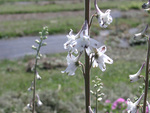
Ranunculaceae : Delphinium carolinianum ssp. virescens
R. Neil Reese
Delphinium carolinianum ssp. virescens is a perennial herb growing from a fibrous to tuberous root system, with sturdy erect, occasionally branched stems, 25-120 cm tall, usually with simple and glandular hairs throughout. There are both basal and alternate cauline leaves, palmately compound, 7-8 cm long, deeply divided into 5 or more primary sections, each with several linear lobes. The basal leaves have long petioles and are usually gone by flowering, and the cauline leave are smaller with shorter petioles. The inflorescence is a spike-like raceme with 5- 30 zygomorphic flowers. There are 5 white sepals, the uppermost having a spur, 11-20 mm long and the lowest pair 7-16 mm long. the 4 petals are white, the upper pair spurred and the lower pair, cleft, bearded, 4-8 mm long and 3-6 mm wide. There are numerous stamens and 3 carpels. The fruit are 3 divergent follicles about 20 mm long. Prairie larkspur blooms in May and June on prairies and pastures throughout South Dakota.
Synonym: Delphinium virescens
-
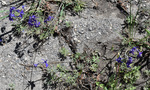
Ranunculaceae: Delphinium nuttallianum
R. Neil Reese
Delphinium nuttallianum is a perennial herb growing 20 to 70 centimeters tall with erect, slender stems. The stems are mostly glabrous or sparsely covered with fine hairs. Leaves are primarily basal, typically 3 to 8 cm long with petioles from 2 to 6 cm in length. They are deeply palmately divided into 3–7 narrow, lanceolate lobes, each about 1–4 cm long, with serrated margins; cauline leaves are fewer, smaller, and simpler. Flowering occurs from May to July. Flowers grow in slender racemes with numerous blue to pale violet, zygomorphic blossoms, often with a slate-gray tint. Each flower has five sepals (one forming a backward-spurred projection 1–2 cm long), four petals (two modified as nectar spurs), numerous stamens, and a single pistil. two upper petals often pale or white and the lower petals that are blue, each petal approximately 7 to 12 millimeters long and 4 to 6 millimeters wide, often bearded. Stamens are numerous, arranged in a ring around the carpels, with filaments about 4 to 6 millimeters long. The pistil consists of several free carpels (apocarpous), each with a slender style ending in a small, rounded stigma. The fruit is a cluster of several dry follicles, each follicle about 10 to 18 millimeters long, containing small seeds. Fruits mature from late summer to early fall. Nuttall’s larkspur is native to South Dakota, commonly found in dry meadows, open woodlands, rocky slopes, and foothills, especially in the western Black Hills and adjacent upland regions.
-
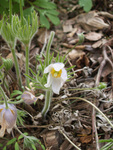
Ranunculaceae: Pulsatilla patens ssp. multifidi
R Neil Reese
Pulsatilla patens is a perennial herb, 5-45 cm tall growing from a stout caudex. One to several flower-bearing stems appear early in the spring as the snow melts. A few to several basal leaves emerge after the flowers bloom. The basal leaves have 5-7 lobes, each dissected into many linear to lanceolate segments. There is a whorl of 3 sessile leaves, just below 2-5 cm long, the flower, palmately compound and divided into several narrow segments like the basal leaves. The leaves and stems are densely covered in long silky hairs. A solitary flower, 4-8 cm across, tops a densely hairy stalk, having 5 to 7 blue-violet to white petal-like sepals. The stamens are numerous and yellow in color that surround a light green columnar center. The sepals are pointed at the tip and lined with numerous parallel veins. The fruiting head is 3-6 cm long by 4-8 cm wide. The achenes are 3-6 mm long, spindle-shaped, brown, covered in long white hairs, with the styles becoming pinkish purple feather-like plumes up to 2-3.5 cm long. The plume facilitates dispersal by wind. Pasqueflower blooms from April into June on open prairies throughout South Dakota.
Synonym: Anemone patens
-
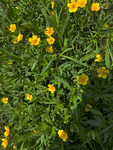
Ranunculaceae: Ranunculus acris
R. Neil Reese
Ranunculus acris is a perennial herbaceous plant growing 30 to 90 cm tall from a fibrous root system. The stems are erect, branching near the top, and covered with fine hairs. Leaves are alternate, pinnately compound, with deeply lobed leaflets. The basal leaves are long-petioled (2 to 8 cm long) with three to five lobes, while upper leaves are smaller and sessile with narrower lobes. The upper leaf surface is medium green and slightly hairy, while the lower surface is paler with fine hairs. The inflorescence is a loose cluster of bright yellow flowers, about 2–3 cm in diameter, blooming from late spring to mid-summer (May to July). Each flower has five to seven glossy, bright yellow petals about 10 to 20 mm long and 7 to 15 mm wide. The calyx consists of five green, lanceolate sepals about 5 to 7 mm long and spreading backward. Numerous stamens (20–40) and pistils (20-60) are densely packed in the flower center. The style is slender with a rounded stigma at its tip. Fruits are small achenes, 2 to 3 mm long, flattened and slightly curved, often with a short beak at the tip, and clustered in a dense head, maturing from summer to early fall (July-August). Native to Europe and Asia, meadow buttercup has been introduced and naturalized in parts of South Dakota, where they grow in meadows, pastures, and disturbed sites.
-
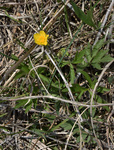
Ranunculaceae: Ranunculus hispidus
R. Neil Reese
Ranunculus hispidus is a perennial herbaceous plant with erect, branched stems growing 20 to 60 cm tall from a fibrous root system. Leaves are alternate and palmately lobed with three to five deeply cut lobes; basal leaves have long petioles 5 to 12 cm long, with leaf blades 4 to 10 cm wide, lobes ovate to lanceolate with pointed tips. Upper leaves are smaller, 2 to 6 cm wide, and may be sessile or have short petioles. The leaf surfaces and stems are densely covered with stiff hairs. Flowers are bright yellow, with five to seven glossy petals that are broadly ovate, 10 to 15 mm long and 7 to 12 mm wide. The calyx consists of five lanceolate sepals, 4 to 6 mm long and 2 to 3 mm wide, often hairy on the back and sides. Each flower contains numerous stamens, typically 20 to 40, with filaments about 2 to 3 mm long and yellow anthers approximately 1.5 to 2 mm long. The flowers also have 20 to 40 pistils, each 2 to 3 mm long, slender and slightly curved, tapering to a pointed tip. Fruits mature from June through July as clusters of small, flattened achenes about 2 to 3 mm long, oblong to slightly curved in shape, and turn from green to light brown or tan when mature. In South Dakota, hispid buttercup is native and is found across a range of habitats including woodlands, open fields, and disturbed sites, preferring moist to well-drained soils throughout the state.
-
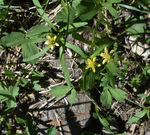
Ranunculaceae: Ranunculus inamoenus
R. Neil Reese
Ranunculus inamoenus is a perennial herbaceous plant typically growing 15 to 50 cm tall from a fibrous root system. The erect, slender stems are often sparsely hairy or nearly glabrous. Basal leaves have long petioles 4 to 10 cm long, with leaf blades 3 to 8 cm long and 3 to 8 cm wide. Cauline leaves are alternate and palmately lobed with three to five deeply cut lobes, ovate to narrowly lanceolate with pointed tips. Upper leaves are smaller, 1.5 to 5 cm long and wide, and may be sessile or have short petioles. Leaf and stem surfaces are generally smooth or with sparse hairs. Flowers are pale yellow, with five to seven petals that are broadly ovate to obovate, 8 to 14 mm long and 5 to 10 mm wide. The calyx consists of five lanceolate to ovate sepals, 3 to 5 mm long and 1.5 to 3 mm wide, typically glabrous or slightly hairy. Each flower contains numerous stamens (15 to 30), with filaments about 1.5 to 2.5 mm long and yellow anthers approximately 1 to 1.5 mm long. The flowers have 15 to 30 pistils, each 1.5 to 2.5 mm long, slender and slightly curved, tapering to a pointed tip. Fruits mature from June through July as clusters of small, flattened achenes about 2 to 2.5 mm long, oblong to slightly curved, turning from green to light brown or tan when mature. In South Dakota, graceful buttercup is native and found mainly in moist to wet habitats such as wet meadows, streambanks, and low-lying areas, scattered throughout suitable locations in the western part of the state.
-
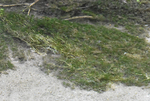
Ranunculaceae: Ranunculus longirostris
R. Neil Reese
Ranunculus longirostris is a perennial, submerged aquatic herb that features a fibrous, adventitious root system capable of anchoring or rooting at the lower stem nodes. The creeping or floating branched stems reach lengths up 90 cm long. Leaves exhibit an alternate insertion pattern, are strictly compound (finely dissected into numerous rigid, thread-like or filiform segments), possess a bright green color, and span roughly 1 to 2.5 cm long and wide. Both upper and lower surface features are structurally identical given their completely submerged nature, though the segmented surfaces can appear lightly tufted or glaucous under close inspection. Petioles are present but typically very short, measuring only 0.4 to 0.6 cm long, and are noticeably dilated at the base into broad stipules that are 1/2 to 3/4 fused to the petiole with acute, free tips. Flowering occurs during the spring and summer months (May through September), with perfect, radially symmetric flowers produced solitary from terminal or axillary pedicels that rise slightly above the water surface. Each flower possesses 5 free, spreading, early deciduous sepals that are lanceolate to elliptic, light green to yellow-green, and measure roughly 2 to 4 mm long and 1 to 2 mm wide. The 5 free petals are obovate to oblanceolate, white with distinct yellow claws or bases featuring a minute basal nectar pit and span 4 to 7 mm long. Surrounding the center are several (usually 8 to 25) yellowish stamens with variable filament lengths and lateral anthers. The compound gynoecium consists of a globose head containing 8 to 25 separate pistils; each pistil features a superior, ovary topped by a short, persistent, straight, thread-like style and a capitate stigma. The resulting fruit is an aggregate head of small achenes reaching maturity between July and October. Individual achenes are transversely wrinkled, lenticular or flattened, dark brown to blackish at full maturity, and roughly 1.5 mm long with a long, characteristic beak. Longbeak buttercup is native to South Dakota, where it can be found throughout the state, including within the Prairie Pothole Region, inhabiting permanent freshwater wetlands, ponds, lakes, ditches, and slow-moving streams.
-
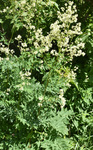
Ranunculaceae: Thalictrum dasycarpum
R. Neil Reese
Thalictrum dasycarpum is a perennial, herbaceous plant with a fibrous root system and short, thick rhizomes, forming loose clumps. Mature plants typically reach 60–200 cm in height. Stems are erect, hollow, round, often branching above, and smooth or sometimes finely grooved, usually glabrous but occasionally sparsely hairy near the nodes. Leaves are alternate, compound, and 2- to 3-ternate (divided two or three times), with the largest lower leaves up to 40 cm long and 30 cm wide, each leaflet ovate to rhombic, 2–6 cm long and 1–4 cm wide, with 3-lobed or coarsely toothed margins; upper surfaces are medium green and smooth, lower surfaces are paler and sometimes slightly hairy along the veins. Leaflets are attached by slender petiolules 0.5–2 cm long; petioles are present, 4–15 cm long, especially on basal and lower leaves. Flowering occurs from May to July, with inflorescences forming large, loose, pyramidal panicles up to 30 cm long, composed of numerous small, apetalous flowers. Each flower has four to six greenish-white sepals, 3–5 mm long and 1–2 mm wide, that are oblong, free, and soon deciduous. True petals are absent. Stamens are numerous (20–50 per flower), with long, slender white to purple filaments and yellow anthers 2–3 mm long, extending well beyond the sepals and giving the flowers a feathery appearance; pistils are also numerous (10–20 per flower), each with a slender style 3–4 mm long and a stigma that is slightly expanded and papillose. The fruit is a small, dry, ovoid to ellipsoid achene, 3–4 mm long, covered with dense, soft hairs (hence the species name, “dasycarpum” meaning “hairy fruit”), maturing from June to August. Purple meadow-rue is native to South Dakota and is common throughout the state in moist prairies, open woodlands, stream banks, wet meadows, and marshy lowlands, especially in rich, moist, well-drained soils in full sun to partial shade.
-
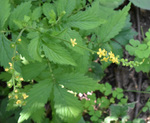
Rosaceae: Agrimonia striata
R. Neil Reese
Agrimonia striata is a perennial herbaceous plant in the Rosaceae family, commonly known as roadside agrimony. It has a fibrous root system and does not reproduce asexually via stolons or rhizomes. The stems are upright, usually simple or occasionally sparingly branched, and range from 30 to 120 cm in height, with a covering of fine, soft hairs that give the young growth a slightly fuzzy texture. Leaves are alternate and pinnately compound, with 3–7 pairs of oblong-lanceolate, coarsely toothed leaflets, usually 3 to 8 centimeters long and 1 to 3 centimeters wide, with serrate margins and petioles approximately 1 to 3 centimeters long. The terminal leaflet being the largest; both basal and cauline leaves are present, with basal leaves forming a rosette and cauline leaves distributed along the stem. Inflorescences are slender, terminal racemes appearing from June to September. Each flower has five yellow petals about 2.5 to 4 millimeters long and 1.5 to 3 millimeters wide, and five green sepals with slender tips roughly 2 to 3 millimeters long. There are numerous stamens (20 or more) arranged around a superior ovary; filaments are slender and about 2 to 4 millimeters long with yellow anthers. The pistil consists of a single ovary , with 2–5 locules, a slender style terminating in a capitate stigma. Fruits mature into small, dry achenes covered with hooked bristles that aid in animal dispersal, turning brown at maturity in late summer or early fall and typically containing a single small, hard, dark brown seed. Roadside agrimony is native to South Dakota, found in moist meadows, woodland edges, thickets, and along riverbanks, and is distributed statewide, with higher abundance in the eastern regions and river corridors.
-
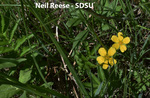
Rosaceae: Argentina anserina
R. Neil Reese
Argentina anserina is a perennial herb with a spreading, mat-forming habit, growing from a fibrous root system with thickened edible storage roots and reproducing vigorously by long, red, above-ground stolons that root at the nodes. Its stems are prostrate and simple, with flowering scapes rising 10–30 cm above the basal rosette. The plant is covered in fine, silky, silvery hairs, especially on the underside of the leaves. Leaves are alternate, pinnately compound with 7 to 15 oblong to lanceolate leaflets covered with dense, silvery hairs on the underside, giving a characteristic silvery appearance. Leaflets are deeply toothed, measure about 1 to 4 centimeters long and 0.5 to 1.5 centimeters wide, with petioles 3 to 7 centimeters long. Flowering occurs from late spring through summer, with solitary, bright yellow, saucer-shaped flowers (1.5–2.5 cm across) borne singly on leafless stalks. Each flower has five bright yellow petals approximately 8 to 15 millimeters long and 5 to 10 millimeters wide, and five green sepals about 5 to 8 millimeters long with pointed tips. Numerous stamens (around 20 to 30) encircle a superior ovary of multiple carpels fused at the base. The pistil consists of several distinct styles, each terminating in a stigma. Fruits develop as small, dry achenes aggregated on a conical receptacle, maturing in late summer. Silverweed is native to South Dakota, found statewide in moist meadows, streambanks, marshes, ditches, and sometimes sandy or disturbed soils, especially in moist lowland habitats.
Synonym: Potentilla anserina
-
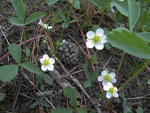
Rosaceae : Fragaria virginiana
R. Neil Reese
Fragaria virginica is a stoloniferous, rosette-forming herb growing from a thick rhizome. The stolons produce new shoots where the touch the ground. The leaves are primarily basal, trifoliate, with long smooth to hairy petioles. The leaflets have short stalks, are 2.5-4 cm long, 18-25 mm wide, elliptic to obovate, with blunt teeth. The terminal tooth is generally smaller than the 2 flanking teeth. The inflorescence consist of 1-3 clusters of flowers (cymes) on top of hairy peduncles that are generally shorter than the leaves. The flowers are perfect, or appear so, with a hypanthium (floral cup) subtended bu 5 bracts. The 5 sepals are green, 4-10 mm long, the 5 white petals 6-14 mm long, with 20-40 stamens in 3 whorls and with many simple pistils on a hemispheric receptacle that enlarges into the fruit. The achenes are embedded in pits in the receptacle. Wild strawberries bloom from March into June on prairies, open woodlands and along streams and roadsides throughout South Dakota.
-
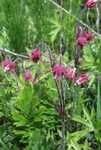
Rosaceae : Geum triflorum
R. Neil Reese
Geum triflorum is perennial herb growing from thick rhizomes, often forming large clumps, with flowering stems 20-40 cm tall. The stems are purplish in color, softly hairy, with a pair of opposite, smaller, finely dissected leaves about half way up. The basal leaves have blades 5-20 cm long, unequally pinnately divided into 7-19 lobes or pinnae up to 5 cm long, generally larger toward the tip. The inflorescences are cymes, with peduncles up to 10 cm long, with 3-4 nodding flowers. Each flower has a hemispherical hypanthium 4-5 mm long, with 5 purple sepals 8-12 mm long and simple to trifid bracts between them. There are 5 yellow to pink to purple rounded petals enclosed by, to exerted from the sepals and bracts. The stamens and pistils are numerous. The fruit are achenes ~ 3 mm long with purplish, plumose styles 2.5-5 cm long. Prairie smoke blooms from April into June on prairies and in open woodlands along the eastern and western borders of South Dakota.