

-
This site is dedicated to Mrs. Dorothy Gill, a Dakota Elder, a mentor and friend.

-
Onagraceae: Epilobium ciliatum
R Neil Reese
Epilobium ciliatum is a perennial herb with erect, simple to branched stems, 5-120 cm in height, green, hairless on the lower portions of the stem and the upper stem with a covering of short hairs mixed with glandular hairs, often in lines running down from the leaves. The leaves are mostly opposite toward the base and alternate on the upper stem, the lower leaves are smooth, obovate with distinct petioles and broader than the upper lanceolate leaves that are nearly sessile and sparsely covered in short hairs mixed with glandular hairs, especially along the midvein. The blades are 3-12 cm long and 5-45 mm wide, blunt to pointed at the tip, and the margins have small widely spaced teeth. The flowers are single at the ends of stems and in the upper leaf axils, atop a short peduncle, < 12 mm long, followed by a slender ovary, about 25 mm long, that is slightly wider than the peduncle. The 4 small, greenish red sepals that cup the flower are 1.5-5 mm long. The sepals, peduncle and ovary are all variously covered in short hairs mixed with gland-tipped hairs, often in lines. The 4 petals are white to pink to rose-purple, notched and < 5 mm long. There are 8 unequal stamens surrounding a white, club-shaped style. The fruit is a long, slender capsule, 4-10 cm long, drying to brown then splitting lengthwise from the top down in 2 to 4 segments. The seeds are brown, 1-1.5 mm long with a tuft of long, white hairs. Fringed willowherb blooms from July into September in moist, often disturbed sites scattered throughout South Dakota.
-
Onagraceae : Oenothera biennis
R. Neil Reese
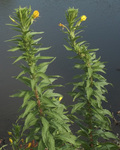
Oenothera biennis is a biennial herb with greenish, erect branching stems 50-200 cm tall, often covered with hairs. The first year plants form rosettes of petiolate leaves, oblanceolate to spatulate, 6-30 cm long, 1-7 cm wide, with an entire to wavey margin and pointed tips. The second year the stems elongate and the cauline leaves are alternate, lanceolate to oblanceolate, 1-10 cm long and 4-20 mm wide with wavey to sparsely toothed margins and pointed tips. The lower stem leaves petiolate, becoming reduced in size and sessile toward the top. The inflorescence is a terminal spike, sometimes with branches, the flowers subtended by hair covered bracts 1-3 cm long. The flower buds are erect and open near sunset. The slender, greenish yellow floral tube is is 2-5 cm in length, with a scattering of hairs. The 4 linear-lanceolate sepals are 1-2.5 cm long with free lobes 1-4 mm long. The 4 yellow obovate petals are 1-2.5 cm long, notched, and become reddish before wilting. There are 8 yellow stamens surrounding a style with a cross-shaped stigma in the center. The fruit is an ascending, hairy, cylindrical capsule, 1.5-3.5 cm long and 3-6 mm in diameter. Common evening primrose blooms From July into October along streams and lakeshores, open woodlands and waste places scattered throughout South Dakota.
-
Onagraceae : Oenothera caespitosa
R. Neil Reese
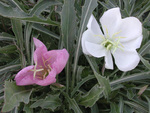
Oenothera caespitosa is a perennial, acaulescent, mound forming herb from a branching caudex. Mature plants are typically 15-25 cm high and up to ~60 cm wide, with lateral roots giving rise to new plants. The leaf blades are oblanceolate to nearly linear, 3-21 cm long, 1-5 cm wide, with a winged petiole that is often as long as the blade. The margins vary greatly from almost entire to pinnately lobed to having irregular teeth that are rounded to sharp. The leaf blades, veins and margins can be variously covered with hairs or with hairs lacking. The flowers are solitary in the leaf axils, open near sunset and have a sweet scent. The floral tube is 3-8 cm long, slender and flared toward the end, often reddish in color. The sepals are 2.5-3.5 cm long lanceolate with pointed tips. The white petals are heart-shaped, 2.5-5 cm long, changing to pink after pollination. The 8 stamens are unequal in length and about 2/3 the length of the petals. The style is about as long as the petals and has a 4-lobed stigma. The fruit is a hard, lumpy, elongated capsule, 2-5 cm long with a constricted end. Gumbo lily blooms from May into August on dry, rocky prairies, hillsides and open woodlands in western and central South Dakota.
-
Onagraceae: Oenothera laciniata
R. Neil Reese
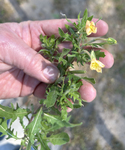
Oenothera laciniata is an annual, winter annual, or biennial herbaceous forb supported by a stout, branched taproot. The plant typically reaches a height of 10 to 60 cm with single or multi-branched stems that range from erect to reclining or prostrate along the ground. These angular stems are densely clothed in long, spreading, and sometimes sticky glandular hairs. Leaves exhibit an alternate insertion pattern, are simple, and possess a dull green to grayish-green color, often highlighted by a distinct whitish mid-vein. Individual cauline leaves are narrowly oblanceolate, elliptic, or oblong, 2.5 to 10 cm long and about 1.3 cm wide. They feature deeply toothed, wavy-edged, or pinnately cleft margins containing rounded lobes, with both the upper and lower leaf surfaces covered in fine, short hairs. Basal leaves narrow down into distinct petioles, whereas the upper stem leaves are mostly sessile or sit on very short petioles. Flowering occurs from May through September, with individual, sessile blossoms borne singly in the distal leaf axils rather than in complex clusters. The flowers open at twilight and close by midday. The calyx features 4 free, linear-lanceolate, reflexed sepals that are 5 to 15 mm long and 2 to 3 mm wide, carrying a green to strongly pinkish or reddish tinge and distinct appressed hairs. The corolla is composed of 4 free, broadly heart-shaped petals measuring 10 to 20 mm long, which open to a pale, whitish-yellow color and shift to an orange-red or pinkish hue as they age and wither. There are 8 prominent stamens with pale yellow filaments and large, versatile yellow anthers that release cobwebby pollen. The compound pistil consists of an inferior, 4-carpel ovary leading up an elongated hypanthium tube to a single long style that terminates in a prominent, deeply cross-shaped (4-lobed) stigma. The fruit is a linear-cylindrical, blunt, often upwardly curved, furry capsule measuring 1.5 to 3.5 cm long and 2 to 3 mm thick. It remains green before turning a dull grayish brown at maturity, which takes place from July through October. The cutleaf evening-primrose is native to South Dakota, where it is primarily distributed across the southern and eastern counties of the state. It thrives in open, highly disturbed habitats characterized by dry, well-drained, sandy soils, such as successional fields, sand prairies, riverbanks, roadsides, and railroad ballasts.
-
Onagraceae: Oenothera rhombipetala
R. Neil Reese
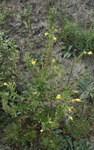
Oenothera rhombipetala is a biennial herbaceous forb that initiates growth as a low-profile basal rosette from a deep, sturdy taproot system. During its second year, the plant shifts into a reproductive phase, developing an erect, robust growth form that reaches a height of 30 to 120 cm (rarely up to 150 cm). Stems are stout, usually unbranched to weakly branched near the apex, and covered in fine, appressed hairs. Leaves are alternate, simple, dull light green to grayish green, narrowly lance-shaped to oblong, measuring up to 10 cm long and 6 to 13 mm wide. Leaf surfaces are slightly crinkled, with both upper and lower planes displaying a finely hairy, texturized pubescence. Lower stem leaves are short-petioled, while upper leaves transition cleanly into sessile structures. Flowering occurs continuously from May through October, peaking mid-summer. The inflorescence forms a dense, terminal bracted spike up 30 cm long, opening progressively from the bottom upward. The flowers are structurally epigynous (petals and sepals attached above the ovary), with an elongated calyx tube (hypanthium) 2 to 4 cm long. The flower features 4 sepals that are free above the hypanthium, narrowly lance-shaped, 15 to 25 mm long, and typically colored green to light yellow with a reddish or tan tinge. These sepals are reflexed, folding sharply back at anthesis, often remaining loosely connected in pairs along one edge. The corolla consists of 4 free, vibrant butter-yellow petals that are distinctly rhombus-shaped, measuring 13 to 25 mm long, and tapering gracefully to a blunt point. The androecium consists of 8 prominent stamens with long, bright yellow filaments and versatile anthers that carry heavy strands of pollen. The gynoecium features a single pistil with an inferior, 4-chambered ovary; a slender, elongated style; and a deeply 4-lobed, cross-shaped stigma that extends outward, elevating itself well above or equal to the level of the stamens. The fruit reaches maturity from August to November as a sessile, narrowly cylindrical, slightly curved woody dehiscent capsule, 13 to 32 mm long. The capsule turns gray brown to tan at maturity, opening at the top via four distinct valves to scatter hundreds of tiny, pitted, golden-brown angular seeds. The fourpoint evening primrose is native to South Dakota. It is found infrequently along the extreme southern tier of counties, including Bennett, Todd, Tripp, and Gregory, where it populates high-drainage, open ecosystems like dry sand prairies, sandhills, blowout dunes, and sandy roadsides.
-
Onagraceae: Oenothera serrulata
R. Neil Reese
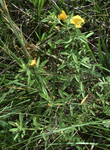
Oenothera serrulata is a biennial or short-lived perennial herb growing from a deep taproot with an erect, 30 to 90 cm tall, branched stem often covered in fine hairs. The basal leaves are lanceolate to narrowly ovate, 5 to 15 cm long and 1 to 3 cm wide, with finely serrated (serrulate) margins, and short petioles. The stem leaves are smaller and more linear. Flowering occurs from late spring into mid-summer (May–July). The flowers are large and showy, born singly or in loose clusters on elongating stems, opening in the late afternoon or evening and lasting into the night. Each flower has four sepals, narrowly lanceolate and 10 to 15 mm long, which reflex as the flower opens. The corolla consists of four petals, bright yellow fading to orange with age, each 25 to 40 mm long and 10 to 15 mm wide, broadly obovate to spatulate in shape with a slightly notched apex. The flower contains eight stamens with slender filaments and conspicuous yellow anthers arranged around a single pistil. The ovary is superior with a slender style, about 15 to 20 mm long, terminating in a four-lobed stigma approximately 3 to 4 mm wide; the lobes are elongated and slightly papillose. The fruit is a slender capsule, 4 to 7 cm long, maturing in late summer, containing numerous small seeds. Serrate-leaved evening primrose is native to South Dakota, typically found in sandy or rocky soils of prairies, open woodlands, and disturbed sites across the central and western parts of the state.
-
Onagraceae : Oenothera suffrutescens
R. Neil Reese
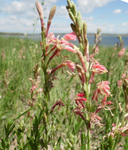
Oenothera suffrutescens is a perennial herb, usually with several branched stems growing 20-100 cm tall, from a branching caudex and spreading underground stems the generate new plants and form large colonies. The simple, alternate leaves are almost sessile, linear to narrowly elliptic, 5-60 mm long and 1-7 mm wide with a pointed tip, the margins entire to having a few small teeth. The inflorescence is a spike-like raceme, 5-60 cm long on a peduncle that is 1-6 cm long. The zygomorphic flowers appear sessile, each subtended by a bract. The floral tube is 4-12 mm long, with 4 sepals 5-10 mm long and 4 clawed (narrowed) petals 3-9 mm long and 2-4 mm wide, that are initially white, then changing to red-orange or reddish brown. There are 8 stamens, the anthers red or yellow and a central pistil with a style 10-20 mm long topped with a 4-lobed stigma. The fruit is a capsule 4-9 mm long constricted at the base. This species is highly variable in habit, flower color, size and pubescence, with plants ranging from smooth to densely hairy. Scarlet guara blooms from May into August in dry prairies, open wooded hillsides and stream valleys throughout South Dakota.
Synonym: Guara coccinea
-
Orchidaceae: Corallorhiza striata
R Neil Reese
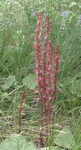
Corallorhiza striata is a perennial saprophytic herb, lacking roots and growing from a much-branched rhizome, with erect stems 15-45 cm tall. The simple stems are succulent, yellow to red to purple to brown, wrapped with membranous bracts, 1-14 cm long. The inflorescence is a terminal raceme, 5-16 cm long with up to 35 flowers loosely arranged and subtended by bracts < 4 mm long. The flowers are nodding, yellow tinged with red to purple stripes. There are 3 narrow sepals, sometimes striped, 5-18 mm long, and 2-5 mm wide and 3, often purplish striped, petals the 2 lateral ones are about the same length as the sepals. The lower petal forms a broad, fleshy, reflexed bilobed lip, 3-16 mm long and 3-8 mm wide. The fruit is an elliptic capsule 1.2-2 cm long. Striped coralroot blooms in May and June in cool, coniferous woodlands in decaying litter in western South Dakota.
-
Orchidaceae: Platanthera dilatata
R Neil Reese
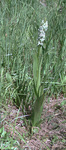
Platanthera dilatata is a perennial herb growing 15-70 cm tall. The mostly alternate, lanceolate leaves are cauline, 3-20 cm long and up to 3 cm wide with a pointed tip. the inflorescence is a loose to densely packed raceme, 5-25 cm long with 10-50 flowers, subtended by lanceolate floral bracts 5-40 mm long. The white flowers have 2 broad petal-like sepals that flare laterally, 4-8 mm long. Two lateral petals and an upper sepal form a hood, 4–6 mm long. The lower lip is narrower than the side sepals and initially curves up, touching the tip of the hood, and then flowing downward forming a sac-like to slender spur. The fruit is an ellipsoid capsule 8–15 mm long and 3-4 mm wide. White bog orchid is fairly rare in SD. It blooms in July in swampy forests and wooded bogs in and around Lawrence County in the State.
Synonym: Habeneria dilatata
-
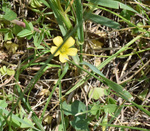
Oxalidaceae: Oxalis dillenii
R. Neil Reese
Oxalis dillenii is a small annual herbaceous plant growing 10 to 30 cm tall with slender, branching stems that are often slightly hairy. The trifoliate leaves are composed of three heart-shaped leaflets, each 1 to 2 cm long and 1 to 1.5 cm wide, with a distinct fold along the midrib and a bright green color. The flowers are borne singly or in small clusters on slender stalks above the foliage, blooming from May through October. Each flower has five green, lanceolate sepals about 4 to 6 mm long and 1.5 to 2 mm wide. The corolla consists of five bright yellow petals, each 8 to 12 mm long and 4 to 6 mm wide, obovate in shape with a rounded apex. The flower contains ten stamens with filaments of varying lengths and yellow anthers arranged around a superior ovary. The pistil has a single style approximately 5 to 7 mm long, terminating in a capitate (head-shaped) stigma about 1 to 1.5 mm wide. The fruit is a cylindrical capsule 10 to 15 mm long and 2 to 3 mm wide, developing after flowering from June through October; it dehisces explosively to release numerous small seeds. Southern Wood-sorrel is considered a native weed in South Dakota. It is difficult to distinguish from Oxalis stricta without a microscopic analysis of mature specimens. Oxalis dillenii has short, dense appressed hairs on the stems. The unbranched flower clusters typically have two flower buds, and the fruits of erect capsules are attached to bent or spreading stalks.
-
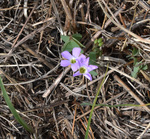
Oxalidaceae: Oxalis violacea
Richard Neil Reese
Oxalis violacea is a perennial herbaceous plant growing 15 to 40 cm tall from fibrous root system with small corms. The trifoliate leaves consist of three heart-shaped leaflets, each 1.5 to 3 cm long and 1.5 to 2.5 cm wide, with smooth margins and they often have a purplish tint on the underside. The leaves are petiolate with slender stalks 5 to 12 cm long. The flowers are borne singly on slender stalks above the foliage, blooming from April through June. Each flower has five green, lanceolate sepals about 6 to 8 mm long and 1.5 to 2.5 mm wide. The corolla consists of five petals, violet to lavender in color, each 10 to 15 mm long and 6 to 8 mm wide, obovate to broadly spatulate with a rounded apex. The flower contains ten stamens in two whorls with filaments of varying lengths and purple anthers arranged around a superior ovary. The pistil has a single style approximately 6 to 8 mm long, terminating in a capitate stigma about 1.5 to 2 mm wide. The fruit is a cylindrical capsule 12 to 18 mm long and 2 to 3 mm wide, developing after flowering from May through July; it dehisces explosively to release numerous small seeds. Violet wood-sorrel is native to South Dakota, commonly found in moist prairies, open woodlands, and along stream banks throughout the eastern and central parts of the state.
-
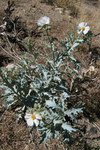
Papaveraceae : Argemone polyanthemos
R Neil Reese
Argemone polyanthemos is an annual to biennial plant with one to a few stems growing from a taproot. Plants vary greatly in size from 0.25 to 1.25 m in height with stems 7-20 mm in diameter. The stems are waxy with few to many yellowish prickles. The leaves are waxy with the upper surface smooth to bearing scattered prickles on the veins, with more prickles on the lower surface. The lower leaves are oblanceolate, deeply pinnately lobed, 7-25 cm long by 3-10 cm wide. The lobes are elliptical to obovate with undulating irregularly spiney-toothed margins and the petioles are winged. The leaves are reduced and become less lobed toward the top, but the margins are like those of the lower leaves. The flowers are 5-12 cm in diameter and are subtended by 2 bracts that are shorter than the sepals. The 3-6 yellowish sepals are 6-10 mm long. The 6-12 white petals are arranged in 2 rows, 2.5-5 cm long and nearly as wide. The center of the flower is dominated by numerous (~150) yellow stamens and the has 3-5 carpels. The fruit is a capsule 2.5-4 cm by 1-1.5 cm wide. The seeds are shiny, dark brown and round. Prickly poppy blooms from May until September. All parts of the plant have a yellow sap that stains the skin and clothing.
-
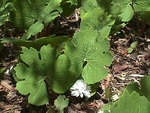
Papaveraceae : Sanguinaria canadensis
R. Neil Reese
Sanguinaria canadensis is a perennial herb with shallow, extensively branched rhizomes, 6-15 mm in diameter, that contain a red juice. The ends of the rhizome branches produce I leaf and 1 flower scape. At anthesis the leaf is usually shorted than the scape, but the petiole and blade rapidly expand and soon over tower the flower scape. The petiole reaches 10-35 cm in length, and the leaf blade becomes 6-20 cm long by 8-20 cm wide. The blade usually 3-7 lobed, almost circular in outline, green on top and waxy below, the margins entire to wavey. The flower forms at the end of a peduncle 5-12 cm long and has 2 rounded, membranous sepals, 2-12 mm long and 5-8 mm wide. The 8 (sometimes up to 16) white petals are oblanceolate to elliptic, 10-30 mm long and 5-12 mm wide, with 4 petals usually slightly larger than the others. The numerous stamens are up to 1 cm long with yellow anthers and the style is 2-lobed. The fruit is a spindle-shaped capsule, 3-5 cm long and 7-11 mm wide, containing ovoid, reddish brown seeds that have a prominent crest. Bloodroot blooms in late March into May on woodland slopes along the eastern edge of South Dakota.
-
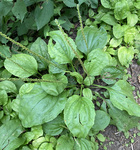
Plantaginaceae : Plantago rugelii
R. Neil Reese
Plantago rugelii is a perennial herb growing from a short, erect caudex forming a low rosette of leaves with smooth, slender flowering stalks that can reach 35 cm in height. The leaf blades are broadly elliptic to ovate, 5-20 cm long and ½ to 2/3 as wide, narrowed at the base and rounded to pointed at the tip, with 5-9 major veins and entire to finely toothed margins. The petioles are 2-20 cm long, winged, and reddish toward the base. The inflorescence consists of 1-several terminal spikes, 5-20 cm long, sitting atop the smooth peduncle. Each flower is subtended by bracts 1.5-2.3 mm long, the 4 sepals are 2-2.5 mm long and the corolla forms a white to purple tube with 4 short lobes. The fruit is a capsule 6-8 mm long containing 4-10 black seeds. Blackseed plantain blooms from May into October in moist, often shaded woodlands and parklands along the eastern and western borders of South Dakota. This species is very similar to P. major, an introduced weed common in lawns and gardens throughout the world.
-
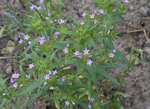
Polemoniaceae: Collomia linearis
R. Neil Reese
Collomia linearis is an herbaceous, taprooted annual forb. The plant reaches a mature height of 10 to 60 cm. Its stems are stout, erect, usually simple or occasionally branched above, and covered with fine, velvety, white non-glandular hairs that become increasingly sticky and glandular near the apex. Leaf insertion is alternate. The simple, lanceolate to linear leaves are dark green, entire along the margins, and measure 1 to 9 cm long and 2 to 13 mm wide. Lower leaves taper gradually, while the upper stem leaves are typically broader, slightly clasping the stem, and sharply pointed at the tip. The lower surface features short, fine hairs primarily along the midvein, whereas the upper surface is largely glabrous; all leaves are sessile. Flowering occurs throughout the summer months from May through August. The inflorescence is a dense, bracted terminal head or cluster holding 7 to 20 flowers. The calyx consists of 5 fused sepals, 4 to 7 mm long, forming a pitcher-like tube connected by a translucent, papery membrane at the sinuses; the lobes are triangular, green, and turn outward but do not rupture as the underlying fruit develops. The corolla features 5 radially symmetrical, fused petals forming a slender, trumpet-like tube 8 to 15 mm long that spreads into small, rounded lobes roughly 2 mm wide. Their colors vary from pale pink or lilac to dull white. Each flower has 5 stamens attached directly to the interior corolla tube at multiple height levels, featuring short filaments under 1 mm long and enclosed anthers that shed white pollen. The single compound pistil consists of a superior, 3-chambered ovary paired with 1 elongated style that terminates in 3 distinct, tiny stigma lobes. The fruit is an oval-to-elliptic, 3-valved, explosively dehiscent capsule measuring 4 to 5 mm in diameter. It ripens to a dry, light tan-brown color between July and September, violently splitting open to project 1 brown, oblong seed per chamber. Tiny trumpet is native to South Dakota, where it is widely distributed across the state. It can be found in a variety of environments, primarily thriving in dry, open woods, sand or gravel prairies, meadows, limestone glades, and sun-exposed, disturbed corridors like roadsides and railroad banks.
-
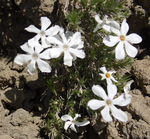
Polemoniaceae: Phlox hoodii
R. Neil Reese
Phlox hoodii is a perennial, herbaceous plant forming dense, cushion-like mats or low tufts. It has a fibrous root system and may develop a woody base with age. Plants typically range from 2 to 10 cm tall. The stems are short, densely branched, and covered with stiff, spreading hairs, giving a somewhat spiny appearance. Leaves are opposite, linear to narrowly lanceolate, simple, and clustered along the stems. Leaf color is gray green to green; leaves are 4–10 mm long and 1–2 mm wide, with ciliate (hairy) margins and surfaces, and a sharp, pointed tip. The upper and lower leaf surfaces are similar, both bearing stiff hairs. Leaves are sessile. Flowering occurs early in the spring, usually from April to June, depending on elevation and latitude. The inflorescence consists of solitary flowers or small clusters at the ends of stems. Flowers have a tubular calyx about 5–8 mm long, with five fused sepals that are green and covered with spreading hairs and glandular tips. The corolla (petals) is salverform, with a narrow tube (10–18 mm long) abruptly spreading into five (6) lobes, each 5–10 mm long; petals are typically white, pink, or lavender. There are five stamens inserted at the mouth of the corolla tube, usually included, with slender white filaments and yellowish anthers. The pistil consists of a single style, 8–12 mm long, ending in a three-lobed stigma. Fruit is a small, ovoid capsule, about 3–4 mm long, that matures in late spring to early summer, turning brown at maturity and splitting to release seeds. Hood’s phlox is native to South Dakota and is found throughout the western and central parts of the state, especially in dry prairies, rocky outcrops, and open pine woodlands.
-
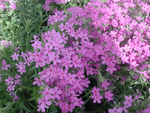
Polemoniaceae : Phlox pilosa
R. Neil Reese
Phlox pilosa is a perennial herb from a stout rootstock, with I-several branching stems with 6-12 nodes, growing 20-75 cm tall, covered with simple and/or glandular hairs. The simple, alternate, sessile leaves are narrowly lance-linear, 30-100 mm long, 3-30 mm wide and hairy, especially along the entire margins and the midvein. The inflorescence is a panicle with up to 100 flowers with pedicels usually les than 10 mm long and covered with glandular hairs. The calyx is 8-15 mm long, the tube and 5 lobes about equal in length and covered with glandular hairs. The white, pink or purple corollas have a tube 8-16 mm long with 5 reflexed oblanceolate to obovate lobes 10-12 mm long and 6-8 mm wide. The style is 3-lobed and 1-3 mm long. the fruit is an ovoid capsule. Prairie phlox blooms from May into July in open woods and meadows in eastern South Dakota.
-
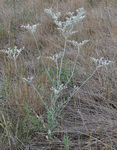
Polygonaceae : Eriogonum annuum
R. Neil Reese
Eriogonum annuum is an annual to biennial herb with 1 to a few erect, simple to branched stems, 10-100 cm tall and covered with silver-gray hairs. The plants start with a few, short-lived, simple, oblanceolate basal leaves, 2-5 cm long. The alternate, petiolate cauline leaves appear similar to the basal leaves, with most of them toward the base of the stem. The inflorescence is a terminal cyme, often with smaller cymes at the ends of the lower branches. The open cymes have a helicoid, bi or trichotomous branching pattern. The flowers are subtended by a sessile, membranous, calyx-like involucres that are funnel-shaped, 2.5-3 mm long, with shallow teeth. The perianth is composed of 6 white segments, sometimes with a pinkish tinge, the insides are hairy and the outer members are wider than the inner ones. There are 9 stamens and a 3 styles. The fruit are smooth achenes. Annual wild buckwheat blooms from July into September on dry, open grasslands in western and southern South Dakota.
-
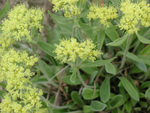
Polygonaceae : Eriogonum flavum
R. Neil Reese
Eriogonum flavum is a perennial mat-forming herb from a thick, branched, woody caudex, usually having old leaf bases attached. The oblanceolate, petiolate, basal leaves are crowded, 3-8 cm long, 3-14 mm wide, green to grayish due to hairs on the upper surface and hairy beneath. The flowering stems are leafless, 4-25 cm tall, hairy, with leaf-like bracts subtending a compound umbel inflorescence, that have hairy rays up to 3 cm long. the cymose clusters of flowers are subtended by a few reduced bracts. The flowers have a campanulate involucre that is 4-6 mm long with shallow or lacking lobes. The perianth is 6-merous, 4-6 mm long, yellow to sometimes pink tinged, with hairs on the outside, narrowed to a short pedicel-like base. There are 9 stamens and 3 styles that are all exerted from the perianth. The fruit are elongated achenes with a tuft of hair at the top. Yellow wild buckwheat bloom from May into September on dry plains and ridges in western South Dakota.
-
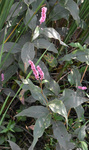
Polygonaceae: Polygonum amphibium
R. Neil Reese
Polygonum amphibium is a perennial aquatic or semi-aquatic herb growing from a rhizomatous root system that allows it to spread horizontally underwater or in saturated soils. The roots are fibrous and fleshy, anchoring the plant in mud or shallow water. Stems can be either emergent or floating, reaching 30 to 90 cm in height. Leaves are alternate and variable: submerged leaves are narrow and linear, 5–15 cm long and 0.5–1 cm wide; floating or terrestrial leaves are broader, ovate to lanceolate, 7–20 cm long and 3–10 cm wide, with entire margins and petioles 2–8 cm long. The flowers are small, pink to rose-colored, clustered in dense terminal spikes blooming from July through September. Each flower has five pink to rose-colored tepals (sepals and petals not distinctly separate), 3 to 5 mm long and 1.5 to 2 mm wide. The flower contains eight stamens with yellow anthers. The pistil has a superior ovary with three styles. Fruits develop from August through October, maturing into small, three-angled achenes about 2 to 3 mm long and 1.5 to 2 mm wide. Water smartweed is native to South Dakota and typically found in wetlands, along lake and pond margins, slow-moving streams, and marshy areas throughout the eastern and central parts of the state.
Synonym: Persicaria amphibia
-
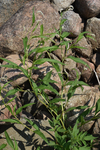
Polygonaceae: Polygonum lapathifolium
R. Neil Reese
Persicaria lapathifolia is a terrestrial or semi-aquatic annual, herbaceous forb supported by a shallow, fibrous taproot system. Plants grow to a height of 30 to 180 cm, with erect, ascending, or sometimes decumbent, heavily branched stems that feature noticeably swollen nodes and are glabrous to sparsely pubescent, frequently exhibiting reddish-purple pigmentation. The leaves have an alternate insertion pattern along the stem and are simple, narrowly lanceolate, elliptic, or ovate-lanceolate, displaying a dull green to pale green color and often bearing a dark, crescent-shaped smudge or "chevron" near the center. Leaf blades measure 6 to 20 cm long and 1 to 5 cm wide, featuring rough, forward-pointing short hairs along the margins, glabrous to moderately appressed-pubescent upper surfaces, and lower surfaces often covered in tiny yellow glands or woolly white hairs. Short petioles ranging from 0.5 to 2.5 cm long are present, anchored at the base by a persistent tubular stipule called an ocrea that is scarious, brownish, 1 to 2 cm long, truncate, and notably devoid of prominent bristle-like fringes along its top margin. Flowering occurs from June through October, with the inflorescence structured as multiple dense, spike-like terminal and axillary racemes measuring 3 to 8 cm long that uniquely droop or arch downward under their own weight. The perianth consists of 4 or 5 fused, petal-like tepals measuring 2 to 3 mm long, ranging in color from greenish-white to pale pink, which are structurally distinguished by their strong, anchor-like veins that branch and curve backward at the tips. Tucked inside the tepals are usually 6 stamens (varying from 5 to 8) featuring tiny, white-to-pink anthers. The single pistil consists of a superior, compressed ovary and 2 (rarely 3) mostly separate, curved styles terminated by small, capitate stigmas. The fruit is a small, flattened, disc-shaped or lenticular achene measuring 2 to 3 mm long with concave faces, featuring a glossy, dark brown to black color, which reaches full maturity between August and October. Pale smartweed is native to South Dakota. It is widely distributed across almost every county in the state, thriving in wet, sun-exposed habitats including mudflats, riverbanks, lake margins, irrigation ditches, marshes, and disturbed agricultural fields.
Synonym: Persicaria lapathifolia
-
Polygonaceae: Polygonum pensylvanicum
R. Neil Reese
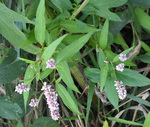
Polygonum pensylvanicum is an annual herbaceous plant growing 30 to 100 cm tall from a fibrous root system. The stems are erect, often reddish, and may be branched. The leaves are alternate and petiolate, with petioles 1 to 6 cm long. Blades are lanceolate to ovate-lanceolate, 5 to 12 cm long and 1.5 to 4 cm wide, with entire or slightly wavy margins and a smooth surface, sometimes marked with a dark spot near the middle. The flowers are small, pink to rose, densely arranged in elongated, cylindrical spikes, 2–10 cm long, blooming from July through September. Each flower has five , pink to reddish tepals about 3 to 5 mm long and 1.5 to 2 mm wide and eight stamens with yellow anthers. The pistil has a superior ovary with three slender styles. The fruit is a small, three-angled achene about 2 to 3 mm long and 1.5 to 2 mm wide, maturing from late summer into fall. Pennsylvania smartweed is native to South Dakota and is commonly found in moist to wet habitats such as floodplains, marshes, pond edges, and ditches, especially in the eastern and central regions of the state.
Synonym: Persicaria pensylvanica
-
Polygonaceae Rumex patientia
R. Neil Reese
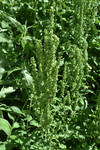
Rumex patientia is a perennial herbaceous plant growing 50 to 150 cm tall from a thick, often reddish, creeping rootstock. Stems are erect, smooth to sparsely hairy. Leaves are alternate, broadly ovate to lanceolate, typically 15 to 40 cm long and 7 to 15 cm wide, with entire to slightly wavy margins and a pointed tip. Basal leaves have long petioles 10 to 20 cm in length; upper leaves are smaller and more lanceolate with shorter or no petioles. Leaf surfaces are smooth or sparsely hairy. The inflorescence is a large, loose panicle of many small flowers blooming from June to August. Flowers have greenish to reddish-brown tepals, usually three to six in number, each 3 to 5 mm long and 1 to 2 mm wide, lanceolate to ovate, with the inner tepals often bearing a tubercle or spine-like tip. Each flower contains six stamens with filaments about 3 to 4 mm long and yellowish anthers approximately 1 to 2 mm long. Pistils number three per flower, each slender and about 4 to 5 mm long, with styles bifid at the tip. Fruits are triangular, three-sided achenes approximately 4 to 6 mm long, dark brown at maturity. Patience dock is native to Eurasia but cultivated and naturalized in South Dakota, commonly found in gardens, disturbed sites, roadsides, and moist open fields , scattered and occasional throughout the state.
-
Polygonaceae: Rumex triangulivalvis
R. Neil Reese
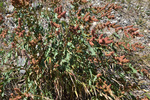
Rumex triangulivalvis is a perennial herbaceous plant growing 40 to 120 cm tall from a thick, creeping rootstock. Stems are erect, smooth to sparsely hairy and often reddish-tinged. Leaves are alternate, broadly ovate to lanceolate, 10 to 30 cm long and 5 to 12 cm wide, with entire to slightly wavy margins and pointed tips. Basal leaves have long petioles, while upper leaves are smaller and may have shorter petioles or be nearly sessile. Leaf surfaces are smooth or sparsely hairy. The inflorescence is a large, loose panicle of many small flowers blooming from June to August. Flowers have greenish to reddish-brown tepals, typically three to six per flower, each 3 to 6 mm long and 1 to 2 mm wide, lanceolate to ovate, with inner tepals often bearing a distinctive triangular shape or tubercle at the tip. Each flower contains six stamens with filaments about 3 to 4 mm long and yellowish anthers approximately 1 to 2 mm long. Pistils number three per flower, each slender and about 4 to 5 mm long, with bifid styles. Fruits are three-sided achenes about 4 to 6 mm long, dark brown to black at maturity, enclosed by the persistent inner perianth. Mexican dock is native to South Dakota and occurs in moist open habitats, disturbed sites, and along waterways, scattered throughout the state.
Synonym: Rumex salicifolius var. mexicanus
-
Polygonaceae : Rumex venosus
R. Neil Reese
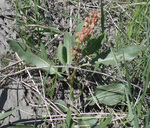
Rumex venosus is a perennial herb from a branching rhizome with erect, branching, reddish, flowering stems that grow 15–40 cm tall. The simple, alternate, petiolate, cauline leaves are lanceolate to ovate, 3–10 cm long with thick leathery blades that are pointed at the tip. The lower most leaves are generally reduced in size. The inflorescence is a panicle with few branches, becoming showy in fruit. The perfect flowers have 2 whorls of tepals 3-4 mm long at anthesis, with 6 stamens and 1 pistil. The outer 3 tepals remain small, the inner tepals (valves), enlarge with the fruit development, becoming reddish, 20–45 mm long orbicular with a cordate-base and lacking growths (tubercles). The fruit are light brown achenes, 5-7 mm long. Wild begonia blooms from April into July on sandy dunes and riverbanks in southern and western South Dakota.