

-
This site is dedicated to Mrs. Dorothy Gill, a Dakota Elder, a mentor and friend.

-
Cyperaceae: Scirpus pallidus
R. Neil Reese
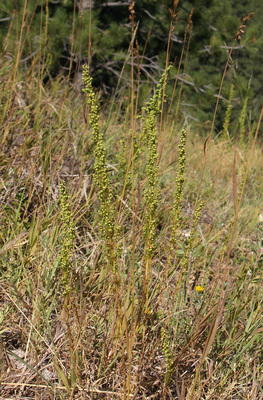
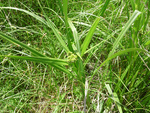
Scirpus pallidus is a perennial, herbaceous sedge that typically forms dense clumps or loose colonies. It grows from a robust, fibrous root system with well-developed, creeping rhizomes. Plants usually range from 50 to 120 cm tall. The stems (culms) are erect, slender, trigonous in cross-section, smooth, and soft, often pale green to green in color. Leaves are mostly basal and reduced, with long, sheathing leaf bases and narrow, grass-like blades; leaf blades can be up to 30 cm long up to 18 mm wide, typically flat or slightly channeled, smooth with a lighter green below and darker above. The sheath at the base is closed, smooth, and often tinged brown or reddish; the collar is indistinct, and the ligule is absent or represented by a short membrane. Flowering occurs from June to August. The inflorescence is a terminal, open to compact panicle (or sometimes head-like cluster), subtended by several leaf-like bracts, with many small spikelets, 2–7 cm across, with each spikelet 5–10 mm long and 2–3 mm wide. Each spikelet is subtended by a scale. The perianth consists of six reduced, bristle-like structures which may aid in seed dispersal. Stamens number three, with slender, pale filaments and small, light brown anthers. The pistil is single, with a short style and a three-branched stigma. Fruit is a small, lenticular achene, 1 mm long, brown at maturity, and matures from late July through September. Pale bulrush is native to South Dakota, found primarily in the eastern and central parts of the state in wet prairies, marshes, streambanks, and along the margins of shallow lakes and ponds.
-
Juncaceae: Juncus arcticus ssp. littoralis
R. Neil Reese
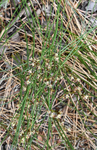
Juncus arcticus ssp. littoralis is a perennial, grass-like herbaceous rush that spreads vigorously through thick, creeping, horizontal, scaly dark-colored rhizomes. The plant typically grows to a mature height of 35 to 110 cm. Its unbranched stems are erect, solid, cylindrical, smooth to finely striate, 1 to 5 mm wide, and light green to dark green. The leaves are entirely basal and lack an expanded lamina or blade, rendering the leaf type a simple, vestigial structure wrapped around the stem base. These bladeless leaf sheaths are 2 to 15 cm long, varying from light tan to dark chestnut brown, and can be dull or shiny. The leaf sheaths feature fused margins that tightly clasp the stem, terminating in small, rounded, ear-like extensions (auricles) at the top. They lack a true distinct ligule or collar. Flowering occurs from June to August. The inflorescence is a lateral-appearing, branched cyme measuring 1 to 7 cm long and contains 5 to 50+ individual flowers. It appears to emerge from the side of the stem because the lowest involucral bract is green, cylindrical, and extends vertically up to 20 centimeters past the flowers, mimicking a seamless continuation of the stem. Individual flowers are small, bisexual, and radial with 6 separate perianth segments (tepals) arranged in two rows. The 3 outer sepals are free, lanceolate, 3.5 to 5 mm long, dark brown to purplish with green midribs, and sharply pointed. The 3 inner petals are similarly free, lanceolate, 3 to 4.5 mm long, and share the same dark brown coloration, but are distinguished by having wider, translucent membranous margins. The flowers have 6 stamens with very short filaments and prominent, linear, yellowish anthers. The single pistil consists of a superior, 3-chambered ovary bearing a short style and 3 long, feathery, protruding reddish-brown stigmas. The fruit is a small, 3-sided ovoid-oblong capsule measuring 3 to 4.5 mm long. It transitions from green to a glossy, dark chestnut brown or blackish color as it reaches maturity between July and October. Mountain rush is native to South Dakota. It is widely distributed across the state, with high concentrations throughout the central prairies and the western wet meadow complexes of the Black Hills region. It is primarily found in wetland habitats, including fens, marshes, wet meadows, stream margins, lake shores, roadside ditches, and low-lying alkali flats.
Synonym: Juncus balticus
-
Juncaceae: Juncus torreyi
R Neil Reese
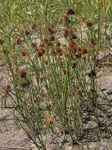
Juncus torreyi is a perennial herbaceous rush form loose colonies from a creeping rhizome, with stiffly erect, unbranched culms 30-80 cm tall. There are 1-3 basal leaves and 2-5 alternate leaves on the culms. Leaves are round in cross-section, often longer than the culms, with cross partitions at regular intervals. The sheath is open at the front with a pair of rounded lobes, 1-4 mm long. The inflorescence consist of 1-many flower heads in a tight cluster at the top of the stem. Each flower head is 1-1.5 cm in diameter, round, with up to 100 flowers. Each flower has 6 tepals, green to straw-colored, drying to dark brown, in 2 whorls, the outer set longer than the inner set. There are 6 stamens, a 3-parted style and the fruit is a capsule. Torrey’s rush blooms from June into October along lakes, streams in wet prairies and ditches throughout South Dakota.
-
Juncaginaceae: Triglochin maritima L.
R. Neil Reese
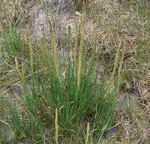
Triglochin maritima is a long-lived perennial, densely tufted, grass-like herbaceous monocot arising from a thick, stout, woody rhizome. The plant reaches a height of 30 to 100 cm at full maturity. Its flowering stems (scapes) are erect, unbranched, leafless, smooth, and stout. The leaves are entirely basal, simple, linear, alternate, and visually resemble thick blades of grass. They are bright green to deep green, measuring 8 to 30 cm long and about 2 to 5 mm wide. The leaf surfaces are fleshy, smooth, and glabrous; they feature a rounded or crescent-shaped cross-section that is flat or slightly channeled on the upper surface and rounded on the lower surface. The leaves transition directly into a wide, open, membranous sheathing base that clasps the stem. At the junction of the leaf sheath and blade, there is a prominent membranous ligule that measures 1.5 to 5 mm long with an entire or slightly notched/bilobed tip. Flowering occurs from May through August. The inflorescence is a dense, spikelike, terminal raceme measuring 10 to 40 cm in length, borne well above the foliage. The tiny, wind-pollinated flowers lack true distinct sepals and petals, featuring instead a perianth composed of 6 scale-like, yellowish green to purple-tinged segments arranged in two whorls of three. The outer three segments and the inner three segments are all free, concave, and roughly 2 mm long. The flower contains 6 stamens with short, nearly sessile filaments that are weakly fused to the base of the perianth segments; they carry small, greenish-yellow anthers. The compound pistil consists of 6 fully fertile, fused carpels with 6 sessile, feathery, papillate stigmas. The fruit is an oblong to almost cylindrical schizocarp, 3 to 8 mm long, which splits completely at maturity into 6 distinct, single-seeded mericarps. These fruits ripen from green to a dark brown color between July and October. Seaside arrowgrass is native to South Dakota, where it can be found locally within glaciated wetland regions, particularly in fens, wet alkaline lowlands, and brackish or saline marshes.
-
Poaceae: Alopecurus pratensis
R. Neil Reese
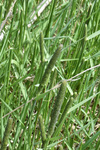
Alopecurus pratensis is a perennial grass in the Poaceae family. It forms dense tufts from a fibrous root system and can also spread via short rhizomes, sometimes forming loose sod. The stems (culms) are erect, simple, and unbranched, typically 40–110 cm in height and are smooth with little or no pubescence. Leaves are mostly basal, soft, flat, and linear, 3–10 mm wide and up to 35 cm long, with a rough texture and finely serrated margins; the ligule is long (up to 8 mm), membranous, and pointed, which is a distinguishing feature. Cauline leaves are fewer and shorter. Inflorescences appear from April to June and are dense, cylindrical spikes (5–12 cm long) that resemble a fox’s tail. Each bisexual spikelet is subtended by two glumes and contains a single floret with one lemma, a short palea, and a straight awn (5–8 mm) extending just beyond the glumes. The fruit is a caryopsis (grain), 2–3 mm long, narrow, and brown at maturity, ripening in early to mid-summer. Meadow foxtail is an introduced, cool-season grass in South Dakota, commonly found in moist meadows, pastures, ditches, and along streambanks, and is most abundant in the eastern part of the state and areas with higher soil moisture.
-
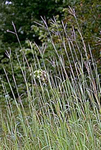
Poaceae: Andropogon gerardii
R. Neil Reese
Andropogon gerardii is a perennial warm season bunch grass. Mature plants have a well-developed fibrous root system 2-3 m deep, sending out short rhizomes, forming large dense bunches. The stems grow 1-3 m tall and become purplish toward the base. which grows 5 dm to 20 dm in height. These culms are solid and grooved on one side. The leaves have prominent midribs but are not keeled, many at the base of the plant and a few coming from the culm. The ligule is a fringed membrane 0.4-2.5 mm long. The inflorescence is a raceme of 3 (2-6) narrow racemes alternately arranged along the top of the stem, often looking like a turkey foot. Each raceme contains many pairs of spikelets, each pair having a stalked spikelet with another stalkless spikelet at the base of the stalk. The stalkless spikelet usually has a fertile, perfect floret with an awn, and the stalked spikelet is sterile or has a staminate flower that is awnless. This species is commonly found in pastures, along roadsides, and in open prairies. Big bluestem has green rust-red flowers that bloom from July to October.
-
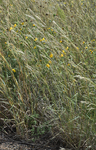
Poaceae: Andropogon hallii
R. Neil Reese
Andropogon hallii is a warm-season perennial, rhizomatous grass that spreads via deep, expansive fibrous roots and elongated, creeping, scaly rhizomes. It reaches a plant height of 90 to 210 cm at maturity. The upright stems are robust, strongly glaucous, and often display yellowish-green coloration near the joints. The leaves have an alternate insertion pattern, featuring simple, linear blades that are blue green to grayish green in color. Individual leaves measure up to 30 cm long and 2 to 10 mm wide. The upper surface is flat to slightly keeled with a prominent midrib and occasional long hairs near the blade base, while the lower surface is smooth and glabrous. Its leaf sheath is open and shorter than the internodes, the collar is distinct and hairless, and the ligule consists of a conspicuous fringed membrane measuring 2 to 4.5 mm long. Flowering occurs from August to October. The inflorescence consists of terminal digitate or panicle-like clustering of spikelets, measuring 4 to 9 cm long and 1.5 to 3 cm wide, comprised of 2 to 3 heavily pubescent branches (rames) with long, dense, yellowish hairs. The flowers are arranged within paired spikelets, each protected by hardened, glaucous glumes that are lanceolate and 7 to 10 millimeters long. The florets contain 3 stamens with distinct linear anthers that change from yellow to reddish-brown as they mature, with a single pistil featuring a superior ovary, 2 distinct styles, and feathery purple stigmas. The fruit is a caryopsis (grain) enclosed within the fertile lemma and palea, displaying an oblong shape, a tan-to-brown color, about 3 to 5 mm long, reaching maturity from late September through October. Sand bluestem is native to South Dakota. It is primarily distributed across the southern and western portions of the state, specifically within the Nebraska Sandhills extension into South Dakota, where it thrives in open sand prairies, sand dunes, and xeric, sandy blowouts.
-
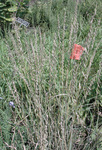
Poaceae : Bouteloua curtipendula
R. Neil Reese
Bouteloua curtipendula is a rhizomatous perennial, warm season bunchgrass, with solid, erect culms arising in clumps. The leaf blades are rolled in the bud, but flat at maturity, 2-30 cm long and 2-6 mm wide. The upper surface is rough to the touch and often has hairs, especially along the margins. The lower surface is smooth. The ligule is fringed to eroded in appearance and less than 1 mm long. The inflorescence consist of 20-45 branches, 5-14 mm long, each with 3-8 spikelets, along the top 15 to 25 cm of the culm. The spikes often fall to one side of the stem, which gives the plant its name. Each spikelet is 4.5 to 10 mm long, with 2 glumes (bracts) and 2 florets, 1 sterile and 1 fertile with orange to brownish red anthers and a feathery 2 white stigmas. The fruit is a 1-seeded grain. Sideoats grama blooms from Jun into August on open grasslands and in woodland openings throughout South Dakota.
-
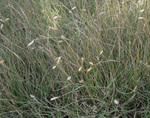
Poaceae : Bouteloua dactyloides
R. Neil Reese
Bouteloua dactyloides is a perennial, strongly stoloniferous, mat-forming grass, with solid culms that grow 3-20 cm in height. The leaves are rolled in the bud and flat at maturity, 1-10 cm long and up to 2 mm wide, smooth except with a few hairs in the collar region. The ligule is a fringe of hairs < 1 mm long, often flanked by long hairs. The plants are dioecious, the male inflorescences are on slender culms Having 2-5 one-sided branches, 7-13 mm long with 2 rows of spikelets each surrounded by 2 unequal bracts (glumes) one 1.4-3 mm the other < 5 mm long , surrounding 2 florets with 3 or fewer stamens. The male inflorescences are often retained into the fall. The female plants produce spikelets in 2-3 burr-like clusters subtended by modified foliage leaves, with 2-3, 1-flowered spikelets per burr. The fruit are grains that are retained in the burr. Buffalograss blooms from April into June in prairies predominantly on western South Dakota.
Synonym: Buchloe dactyloides
-
Poaceae : Bouteloua gracilis
R. Neil Reese
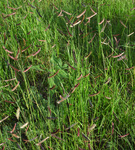
Bouteloua gracilis is a mat-forming perennial grass, growing from short rhizomes, with solid culms reaching up to 50 cm in height. The leaf blades are C-shaped in the bud and flat to slightly rolled at maturity, 1-19 cm long and 0.5-2.5 mm wide. The leaf surfaces are often rough to the touch and may have hairs on one or both sides. The ligule is a short fringe of hairs less than 0.5 mm long. The inflorescence consists of 1-3 branches, 14-40 mm long bearing numerous spikelets. Each spikelet is surrounded by a pair of unequal glumes (bracts) with hairs along the midribs, one < 3.5 mm the other < 6mm long, containing 1 sterile and 1 fertile floret, each with a short awn. Fruit are single seeded grains. Blue grama blooms from June through August on dry prairies and waste grounds throughout South Dakota.
-
Poaceae : Bouteloua hirsuta
R. Neil Reese
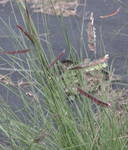
Bouteloua hirsuta is a tufted perennial grass, with solid, erect and sometimes bent culms, which grow 10 cm to 45 cm in height. The leaves are basal and alternate on the culms, c-shaped in the bud and flat to rolled at maturity. The blades are 5-25 cm long and 1-3 mm wide, with thickened margins and long, white hairs with pimple-like bases on at the base of the blade, on the margins and occasionally on either or both surfaces. The leaf sheath is smooth to hairy, especially near the ligule and the ligule is a fringe of hairs < 0.5 mm long. The inflorescence has 1 (occasionally 2+) branch, 15-30 mm long, that has 20 to 50 spikelets arranged on one side of the rachis, tightly packed in 2 rows, with the tip of the rachis extending 5 to 10mm beyond the terminal spikelet. The spikelets each have 2 unequal bracts (glumes) with extended tips (awns) that are green to purple, one < 4 mm long and the other 5 to 6 mm long with hairs along the midrib, which enclose one fertile and usually one sterile floret. The fruit is a 1-seeded grain, oblong-elliptic, brown, 2.5 to 2.6 mm long. Hairy grama blooms from July into October in prairies and pastures in southern South Dakota.
-
Poaceae: Brachyelytrum erectum
R. Neil Reese
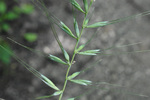
Brachyelytrum erectum is a perennial, tufted grass with a short, fibrous root system and sometimes creeping rhizomes, though it rarely forms dense colonies. The plant has upright to arching, slender stems (culms) that are typically unbranched, growing 40–100 cm tall. Leaf blades are alternate, thin, flat, and softly hairy, 10–30 cm long and 0.5–2 cm wide, tapering to a pointed tip, with margins that may be rough to the touch. The leaf sheath is open, and the ligule is a short fringe of hairs. The inflorescence is a narrow, nodding panicle (spike-like in appearance), 5–15 cm long, with few to several spikelets. Spikelets are one-flowered, about 1–1.5 cm long, with a long, straight or slightly bent awn extending from the lemma. The fruit is a small, brown, dry caryopsis (grain) about 3–5 mm long, maturing in late summer. Bearded Shorthusk is native to South Dakota, generally found in rich, moist to mesic deciduous woods, shaded slopes, and streambanks, especially in the eastern and central regions.
-
Poaceae: Bromus inermis
R. Neil Reese
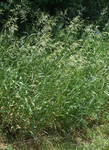
Bromus inermis is a long-lived perennial, herbaceous cool-season grass equipped with an aggressive, deeply penetrating fibrous root system coupled with an extensive network of tough, creeping underground rhizomes that form a dense sod. The plant typically reaches a mature height of 60 to 120 cm. Its erect, unbranched, and robust stems (culms) are smooth and completely glabrous, though the nodes may occasionally feature fine, sparse hairs. Leaf insertion is alternate along the culm, bearing simple, flat, linear, and deep green to grayish-green leaf blades that measure 15 to 40 cm in length and 5 to 15 mm in width. The leaf surfaces are primarily smooth and glabrous on both upper and lower faces, though they uniquely exhibit a conspicuous, tactile, "M" or "W"-shaped crinkle or crimp situated near the middle of the blade. Structurally, the leaf sheaths are continuous and closed (fused) for most of their length—a defining characteristic of the genus—and are hairless or nearly so. The collar is a distinct, pale band, while the ligule is a short, truncate, membranous ring measuring 0.5 to 3 mm long with an entire to slightly lacerate margin. Flowering occurs from June through July, giving rise to an open, terminal panicle inflorescence that measures 10 to 20 cm in length. The panicle branches are initially erect and spreading but typically droop or nod slightly to one side at maturity. Each branch holds multi-flowered, elongated, cylindrical spikelets that span 20 to 40 mm long. Two unequal, unawned glumes occur at the base of each spikelet. The lower glume is single-nerved, 4 to 6 mm long, while the upper glume is three-nerved, 6 to 10 mm long; both are lanceolate, free, glabrous, and green with purplish or translucent margins. The lemma is oblong-lanceolate, 9 to 12 mm long, purplish-brown to green, unnotched or slightly notched at the apex, and notably lacks an awn (or bears a minute vestigial awn under 1 mm long). Inside each floret, the androecium contains 3 stamens with prominent, pale yellow to reddish purple anthers measuring 3.5 to 6 mm in length. The gynoecium consists of a single pistil with a superior, 1-celled ovary bearing 2 distinct, feather-like styles and stigmas projecting laterally during anthesis. The fruit is a specialized caryopsis (grain) that is flat, linear-oblong, dark brown to purplish-black, measures 6 to 8 mm long, and tightly adheres to the palea. The grains ripen to full maturity between July and August. Smooth brome is not native to South Dakota; it is an introduced species native to Europe and temperate Asia. Since its introduction, it has spread aggressively throughout the entire state of South Dakota. It is primarily found invading disturbed areas, degraded prairies, old pastures, roadside ditches, and fields where it readily outcompetes native vegetation.
-
Poaceae: Bromus tectorum
R. Neil Reese
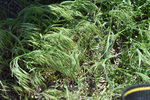
Bromus tectorum is an annual grass with a fibrous root system that often penetrates deeply into the soil, reproducing solely by seed. The culms (stems) are slender, erect to ascending, and typically 20–70 cm tall, often loosely tufted and branching only at the base. The plant is densely covered in soft, fine hairs, giving it a downy texture throughout. Leaf blades are alternate, linear, 5–20 cm long and 2–5 mm wide, flat or loosely folded, and also softly hairy. Sheaths are open and hairy, with a membranous, notched ligule at the base of each blade. Flowering occurs in the late spring to early summer. The inflorescence is a loose, nodding panicle 7–20 cm long, often purplish at flowering, with slender, drooping branches. Spikelets are 1.5–3 cm long (excluding awns), each with 5–8 florets. Each floret has a lemma with a long, straight awn (10–15 mm) that becomes conspicuously sharp and barbed at maturity. The fruit is a slender, brown caryopsis (grain), maturing in early to mid-summer. Cheatgrass is introduced and invasive in South Dakota, rapidly colonizing disturbed ground, pastures, rangelands, roadsides, and open woods, found statewide but especially abundant in dry, open sites.
-
Poaceae: Cenchrus longispinus
R Neil Reese
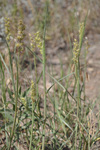
Cenchrus longispinus is an annual grass with solid culms 20-60 cm tall. Multiple culms can be sprawling, ascending or erect, are smooth, often branching and mostly covered by the sheaths. The stem is often reddish at the base and light green above. The ligule is fringed with short, white hairs, 0.6-1.8 mm long. The sheath is contracted where the blade emerges, open at the front, and sometimes with a few long hairs at the constriction. The alternate leaves , 4-14 cm long, 3-7 mm wide, rough on the upper surface, mostly smooth on the lower, flat, folded lengthwise, or rolled up along the edges. The inflorescence consists of terminal and axillary spike-like clusters of burs, 2.5-10 cm long. Each bur has 30 or more spines of various sizes, the largest ones 3-5 mm long. There are with 2 or 3 spikelets per bur and 2 florets per spikelet, 1 fertile and the second staminate of sterile. The fruit are a single grain per spikelet that are retained within the bur. Sandbur blooms from July into September in disturbed ground throughout South Dakota.
-
Poaceae: Echinochloa muricata
R. Neil Reese
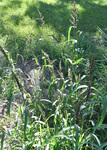
Echinochloa muricata is an annual grass growing from a fibrous root system. Stems are 30 to 100 cm in height, erect and robust, often branched near the top, usually smooth or slightly rough, with a round to slightly flattened cross-section. Leaves are alternate and linear-lanceolate, 10–30 cm long and 1–2 cm wide, with rough margins and a prominent midrib. The leaf sheath encloses the stem partially; the ligule is membranous, short, and translucent. Flowering occurs from mid to late summer (July–September). The inflorescence is a large, open, pyramidal to somewhat contracted panicle up to 20 cm long, composed of many spikelets. Each spikelet is flattened, lanceolate, about 3–6 mm long, green to purplish, bearing one to several florets. Spikelets have a scabrous (rough) surface covered with minute prickles (muricate texture), which gives the species its name. Each floret has three stamens and two feathery stigmas. The fruit is a small, oval caryopsis (grain), enclosed within a hardened lemma and palea, brown at maturity and 1.5–2 mm long, maturing in late summer. Rough barnyard grass is native to South Dakota, found in wetlands, ditches, floodplains, moist fields, and disturbed wet sites statewide, especially in eastern parts of the state.
-
Poaceae: Elymus canadensis
R. Neil Reese
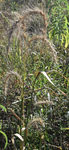
Elymus canadensis is a perennial cool-season bunchgrass growing from a robust, fibrous root system forming clumps rather than sod. . Stems (culms) are sturdy, erect, rigid, and typically 60–150 cm tall, smooth to slightly rough. Leaves are alternate, flat, and linear, typically 10 to 30 centimeters long and 5 to 15 millimeters wide, with rough margins and a blunt or tapered tip and sheaths that tightly wrap the stem. Both basal and cauline leaves are present. The ligule is prominent, translucent, membranous, about 2 to 5 millimeters long, with a finely toothed or jagged margin. The inflorescence is a dense, spike-like raceme 10 to 30 centimeters long, composed of several spikelets arranged in two rows along the axis. Each spikelet is 10 to 15 millimeters long, containing 2–5 florets with awns 1–3 cm long. Flowers are bisexual, with three stamens with slender filaments and large anthers and a single pistil topped with two feathery stigmas The fruit is a caryopsis (grain), 5–7 mm long, brown at maturity, ripening in late summer. Canada wild rye is native to South Dakota, growing in prairies, open woodlands, roadsides, and disturbed sites statewide, with higher abundance in central and eastern regions.
-
Poaceae: Elymus repens
R. Neil Reese
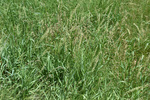
Elymus repens is a perennial, cool-season grass that spreads aggressively via rhizomes, often forming dense mats. Stems (culms) are erect to arching, simple to sparingly branched, typically 30–120 cm tall, smooth or slightly roughened near the nodes. Leaves are alternate, flat, linear, typically 10 to 30 centimeters long and 5 to 12 millimeters wide, with rough margins, a pointed tip and sheathing bases. The ligule is membranous, about 2 to 4 millimeters long, with a jagged or irregular margin. The inflorescence is a slender, spike-like raceme 10 to 25 centimeters long, composed of numerous spikelets arranged in two rows along the axis. Spikelets are 10 to 18 millimeters long, each containing 2–4 florets with long awns often 3–6 cm in length giving the spikes a bristly look. Flowers are bisexual with three stamens and a single pistil crowned with two feathery stigmas. Fruits are caryopses (grains) about 4 to 7 millimeters long, enclosed by the lemma and palea. Seed maturation occurs from late summer to early fall. Quackgrass is native to Europe and parts of Asia. It is naturalized in South Dakota and considered an invasive weed, abundant in croplands, roadsides, disturbed soils, and pastures statewide.
-
Poaceae : Hierochloe hirta
R. Neil Reese
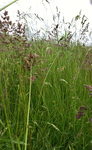
Hierochloe hirta is a perennial rhizomatous sod-forming grass with erect, hollow, hairless culms that grow 10 to 70 cm in height. The culms appear early in the spring and large tufts of basal leaves follow. The shiny leaf blades are rolled in the bud and flat at maturity, 10-30 cm long and 2-5 mm wide, with the 2-3 alternate culm leaves being much shorter and somewhat narrower, occasionally with hairs at the collar. The ligule of the culm leaves is membranous and 2-3 mm long. the inflorescence is a 4-9 cm long panicle of 3-floret spikelets, with the 2 lower florets having just stamens and the upper one being perfect. The 3 spikelets are surrounded by 2 bracts (glumes) that are usually membranous, hairless and slightly unequal in length. The bracts subtending the individual florets (lemma and palea) are often hairy. Sweetgrass blooms from May into July in wet meadows, sloughs and marshes in the northeastern and southwestern portions of South Dakota.
Synonym: Anthoxanthum hirtum
-
Poaceae: Koeleria macrantha
R.n Neil Reese
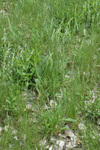
Koeleria macrantha is a perennial bunchgrass typically growing 15 to 60 cm tall. It grows from a fibrous root system forming tufts or clumps. The stems are slender, erect, and generally glabrous or finely pubescent. Leaves are mostly basal and alternate along the stem, simple and linear, measuring about 5 to 15 cm long and 2 to 5 mm wide, with entire margins and smooth to slightly rough surfaces due to minute hairs. Leaf sheaths are open, smooth or slightly pubescent, and mostly shorter than the internodes. The ligule is membranous, short (1–2 mm), and rounded to truncate. The inflorescence is an open, narrow panicle that flowers from late spring to early summer (May–July). Spikelets are about 8 to 15 mm long, each containing several florets with three stamens per floret. The pistil consists of a single ovary with two feathery stigmas. The fruit is a small caryopsis (grain) about 2 to 3 mm long. In South Dakota, Junegrass is native and commonly found in dry prairies, open rocky slopes, and well-drained sandy or gravelly soils across much of the state.
-
Poaceae: Leymus cinereus
R. Neil Reese
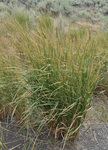
Leymus cinereus is a robust perennial bunchgrass growing 60 to 150 cm tall. It has a fibrous root system with extensive rhizomes, allowing it to spread and form dense clumps. The stems are erect, round to slightly flattened, and typically glabrous or sparsely hairy. Leaves are alternate, simple, and linear, measuring about 15 to 40 cm long and 8 to 15 mm wide, with entire margins and smooth to slightly rough surfaces. Leaf sheaths are open, smooth or sparsely pubescent, and longer than the internodes. The ligule is a short, membranous fringe about 1 to 2 mm long. The inflorescence is a narrow, dense spike or spike-like panicle flowering from late spring to mid-summer (May–July). Spikelets are 10 to 20 mm long, each containing multiple florets. Flowers have three stamens, and the pistil consists of a single ovary with two feathery stigmas. The fruit is a caryopsis approximately 4 to 6 mm long. Basin wild rye is native to South Dakota and thrives in a variety of habitats including prairies, riverbanks, and disturbed sites, especially in well-drained soils.
-
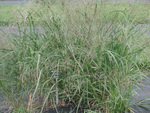
Poaceae : Panicum virgatum
R. Neil Reese
Panicum virgatum is a rhizomatous perennial clump-forming grass, with multiple, erect hollow culms, that grows to 1.5 m tall. The leaves are all alternate, ascending to droopy, the leaf blades flat to rolled upward, 15-55 cm long and 5-11 mm wide, smooth to hair covered, particularly on the upper surface above the ligule. The ligule is 2-4 mm long consisting of a fringe of hairs on a membranous base. The inflorescence is a very open and diffuse panicle, 20-45 cm long, with slightly compressed, purplish spikelets, containing 1 fertile and 1 often staminate floret, surrounded by unequal bracts (glumes), the smaller 2.3-4 mm long and the larger 3.3-6 mm long, narrowly egg-shaped and tapering to a pointed tip. The glumes spread apart as the flower develops, with the stamens and styles becoming visible. A single grain develops in each spikelet. Switchgrass blooms from July through September in moist lowlands and prairies throughout South Dakota.
-
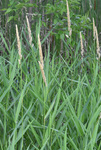
Poaceae: Phalaris arundinacea
R. Neil Reese
Phalaris arundinacea is a robust, perennial grass growing from a vigorous, rhizomatous root system. The roots are thick, fibrous, and rhizomes extend horizontally underground, allowing the rapid formation of dense colonies. Stems are erect, hollow, and can reach heights of 1 to 2.5 meters. The leaves are alternate, flat, and linear, 20 to 50 cm long and 1 to 3 cm wide, with rough margins and a prominent midrib. The leaf sheaths are open, and ligules are short and membranous. The inflorescence is a dense, cylindrical to spike-like panicle 5 to 15 cm long, blooming from late spring through summer (June–August). Spikelets are 5 to 7 mm long, each containing several florets with two glumes. Flowers have three stamens with yellow anthers and feathery stigmas. The fruit is a small caryopsis (grain) about 3 to 5 mm long, maturing in late summer. Reed canary grass is native to South Dakota and commonly found in wetlands, stream banks, marshes, ditches, and moist meadows throughout much of the state, especially in the eastern and central regions.
-
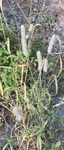
Poaceae : Phleum pratense
R. Neil Reese
Phleum pratense is a tufted perennial grass with smooth, hollow, erect, bulbous-based culms that grow 55-140 cm in height. The leaves are rolled in the bud and flattened at maturity. The blades are 3-27 cm long, up to 8 mm wide and occasionally rough to the touch. The leaf sheaths are open with a membranous ligule, 2-5 mm long, V-shaped at the front, white, and ragged at the top. The inflorescence is a cylindrical spike-like raceme of single-flowered spikelets, 2-25 cm long and < 1 cm wide. Each spikelet has a pair of equal bracts (glumes), 3 to 4 mm long including the awn. The fruit is a single grain, often retained within the glumes. Timothy blooms from late May into early August in pastures, along roadsides and in ditches scattered throughout South Dakota. This species was introduced as a forage grass and has become naturalized in many areas.
-
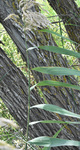
Poaceae: Phragmites australis
R. Neil Reese
Phragmites australis is a tall, perennial grass growing from an extensive, aggressive rhizomatous root system. The rhizomes are thick, woody, and spread horizontally underground, allowing the plant to form dense, often monoculture stands. The roots are fibrous and deeply penetrating, anchoring the plant in wet soils. Stems are erect, hollow, with a smooth texture, and can reach heights of 2 to 4 meters. The leaves are alternate, flat, and linear, 20 to 60 cm long and 2 to 5 cm wide, with rough margins and a pointed tip. The leaf sheaths are smooth, and ligules are short (> 1 mm) and membranous. The inflorescence is a large, feathery, plume-like panicle 15 to 40 cm long, blooming from August through September. Spikelets are small, about 4 to 6 mm long, each containing several florets. Flowers have three stamens with yellow anthers and feathery stigmas. The fruit is a small caryopsis (grain) about 2 to 4 mm long, maturing from September into October. is native to South Dakota or naturalized and occurs in wetlands, marshes, ditches, and along lakes and riverbanks statewide, particularly in lowland and floodplain areas.