

-
This site is dedicated to Mrs. Dorothy Gill, a Dakota Elder, a mentor and friend.

-
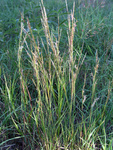
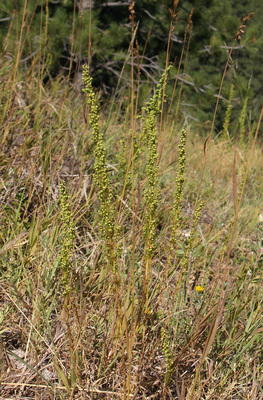
Poaceae : Schizachyrium scoparium
R. Neil Reese
Schizachyrium scoparium is a tuft forming, perennial bunchgrass with short rhizomes and solid, slightly flattened culms that grow to 1 m in height. The leaf bluish colored blades are folded and sometimes rolled under, smooth to hair, especially near the collar, 4-30 cm long and up to 4 mm wide. The usually hairless sheath has a keel and the membranous ligule is fringed and < 2.5 mm long. The flowering culms are many branched, each terminating in a single spicate straight to undulating raceme, 2-6 cm long, the rachis and pedicels hairy. The copper colored spikelets occur in pairs, one sessile and perfect with bracts (glumes) 6-9 mm long, the other pedicellate and usually staminate with glumes 3-6 mm long. Little bluestem blooms from July into October on prairies throughout South Dakota.
-
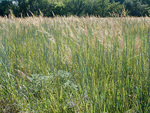
Poaceae : Sorghastrum nutans
R. Neil Reese
Sorghastrum nutans is a perennial, warm-season bunchgrass with a fibrous root system and short, scaly rhizomes, forming loose, upright clumps. Mature stems are erect, stout, round, hollow, culms, 0.6-2 m tall, that have hairy nodes, often with a bluish green to golden hue. Leaves are alternate, simple, the blades are rolled in the bud and flat at maturity, 5-60 cm long, 3-12 mm wide, with a prominent midrib near the base and rough margins. The sheath is smooth to hairy, with projections from the collar and joined to the firm, membranous ligule that is 2-7 mm long, fringed with long, silky hairs. The upper surface is green and smooth, while the lower surface is slightly paler and may be finely hairy near the base. Leaf blades taper gradually to a pointed tip. Flowering occurs from August to October, with the inflorescence forming a narrow, plume-like, golden-brown panicle 15–30 cm long, composed of many paired spikelets. Each spikelet is 8–10 mm long, with a single fertile floret and a conspicuous, bent, twisted awn (15–20 mm long) extending from the lemma. The hairy, subequal glumes are lanceolate, 7–10 mm long, yellowish to purplish, and often shiny. Stamens are three per floret, with large, yellow anthers (3–5 mm long) that dangle from the florets at anthesis. The pistil consists of a single ovary, a slender style, and two feathery stigmas. The fruit is a small, brown, ellipsoid caryopsis (grain), 4–5 mm long, maturing in late fall and often retained in the inflorescence through winter. Indiangrass is native to South Dakota and occurs throughout the state, especially in prairies, open woodlands, roadsides, and other well-drained, sunny habitats.
-
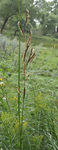
Poaceae: Spartina pectinata
R. Neil Reese
Spartina pectinata is a perennial, warm-season grass with a robust, extensive rhizome system that forms dense, tufted, spreading colonies. Mature plants typically reach 1–2.5 meters in height. Stems are erect, stout, round, and unbranched, often rough to the touch due to tiny hairs. Leaves are alternate, simple, linear, 30–100 cm long and 0.5–2 cm wide, with very rough, scabrous margins and a prominent midvein; the upper surface is green and smooth, while the lower surface is coarser. Leaf bases are sheathed and often overlap, with a short, membranous ligule (1–2 mm) at the junction of blade and sheath. Petioles and stipules are absent, as is typical for grasses. Flowering occurs from July to September, with the inflorescence forming a distinctive, one-sided, comb-like raceme (spicate panicle) 10–30 cm long, composed of 10–40 closely spaced, sessile spikelets arranged alternately along the main axis. Each spikelet is 10–15 mm long, flattened, with two glumes and a single fertile floret. Glumes are lanceolate, 10–15 mm long, greenish to yellowish, rough-edged, and often pointed, one with an awn 1-4 mm long. Each floret has three stamens with long, yellow anthers (2–4 mm) and a pistil with two feathery stigmas; the ovary is single and superior. The fruit is a small, brown, ellipsoid caryopsis (grain), 3–4 mm long, maturing in late summer to early fall and often dropped quickly after ripening. Prairie cordgrass is native to South Dakota and widespread across the state, thriving in wet prairies, sloughs, marsh edges, roadside ditches, and stream banks, especially in moist to wet, periodically flooded soils in full sun.
-
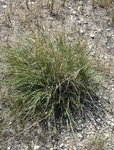
Poaceae: Sporobolus airoides
R. Neil Reese
Sporobolus airoides is a warm-season, long-lived perennial grass that forms densely tufted, robust bunchgrass structures or large tussocks supported by a deep, coarse, and glossy fibrous root system. The plant relies on basal tillering to form broad clumps that reach a total height of 35 to 120 cm (or up to 150 cm under optimal conditions). The flowering stems (culms) are erect to spreading or decumbent at the base, round, smooth, hollow, and notably stout and solid near the crown. Leaf insertion along the culm is alternate and two-ranked. The simple, unlobed leaves feature a distinct, shiny, and smooth sheath that is open along its margins and sparingly pilose with a tuft of long hairs (up to 6 mm) at the throat. The leaf collar is distinct, and the ligule is reduced to a minute line of short, stiff hairs measuring 0.1 to 0.3 mm long. Leaf blades are stiffly fibrous, flat to strongly involute (rolled inward towards the margins), tapering to a sharp, fine point; they are gray green to silvery-green, 5 to 35 cm long, and 1 to 5 mm wide, with smooth to slightly roughened upper and lower surfaces. Flowering occurs from early summer to autumn (June to October). The inflorescence is a massive, diffuse, and open pyramidal panicle measuring 10 to 45 cm long and 15 to 25 cm wide; its lower portion is initially enclosed in the uppermost leaf sheath before expanding fully into a cloudy haze of fine branches. Each floret contains a single-flowered spikelet. The outer bracts (the glumes) are unequal, 1-veined, acute, glabrous, and range in color from pale green to purple, with the lower glume measuring 1.5 to 1.8 mm long and the upper glume measuring 1.1 to 2.8 mm long. The lemma is membranous, veinless or 1-veined, acute, awnless, and 1.2 to 2.5 mm long, tightly matching the palea in texture and length. Inside these bracts sit 3 stamens with distinct, slender filaments bearing prominent, pale to reddish-purple anthers that are 1.1 to 1.8 mm long. The single compound pistil features a superior ovary with 2 distinct, highly plumose (feathery) styles and receptive stigmas. The fruit is a minute, reddish-brown, obovate to globose caryopsis-like achene (grain) measuring 1 to 1.4 mm long. It reaches maturity from late summer through fall (August to October), separating from the lemma and palea to drop freely or expand out of the drying seed husk. Alkali sacaton is native to South Dakota, occurring primarily in the western and central portions of the state within saline or alkaline flats, claypan prairies, seasonally wet meadows, and low-lying alluvial floodplains.
-
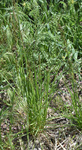
Poaceae: Sporobolus heterolepis
R. Neil Reese
Sporobolus heterolepis is a perennial, warm-season bunchgrass with a fibrous root system and very short, scaly rhizomes, forming dense, arching clumps. Mature plants typically reach 30–90 cm in height, with flowering stems (culms) rising above the foliage to 60–100 cm. Stems are slender, erect, wiry, and smooth, often with a subtle reddish tinge at the base. Leaves are alternate, simple, narrow, and linear, 20–50 cm long and 1–3 mm wide, tapering to a fine point. Leaf blades are medium to dark green, smooth, and hairless above, with a rougher texture below, and often curl gracefully. The leaf base is sheathed with a short, membranous ligule (1–2 mm). Flowering occurs from August to September, with the inflorescence forming an open, airy, pyramidal panicle 15–30 cm long, bearing many tiny spikelets. Each spikelet is 2–3 mm long, ovoid, with a single floret and two unequal, translucent glumes (1.5–3 mm long). The floret has three stamens with yellow anthers (1–1.5 mm long) and a pistil with two feathery stigmas. The fruit is a small, round, tan to orange-brown caryopsis (grain), 1.5–2 mm in diameter, maturing in early fall and readily dropping to the ground at maturity. Prairie dropseed is native to South Dakota, found throughout the state in prairies, open hillsides, savannas, and roadsides, typically in well-drained, sandy or gravelly soils under full sun.
-
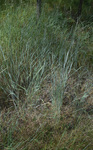
Poaceae: Thinopyrum intermedium
R. Neil Reese
Thinopyrum intermedium is a perennial, cool-season grass with a fibrous root system and long, stout, creeping rhizomes, forming dense, spreading sods. Mature plants typically reach 90–150 cm in height. Stems are erect, round, smooth, and hollow, with distinct nodes and internodes. Leaves are alternate, simple, linear, 15–30 cm long and 3–10 mm wide, with flat or slightly inrolled blades, scabrous margins, and a prominent midvein; the upper surface is green and smooth or slightly rough, while the lower surface is paler. Leaf sheaths are open and smooth with a prominent, membranous ligule 1–2 mm long at the junction of the blade and sheath; auricles are absent. Flowering occurs from June to July, with inflorescences forming narrow, erect, spike-like racemes (spikes) 8–20 cm long, each with 40–60 closely spaced, sessile spikelets arranged alternately along the central axis. Each spikelet is 12–18 mm long, flattened, and contains 5–10 florets. Glumes are lanceolate, 8–12 mm long, green to straw-colored, and rough-edged. Each fertile floret has three stamens with yellow anthers (2–3 mm long) and a pistil with two feathery stigmas. The fruit is a dry, ellipsoid caryopsis (grain), 6–8 mm long, brownish when mature, and matures from July to August. Intermediate wheatgrass is introduced in South Dakota, native to Europe and western Asia, and is now widely established in prairies, pastures, conservation plantings, roadsides, and disturbed areas, especially in moderately moist, well-drained soils under full sun.
-
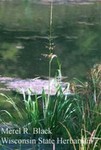
Poaceae : Zizania palustris
R. Neil Reese
Zizania palustris is an annual, solitary-stemmed grass that can grow to over 2 m tall. The erect culms are round, hollow and smooth except at the nodes where they can be hairy. There are both basal and alternat leaves on the culm. Early leaves float on the water’s surface. The leaf blades are rolled in the bud and flat at maturity, 5-100 cm long and 5-35 mm wide. The leaf sheaths are open, smooth with hairs at the collar and base, with a membranous ligule 7-20 mm long. the inflorescence is a much-branched panicle, 15-60 cm long, with male (staminate) spikelets below and female (pistilate) spikelets above. The branches are initially erect with the staminate ones spreading or drooping at maturity. The male spikelets are reddish in color, with 6 stamens that are 4-6 mm long. The female spikelets are paler, 12-15 mm long with a terminal awn 2.5-6.5 cm long. Both the staminate and pistilate spikelets lack glumes (bracts). The fruit is a dark, slender cylindrical grain up to 30 mm long and 2 mm wide. Northern wild rice blooms in July and August on the margins of streams lakes and ponds along the eastern and southern borders of South Dakota.
Synonyms: Zizania aquatica var. interior, Z. interior
-
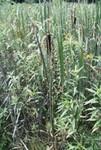
Typhaceae : Typha angustifolia
R. Neil Reese
Typha angustifolia is a perennial herb of wetlands, arising from a stout, creeping rhizome and forming dense colonies, with simple stems reaching up to 3 m tall. The alternate leaves are both basal and cauline, stiff, linear and flat, green, 6-10 mm wide, the uppermost leaves usually reaching well above the flowering spikes. The rounded leaf sheath has a narrow papery edging, near the tip of the sheath where it meets the blade, especially the on upper leaves. The single stems are unbranched, erect and light green. The plants are monoecious, with the brown male flower spike above, up to 20 cm long, separated by 1-8 cm of bare rachis. The brown female spike is about the same length and width, reaching up to 2 cm in diameter in fruit. The fruit is an achene covered in white hairs and with a short stalk. Narrowleaf cattail blooms from May into July in wetlands throughout South Dakota.
-
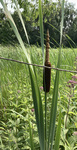
Typhaceae : Typha latifolia
R. Neil Reese
Typha latifolia is a perennial herb of wetlands, arising from a stout, creeping rhizome and forming dense colonies, with simple stems reaching up to 3 m tall. The alternate leaves are both basal and cauline, stiff, linear and flat, green, 10-25 mm wide, the uppermost leaves usually not reaching much above the flowering spikes. The squarish leaf sheath has a narrow papery edging, near the tip of the sheath where it meets the blade. The single stems are unbranched, erect and light green. The plants are monoecious, with the yellowish male flower spike above, up to 25 cm long, generally directly adjacent to the female spike, and the flowers are rapidly deciduous after anthesis. The brown female spike is about the same length and width as the male, reaching up to 3.6 cm in diameter in fruit. The fruit is an achene covered in white hairs and with a short stalk. Broadleaf cattail blooms from May into July in wetlands throughout South Dakota.
-
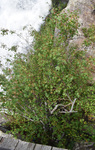
Aceraceae: Acer glabrum
R Neil Reese
Acer glabrum is a deciduous shrub or small tree typically growing 3 to 9 meters tall, characterized by smooth to slightly rough bark. Leaves are opposite, simple, and palmately lobed with 3 to 5 lobes, measuring 5 to 12 centimeters long and 6 to 14 centimeters wide, with petioles about 3 to 9 centimeters long. Leaves are glabrous or sparsely hairy. Flowering occurs from April to June, with flowers borne in small corymbs. Each flower is about 5 to 8 millimeters in diameter, having five greenish-yellow petals approximately 2 to 3 millimeters long and 1 to 1.5 millimeters wide, and five green sepals roughly 1.5 to 3 millimeters long and 0.5 to 1.5 millimeters wide. There are eight stamens inserted around the ovary, with filaments about 3 to 5 millimeters long and small anthers. The pistil consists of two fused carpels forming a superior ovary, with a short style and a bifid stigma. The fruit is a paired samara with wings spreading at nearly 180 degrees, each samara about 15 to 25 millimeters long and 5 to 7 millimeters wide, maturing from late summer to early fall. Rocky Mountain maple is native to western North America and is found in South Dakota primarily in the Black Hills, growing in montane forests and along stream banks.
-
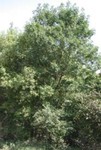
Aceraceae : Acer negundo
R. Neil Reese
Acer negundo is a perennial short-lived tree growing to about 25 to 35 meters. Leaves are opposite compound pinnate with three to seven leaflets. Leaflets are 5 to 10 centimeters long and three to seven centimeters wide. Flowers appear in the spring with staminate flowers that have 3-5 stamens, hang in clusters at the tips of branches and are often maroon in color. Pistillate flowers on drooping clusters of 6-12 flowers having 3-5 sepals and a 2-parted style. The fruit is a winged double samara. The trees are dioecious, with male and female flowers on separate trees.
-
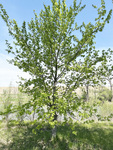
Aceraceae: Acer saccharinum
R. Neil Reese
Acer saccharinum is a fast-growing, deciduous tree with a widespread, shallow fibrous root system. Mature trees typically reach 15–30 meters in height, with a broad, rounded to open crown and often multiple trunks. Bark on young stems is smooth and light gray, becoming deeply furrowed and scaly with age. Leaves are opposite, simple, palmately lobed with 5 deeply cut lobes, 10–20 cm long and wide, with coarsely toothed margins. The upper leaf surface is bright green and smooth or slightly rough, while the lower surface is covered with silvery hairs. Petioles are long, 5–15 cm, often reddish. Flowering occurs in early spring (March to April) before leaf emergence. Flowers are found in clusters of 3 to 6, each flower has 4 to 5 small, inconspicuous, and often yellowish-green or reddish sepals and no petals Both male and female flowers have can be on separate trees or on separate branches on the same tree or occasionally within the same flower cluster. Males flowers have 3-7 (12), erect stamens, 5–6 mm long. The females have two bright red, short (barely visible) arching styles. The fruit is a paired samara with wings spreading nearly horizontally, 3–5 cm long, each nutlet 1–1.5 cm wide, maturing from May to June. Silver maple is native to South Dakota and is commonly found along rivers, floodplains, wetlands, and moist woodlands, preferring rich, moist, well-drained soils in full sun to partial shade.
-
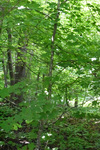
Aceraceae: Acer saccharum
R. Neil Reese
Acer saccharum is a large, deciduous tree, commonly reaching heights of 20–35 meters with a broad, rounded crown and a strong central trunk. Its root system is deep and extensive, supporting its longevity and drought resistance. The bark is grayish-brown, initially smooth, but developing vertical fissures and shaggy plates with age. Leaves are opposite, simple, and palmately lobed with 5 distinct, deep lobes; blades are 8–15 cm long and wide, dark green above and paler below, turning brilliant shades of yellow, orange, or red in autumn. Flowers are small, yellow-green, and appear in pendulous clusters (corymbs) before leaf-out in early spring; each flower has five petals and is functionally unisexual, with trees often monoecious or dioecious. The fruit is a paired samara, each wing 2–3 cm long, maturing from green to brown in late summer. Sugar maple is native to the hardwood forests of eastern North America, from southern Canada through the northeastern U.S. and extending into the eastern edge of South Dakota. It is mainly found as an ornamental or planted in windbreaks throughout the state.
-
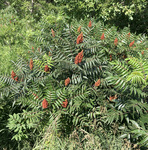
Anacardiaceae : Rhus glabra
R. Neil Reese
Rhus glabra is a shrub to small tree with a spreading, open habit, growing from 3 to 5 m tall and spreading by root suckers to form dense thickets. The young stems and branches are hairless or nearly so and waxy. The bark on older wood is smooth and grey to brown. The compound pinnate leaves are alternate, 30-50 cm long with very short petioles (4-7 mm long). Each leaf has 11–31 oppositely paired leaflets, each leaflet lanceolate to ovate-lanceolate, 7-9 cm long, with a toothed margin. The leaves turn scarlet in the fall. The inflorescence is a dense terminal panicle 10-20 cm long, with numerous tiny green flowers. The fruit are compressed crimson drupes 3.5-4.5 mm in diameter, and they remain throughout the winter. The seeds are yellowish, smooth and about 3 mm long. Smooth sumac bloom in May and June and the fruit ripen in August and September. They are common in open woodlands in thickets, prairies, and roadsides throughout South Dakota.
-
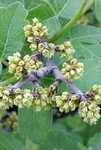
Anacardiaceae: Rhus trilobata
R. Neil Reese
Rhus trilobata is a deciduous shrub, upright, ascending or spreading, 2-3 m tall, branches covered with short hairs when young. The compound leaves are alternate, trifoliate, petiolate, the leaflets are each elliptic to obovate, 1.5-2.5 cm long, with a wedge-shaped base and a few rounded teeth. The terminal leaflet is often 3-lobed. Leaves and branches have an strong unpleasant odor. The inflorescence is a terminal compound spike of dioecious catkins (0.5-2 cm) with 5-merous flowers that have greenish sepals, united at the base and greenish white to creamy yellow petals. Fruit is a subglobose drupe, orange-red, 5-7 mm in diameter wide with red glandular and translucent hairs. Skunkbrush sumac flowers in the spring (April – June) with leaves and flowers often appearing at the same time. This shrub is found on wooded hillsides, in canyons and prairie ravines mostly on the western side of South Dakota.
-
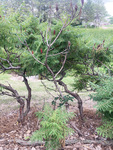
Anacardiaceae: Rhus typhina
R Neil Reese
Rhus typhina is a shrub to small tree with a spreading, open habit, growing from 3 to 5 m tall and spreading by root suckers to form dense thickets. The young stems, leaf petioles and buds are densely covered with rust colored hairs. The bark on older wood is smooth and grey to brown. The compound pinnate leaves are alternate, 25-55 cm long with very short petioles (4-7 mm long). Each leaf has 9–31 oppositely paired leaflets, each leaflet lanceolate to ovate-lanceolate, 6–11 cm long, with a toothed margin. The leaves turn scarlet in the fall. The inflorescence is a dense terminal panicle 10-20 cm long, with numerous tiny green flowers. The fruit are compressed crimson drupes 3.5-4.5 mm in diameter with knobby hairs on much of the surface. The fruit remain on the plants throughout the winter. The seeds are yellowish, smooth and about 3 mm long. Staghorn sumac bloom in May and June and the fruit ripen in August and September. They are common in open woodlands in thickets, prairies, and roadsides throughout South Dakota.
-
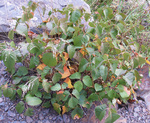
Anacardiaceae: Toxicodendron rydbergii
R Neil Reese
Toxicodendron rydbergii is a perennial shrub or subshrub with simple, unbranched stems 0.3-2 m in height and growing from branched subterranean stolons that often form thickets. Leaves are compound ternate, often drooping, each group of 3 at the end of a long stalk alternately attached to the woody main stem. Leaflets are up to 16 cm long and 11 cm wide, the center leaflet ovate to rhomboid, pointed at the tip and rounded or tapering at the base with toothed margins. The 2 lateral leaflets sessile or with short petioles and asymmetrical in shape, toothless or having a few large teeth, sometimes just on one side. The upper leaf surface is hairless and shiny, becoming dull with age; the underside is lighter in color with a few hairs along the midvein. Flowers are in small, paniculate clusters that arise from the leaf axils. Each small flower 1-3 mm across, has 5 sepals that are fused and green below and cream colored and free above. The 5 petals are cream colored with purplish veins and yellow stamens are usually visible. The fruit is a whit to yellowish globose drupe 4-7 mm in diameter that often persist into the next year. Poison ivy blooms in May and June and sometimes again later in the summer. Plants are found on prairie hillsides, stream banks, flood plains, roadsides and open woodlands throughout South Dakota.
-
Asteraceae : Artemisia cana
R Neil Reese
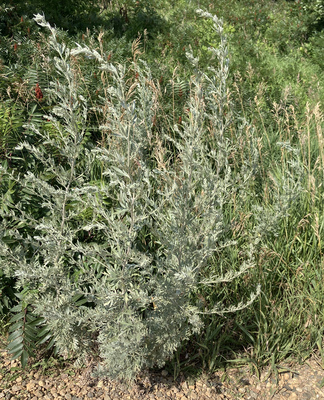
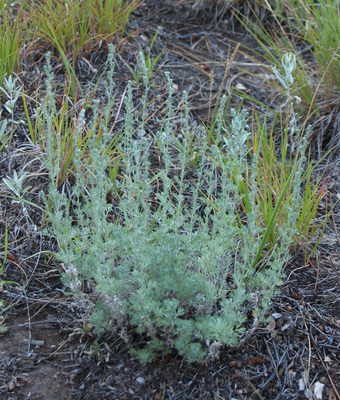
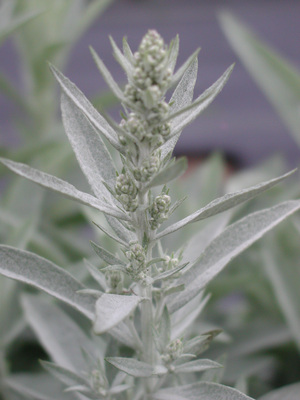
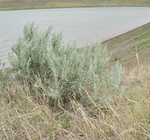
Artemisia cana is perennial aromatic shrub mostly growing to < 1 m tall, but occasionally taller. The older stems become twisted with exfoliating bark and the younger stems are greenish, covered with grayish hairs. The lanceolate leaves are narrow, ranging from 2-9 cm in length, not often more than 5 mm wide, have a silvery gray pubescence and are retained year-round. The inflorescence is a series of spike-like, leafy panicles of small heads. The involucre is 4-5 mm long and has a naked receptacle. The several tiny disk flowers are all perfect producing small dark achenes. Silver sagebrush bloom in August and September and can be found in both east and west river South Dakota.
-
Asteraceae : Artemisia dracunculus
R Neil Reese
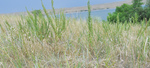
Artemisia dracunculus is a woody, perennial shrub, often quite fragrant, with stems ranging from 40 to 150 cm tall. The stems arise from thick, horizontal rhizomes growing singly or in clusters. The stems are often reddish colored and smooth to pubescent. Leaves are alternate, linear, 2 to 8 cm long and 1 to 6 mm wide. Basal leaves are cleft with 1 to 3 lobes. The inflorescence is a panicle with numerous heads. Each head is surrounded by an involucre that is 2-3 mm tall and has a naked receptacle. The yellow outer florets are pistillate and fertile. The central flowers are yellow, sterile, with ovaries that are abortive. The fruits are achenes elliptical and about 1.5 mm in length. Wild tarragon blooms in August and September and is usually found on dry open slopes throughout South Dakota.
-
Asteraceae : Artemisia tridentata
R. Neil Reese
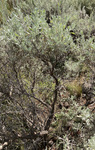
Artemisia tridentata is an erect, branching, aromatic, evergreen shrub, having both a deep taproot and a broad shallow root system, and growing from 0.5 to 3 m in height. The older stems are dark colored and are often gnarled with exfoliating bark. The younger branches are covered with a short pubescence. The leaves are wedge shaped, narrow at the base and tridentate at the tip. The inflorescence is a loose panicle of near sessile heads. The heads have involucral bracts 2-4 mm long and covered in whitish hairs. The several yellow florets are attached to a naked receptacle and are all perfect. The leaves contain camphor and other essential oils. The achenes are small and very dark when mature. Flowering occurs from June into September. Big sage is found on open dry plains and hills in western South Dakota.
-
Asteraceae: Chrysothamnus viscidiflorus
R. Neil Reese
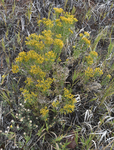
Chrysothamnus viscidiflorus is a perennial, deciduous shrub that develops from a deeply penetrating taproot system connected to a branched, woody caudex; it features an aggressive root habit capable of sprouting when injured. The plant typically reaches a height of 10 to 120 cm. Its erect to spreading, brittle stems are highly branched from the base, showing a green, smooth, or puberulent surface when young that matures into a whitish-tan, gray, and ultimately flaky, fibrous bark. Leaves feature an alternate insertion pattern, are simple, sessile, and display a distinctive bright green to gray-green color. Individual blades are linear, oblong, or lanceolate, measuring 10 to 75 mm in length and 0.5 to 10 mm in width; they are frequently characteristically twisted, with flat to wavy margins, acute to apiculate apices, an evident midnerve, and surfaces that range from completely smooth (glabrous) to finely hairy or resin-dotted and sticky (viscid). Flowering occurs from July to September. The inflorescence consists of dense, flat-topped or rounded cyme-like clusters (panicles) of small, discoid heads elevated above the foliage. The flower head is subtended by a cylindrical to conicical involucre measuring 4 to 7 mm high and 1.5 to 2.5 mm wide, formed by approximately 15 yellow-green, sticky phyllaries (bracts) arranged in 3 to 7 overlapping series along 5 vertical to spiral ranks. The pappus consists of numerous white to tan, capillary bristles that equal or slightly exceed the corolla tube length. Each head contains 3 to 5 (rarely up to 14) golden-yellow, perfect disc florets with a corolla 3.5 to 7.5 mm long terminating in 5 small, spreading lobes measuring 0.7 to 1.7 mm. Inside the floret, there are 5 stamens featuring narrow, acute anther tips fused into a cylinder around the style. The single compound pistil features an inferior ovary, a long-exserted, slender style, and a pair of prominent, elongated stigma branches. The fruit is a dry, single-seeded cypsela (achene) measuring 3 to 5 mm in length, which is conic or cylindric, light brown, 5 to 10 ridged, and densely hairy. Fruits generally reach maturity between late August and October. Yellow rabbitbrush is native to South Dakota, where it is primarily localized within the western portion of the state, specifically throughout the dry foothills, grasslands, and rocky slopes of the Black Hills region.
-
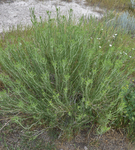
Asteraceae: Ericameria parryi
R. Neil Reese
Ericameria parryi is a perennial, small to medium-sized woody shrub that grows from a deep, woody taproot system. The plant reaches a typical height of 10 to 100 centimeters. Its flexible, ascending-to-erect stems emerge greenish when young before turning tan or gray, often displaying fastigiate branching and a dense coating of white-to-grayish matted felt hairs. The leaves are alternately arranged, simple, linear to spatula-shaped, and entire along the margins. They vary from hairless to densely woolly, appear green to grayish-green, measure 10 to 80 mm long by 0.5 to 14 mm wide, and are sessile or lack a distinct petiole. Flowering occurs from July to September. The inflorescence forms a compact, terminal cyme-, raceme-, or spike-like cluster containing multiple flower heads. Each head features a widely cylindrical involucre measuring 10 to 18 millimeters long by 4 to 8 millimeters wide, built from slightly keeled, green-tipped bracts layered in 3 to 6 series. The pappus consists of a single series of minutely barbed, tan bristles that measure slightly shorter than the corolla. Five to 20 yellow disc flowers hace 5 fused petals forming a corolla tube 8 to 12.5 mm long; ray flowers are completely absent. Each floret holds 5 stamens featuring narrow, triangular anther tips with a distinct yellow-to-tan tint. The single inferior ovary contains a solitary pistil with a long, slender style and lanceolate-to-awl-shaped stigma appendages that extend past the corolla. The fruit is a small, hairy cypsela (achene) measuring 4 to 7 mm long, ripening to a tan or brown color between October and November. Parry's rabbitbrush is native to South Dakota, where it is primarily distributed along the western edge of the state, particularly within the mountainous, rocky, and semi-arid terrain of the Black Hills and the surrounding high plains. It is typically found inhabiting open, dry pine forests, mixed-grass prairies, exposed hillsides, and eroded badlands slopes characterized by minimalist, minimally developed soil layers.
Synonym: Chrysothamnus parryi
-
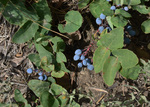
Berberidaceae: Mahonia repens
R. Neil Reese
Mahonia repens is a low-growing, evergreen shrub typically reaching 15 to 30 cm in height but spreading widely by trailing stems, forming dense mats. The plant has a woody root system and spreads by creeping stems that root at the nodes. Stems are wiry and covered with a smooth to slightly hairy bark. Leaves are alternate, pinnately compound with 5 to 9 leaflets, each leaflet measuring about 3 to 7 cm long and 1 to 3 cm wide. Leaflets are broadly elliptic to oblong with spiny-toothed margins and a leathery, glossy surface. Leaves have short petioles about 1 to 3 cm long. The inflorescence is a raceme of small, fragrant yellow flowers blooming from late spring to early summer (May–July). Each flower has six sepals and six petals arranged in two whorls; sepals are greenish yellow, about 4 to 6 mm long and 2 to 3 mm wide, ovate and spreading. The petals are bright yellow, about 6 to 8 mm long and 3 to 4 mm wide, obovate with rounded tips. Flowers have nine stamens with spurred filaments and a superior ovary. The fruit is a blue to dark purple berry about 6 to 10 mm in diameter with a waxy coating maturing in summer. In South Dakota, Oregon grape is native and found in forest understories, rocky slopes, and shaded areas primarily in the Black Hills region.
Synonym: Berberis repens
-
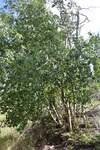
Betulaceae: Betula papyrifera
R. Neil Reese
Betula papyrifera is a medium to large deciduous tree, reaching 15–25 meters tall, with a shallow, wide-spreading root system and reproducing sexually by seed and vegetatively by stump or root sprouting. The trunk is slender, up to 60 cm in diameter, with thin, white, peeling bark marked by horizontal lenticels and often curling in papery sheets; younger bark may be reddish-brown. Twigs are slender, reddish-brown, and lack hairs. Leaves are alternate, simple, ovate to rhombic, typically 5 to 10 centimeters long and 4 to 8 centimeters wide, with doubly serrate margins and a pointed apex and a rounded or heart-shaped base. Petioles are slender and about 1 to 3 centimeters long. Both leaf surfaces are hairless or sparsely hairy when young, and leaves turn bright yellow in autumn. Flowering occurs in early spring before or as the leaves unfurl. Flowers are borne in separate male and female catkins on the same tree (monoecious). Male catkins are pendulous, cylindrical, and 3 to 8 centimeters long, releasing pollen in early spring before leaf emergence. Female catkins are shorter, erect, and take the growing season to mature. Male flowers have several stamens with pollen-producing anthers; female flowers consist of superior ovaries. Fruits are small winged nutlets (samara-like), clustered in cone-like catkins that open in fall to release seeds. Seeds mature in late summer to fall Paper Birch is native to South Dakota and widespread in moist woods, streambanks, lakeshores, and upland slopes, especially in the Black Hills and northern parts of the state.
-
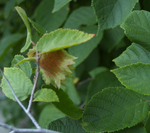
Betulaceae: Corylus americana
R Neil Reese
Corylus americana is a perennial, monoecious shrub that grows, from rhizomes to a height of roughly 2.5- 5 m with a crown spread of 3- 4.5 m. Plants are usually multi-stemmed with long branches that produce a dense spreading shape and form thickets by sending up suckers from the underground rhizomes. The young twigs are hairy-glandular. The petiolate leaves are simple, alternate, the blades ovate, pointed at the tip and rounded or heart shaped at the base, 1-12 cm long, doubly toothed and hairy underneath. Male flowers present in the winter and bloom very early in the spring in long (4-8 cm) cylindrical stalked, whitish catkins having numerous crowded flowers, each having a pair of bracts and 4 stamens. The female flowers emerge before the leaves in ovoid brownish catkins of few flowers, with the red styles becoming visible. The fruit are nuts that are solitary or clustered, each enveloped in expanded leafy bracts. America hazelnut grows in upland forests and thickets along the edge of the coteau des prairies in eastern South Dakota.