

-
This site is dedicated to Mrs. Dorothy Gill, a Dakota Elder, a mentor and friend.

-
Grossulariaceae : Ribes americanum
R. Neil Reese
Ribes americanum is a perennial shrub, with erect to ascending, unarmed stems, growing 1-1.5 m tall. The younger stems are hairy, and dotted with yellow glands, becoming smooth and gray to black with age. The simple, alternate leaves are nearly round in shape, 3-8 cm long, with 3 deeply parted lobes and 2 shallow lobes at the outer edges. The leaf margins have sharp to rounded teeth, the upper leaf surface is smooth, and the lower surface is covered with hairs and small glands. The inflorescences are composed of hairy, axillary, drooping, racemes with 6-15 flowers. The calyx is tawny brown at the base, becoming greenish white above, 8-10 mm long, the hairy, bell-shaped hypanthium is 3-4.5 mm long, with 5 sepal spreading to reflexed lobes, 4-5 mm long. The 5 petals are white 2-3 mm long, inserted at the top of the hypanthium. The 5 stamens are inserted between the petals, have a broad base, are tapered toward the top. The fruit is a black, ovoid berry, 6-10 mm in diameter, with persistent floral remnants on the end. Black currant blooms in May and June on the edges of woods, in moist ravines and along streambanks in much of South Dakota.
-
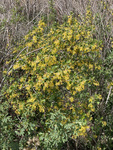
Grossulariaceae : Ribes aureum var. villosum
R. Neil Reese
Ribes aureum var. villosum is a perennial woody shrub, erect to arching main stems are 1-2 long, the younger stems and branches light brown, darkening with age. The stems are unarmed. The alternate, simple leaves develop directly on the branches of the current year and in clusters on projections from older stems. The leaf petioles are 2-5 cm long, the blades about the same length, broadly diamond to oval shaped, with 3 main rounded or bluntly pointed lobes, occasionally more, often further divided into shallow lobes. The margins are entire, or with a few blunt to rounded teeth. The inflorescence consists of axillary racemes of 3-8 flowers on peduncles 3-6 mm long. The yellow calyx tube is 10-14 mm long with 5 reflexed lobes, 3-5 mm long and showier than the corolla. The corolla has 5, erect, yellow petals, 2-3.5 mm long, often with all of the petals or their distal ends turning red. There are 5 stamens 1-2 mm long, attached to the hypanthium opposite the sepals. The fruit is a globose berry, 7-9 mm in diameter, greenish yellow and turning black as it matures. Buffalo currant blooms in April and May on dry, open hillsides, along the edges of thickets and streambanks, predominantly in western South Dakota.
Synonym: Ribes odoratum
-
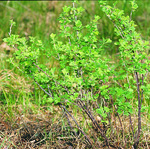
Grossulariaceae : Ribes hirtellum
R. Neil Reese
Ribes hirtellum is a perennial shrub, with erect to ascending stems with 1-3 nodal spines or often lacking these spines, the stems growing 0.5-1.5 m in height. The internodal prickles are few when present. The upper stems develop thin gray bark, shedding away along with any prickles, and the older branches are brown. The simple, alternate leaves are usually clustered on short lateral shoots, with slender, hairy petioles are up to 5 cm in length, often longer than the blades. The blades are almost round in outline, 1-5-3.5 cm long and 2-4 cm wide, with 3 major lobes and 2 smaller outer lobes. The margins have shallow, rounded teeth. The flowers are solitary or in small clusters along the stem, with slender, hairy pedicels 5-8 mm long. The flower parts form a yellow to lightly purplish, bell-shaped, hypanthium that is 5-8 mm long with 5 light green, flared sepals 3-4 mm long, and with 5, erect petals, 1-2 mm long. There are 5 stamens, opposite the sepals, 3-5 mm long, exerted above the petals. The fruit is a smooth, blue to black, ovoid to spherical berry, 8-10 mm in diameter, with persisting floral remnants on the end. Hairystem gooseberry blooms in May and June in rocky woods, along hillsides, in ravines and thickets along the eastern edge and western half of South Dakota.
-
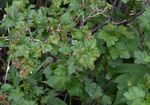
Grossulariaceae: Ribes lacustre
R. Neil Reese
Ribes lacustre is a long-lived perennial, deciduous woody shrub that grows from a fibrous, spreading shallow root system. Plants typically reach a height of 1 to 1.5 m, with erect to spreading, heavily armed stems. The grayish brown to reddish bark is covered with numerous slender, sharp, internodal prickles, supplemented by clustered, larger nodal spines protruding where leaves emerge. Leaves are arranged alternately, simple in structure, and display a deep, shiny green color on top. The blades measure 2.5 to 7.5 cm in both length and width, have a cordate base and 3 to 5 deeply indented, palmately arranged lobes with coarsely serrated margins. Both the upper and lower surfaces are mostly glabrous to sparsely hairy, with stalked, sticky glands embedded along the veins underneath. Slender, hairy, and glandular petioles are always present, measuring 1 to 4 cm in length; stipules are absent or reduced to indistinct margins at the petiole base. Flowering occurs from May through July, producing drooping axillary racemes containing 7 to 15 small, saucer-shaped flowers arranged along a glandular axis. Each flower features 5 sepals that are fused at the base to form a saucer-like hypanthium; the free sepal lobes are broadly ovate to flaring, measuring roughly 1 to 2 mm long and wide, and show a dull greenish-yellow, pinkish, or dark maroon-red coloration. Alternating with the sepals are 5 distinct, free petals that are pinkish to reddish, fan-shaped or obovate, and much smaller than the sepals (under 1 mm long). Directly inside the petals sit exactly 5 small stamens alternating with the petals, bearing short, pale filaments and cream-colored to yellow anthers that do not exceed the sepals. The single inferior ovary supports a pistil with a short style that is deeply cleft or divided into 2 distinct branches, each terminating in a small, capitate stigma. The fruit is a spherical, fleshy berry measuring 6 to 10 mm in diameter. It turns dark purple to black at full maturity, is densely covered in stiff, gland-tipped, bristly hairs, and ripens from late July through September. Prickly currant is native to South Dakota, where it is confined almost exclusively to cool, moist microclimates within the high-elevation Black Hills region, thriving in damp shaded habitats such as mountain streamsides, wet ravines, boggy woodlands, and talus slopes.
-
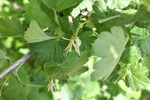
Grossulariaceae: Ribes missouriense
R. Neil Reese
Ribes missouriense is a deciduous, spiny shrub growing 1 to 2 meters tall. The stems are slender, often with arching branches and scattered spines or prickles along its stems. Leaves are alternate, simple, sometimes fascicled on short lateral branches, broadly ovate to orbicular, 3 to 7 cm long and 3 to 6 cm wide, with 3 to 5 lobes, the 2 primary sinuses almost reaching the middle, and coarsely toothed margins. The upper leaf surface is dark green and sparsely hairy, while the lower surface is lighter and more densely hairy. Petioles measure 1 to 3 cm long. The inflorescence consists of nodding, solitary or paired (to 4) flowers that bloom from April through June. The calyx has five triangular sepals, 3 to 5 mm long and about 2 to 3 mm wide, often reflexed. Flowers have five petals that are pale yellow to greenish yellow, rounded to obovate in shape, measuring 6 to 10 mm long and 4 to 7 mm wide. Each flower contains 5 stamens, with filaments about 2 to 3 mm long and yellow anthers approximately 1 to 1.5 mm long, inserted alternate with the petals. The pistil is single with a superior ovary. Fruits mature from July through August as rounded berries about 1 to 1.5 cm in diameter, green when immature, turning dark purple to black when ripe, often covered with a waxy bloom. Missouri Gooseberry is native to South Dakota and grows mainly in wooded ravines, limestone bluffs, and rocky slopes, woodlands, thickets, and along stream banks, primarily in the eastern and southeastern parts of the state.
-
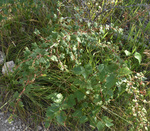
Grossulariaceae: Ribes oxyacanthoides
R. Neil Reese
Ribes oxyacanthoides is a deciduous, spiny shrub typically growing 0.5–1.5 meters tall with irregularly branched, ascending to sprawling, prickly branches. The stems are slender, yellow to brown when young wing dense prickles on the internodes. The nodes have 1-4 stout brown spines, 5-14 mm long. Older stems become blackened and unarmed. Leaves are alternate, simple, often fascicled at the ends of lateral shoots, broadly ovate to orbicular, usually 3 to 7 cm long and 3 to 6 cm wide, with three major and 2 minor lobes that are sharply toothed or coarsely serrated. The upper leaf surface is dark green and sparsely hairy; the underside is lighter and more densely hairy. Petioles range from 1 to 3 cm long. The inflorescence consists of 1-3(4) nodding flowers blooming from April to June. The calyx has five white to green triangular sepals, forming a hypanthium tube with lobes 3 to 5 mm long and about 2 to 3 mm wide, often reflexed. Flowers have five petals that are pale yellow to greenish yellow, broadly ovate to obovate, measuring 2-3 mm long, erect and shorter than the sepals. Each flower contains 5 stamens with filaments approximately 2 to 3 mm long and yellow anthers about 1 to 1.5 mm long, inserted alternate with the petals. They have a single pistil with a superior ovary and a slender style terminating in a small stigma. Fruits mature from July through August as rounded berries 1 to 1.5 cm in diameter, green when immature, turning red to dark purple at maturity, often covered with a waxy bloom. In South Dakota, northern gooseberry occurs primarily in moist woodlands, forest edges, streambanks, and rocky hillsides, scattered in the western region of the state.
-
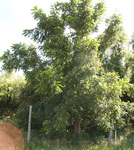
Juglandaceae : Juglans nigra
R. Neil Reese
Juglans nigra is a large tree with brown bark that grow to 25 m tall with a trunk up to 1 m in diameter in a forest stand. Individual specimens growing under ideal conditions can grow much larger. Young twigs are green and covered with glandular hairs. The alternate, compound palmate leaves grow to 50 cm long, the 11-23 leaflets are sessile, oblong lanceolate, pointed at the tip and usually with small teeth along the margins. The trees are monoecious, with green male flowers in catkins up to 12 cm long, each with about 4 sepals and 8-40 stamens. The female flowers are terminal on new growth in clusters of 1-several flowers, each with 3 small bracts and a hairy pistil with a short style and 2 yellow green stigmas. The fruit is a globose, yellow green turning brown nut, 5 cm in diameter, containing a nut 4 cm in diameter. Black walnut blooms in April and May. This species is native to the southeastern corner of South Dakota, but has been planted in windbreaks and yards state wide, becoming naturalized throughout the state.
-
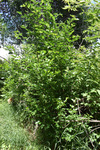
Moraceae: Morus alba
R. Neil Reese
Morus alba is a deciduous tree growing 10 to 20 meters tall, with a broad, spreading crown and rough, furrowed grayish-brown bark. Leaves are alternate, simple, and variable in shape—ovate to deeply lobed—measuring 5 to 15 cm long and 4 to 12 cm wide, with serrated or wavy margins and petioles 1 to 3 cm long. Leaf surface can be smooth or slightly hairy, sometimes variegated. . The species is dioecious or sometimes monoecious, with small greenish unisexual flowers arranged in catkin-like inflorescences. Male flowers occur in slender cylindrical catkins 3 to 7 cm long and 0.5 to 1 cm wide, each flower apetalous with usually 4 stamens bearing 2 to 3 mm long filaments and longitudinally dehiscent anthers that release pollen. Female flowers are grouped in shorter, compact catkins 1.5 to 4 cm long and 0.5 to 1 cm wide, consisting mainly of a single superior ovary with one locule and ovule, a short cylindrical style 1 to 2 mm long, and a bifid, papillose stigma. Both flower types have a perianth of 4 to 6 small, scale-like tepals under 1 mm long protecting reproductive parts. The fruit is a multiple fruit (syncarp), 2 to 3 cm long, resembling a blackberry and ripening to white, pink, red, or dark purple, composed of numerous small druplets. The fruits are edible and sweet. Native to China, White mulberry has been widely introduced worldwide, and has adapted well to the region’s climate. Its presence is most notable in the eastern and central parts of the state where human settlement and cultivation have introduced it widely.
-
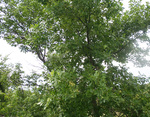
Oleaceae: Fraxinus pennsylvanica
R Neil Reese
Fraxinus pennsylvanica is a large tree reaching 20 m tall with dark gray to brown, furrowed bark. The younger branches go from greenish with white lenticels (pores) to brown to gray and can be smooth to hairy. The petiolate, opposite leaves are compound odd-pinnate,11-30 cm long, with 5-9 leaflets. The leaflets are lanceolate to elliptic, 6-15 cm long and up to 5 cm wide, with short stalks. The first pair of leaflets is usually the shortest. The margins usually have small teeth, the upper surface is dark green and smooth and the lower surface is paler with short hairs along the midvein or across entire surface. The trees are dioecious, having either male or female flowers. The inflorescences consist of panicles, 3-5 cm long, in the axils of leaves on the first year branches. The flowers have an irregularly toothed, cup-shaped calyx, no petals and either 2-3 stamens or a pistil with a long style. The fruit is a tan, narrowly oblanceolate single samara. Green ash blooms in April and May in flood plains, ravines and along stream and lake shores throughout South Dakota.
-
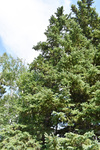
Pinaceae: Picea glauca
R. Neil Reese
Picea glauca is a tall, evergreen conifer that can reach heights of 20 to 30 meters or more. It has a conical crown with horizontal to slightly drooping branches, a straight trunk with thin, scaly, gray-brown bark. Needles are attached individually and arranged spirally around the twig. They are stiff, sharp, four-sided, 1 to 2.5 cm long, and bluish green to gray green with a whitish waxy coating. Male cones are small, cylindrical, and yellowish, producing pollen released from May to June. Female cones are green when young, maturing to brown in fall, typically 3–7 cm long, with thin, flexible scales. They mature from September through October, with seed dispersal occurring shortly after. The bark, needles, and cones are distinctive to this species. White spruce is native to boreal forests across much of North America, including parts of South Dakota, favoring cooler, moist environments and well-drained soils. Black Hills spruce is a variety of white spruce that is native to a geographically isolated area in and around the Black Hills of South Dakota. It was originally called Picea glauca var. densata, but many experts now designate it as Picea glauca ‘Densata’ because its differences from the species are judged insufficient to justify classification as a botanical variety.
-
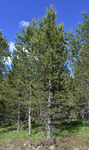
Pinaceae: Pinus contorta
R. Neil Reese
Pinus contorta is a medium-sized evergreen conifer reaching heights of 15 to 30 meters. It has a narrow, conical crown with dense branches. The bark is thin and scaly on young trees, becoming thick and deeply furrowed with age. Needles occur in pairs (2 per fascicle), are slender and sharp-pointed, 3 to 7 cm long, often twisted and dark green. Male cones are small, cylindrical, 1 to 3 cm long and about 0.5 to 1 cm wide, releasing pollen from May to June. Female cones are oval to conical, 3 to 7 cm long and 2 to 3 cm wide, often serotinous (remaining closed until exposed to fire or heat), they mature over two seasons, changing from a purple green to a light brown color in September or October. Lodgepole pine is native to the Black Hills of South Dakota where it grows in cooler, moist, higher elevation sites, often mixed with ponderosa pine and spruce. It is well adapted to fire ecology.
-
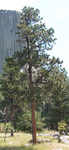
Pinaceae : Pinus ponderosa
R. Neil Reese
Pinus ponderosa is a large evergreen tree with a pyramid-shaped crown that broadens with age and can reach 35 m in height. The trunk is straight, gray brown and furrowed when young, becoming scaley and gray mixed with orange brown with age, and the branches are gray black in color. The needle-like leaves are clustered toward the branch tips, usually 3 (2) per fascicle, 8-20 cm long, with small teeth along the margins. The fascicles emerge from a membranous, orange brown, deciduous sheath that is 1.5-2.5 cm long. Ponderosa pines are monoecious, the male cones are yellow orange, cylindrical, 1.5-3 cm long, in axillary clusters of 10-20 cones. The female cones are brown, woody, broadly ovoid, 6-12 cm long, 6-8 cm wide, and mature in the second year. Each cone scale has a thin prickle on the outer side. The seeds are in pairs underneath the scales, 6-7 mm long with a papery wing 3-4 times as long as the seed. The cones release pollen in May and June on low mountains and rocky hillsides in western and southcentral South Dakota.
-
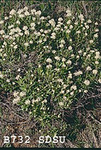
Rhamnaceae: Ceanothus herbaceus
R. Neil Reese
Ceanothus herbaceous is a deciduous, perennial, woody, bushy shrub growing up to 1 m tall. The simple, alternate leaves are 3-nerved, oblong to oblanceolate, the margins with small teeth and glandular when young. The upper surface of the leaves usually have a slightly white waxy covering and the lower surface with long white hairs. The inflorescence consists of terminal panicles at the ends of the leafy branches of the new year, on peduncles 1-5 cm long. the tiny white flowers have a short calyx tube with 5 lobes 1.6 mm long, 5 hooded petals, ~2.5 mm long, constricted (clawed) for ½ their length. There are 5 stamens with a 3-lobed ovary surrounded by a 10-lobed collar, 1.5 mm wide. The fruit is a 3-lobed capsule, 3-4.5 mm wide. New Jersey tea blooms in May and June on prairies and open wooded hills in western South Dakota.
-
Rhamnaceae : Ceanothus velutinus
R. Neil Reese
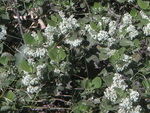
Ceanothus velutinus is an evergreen, perennial, spreading shrub growing 0.5-2.5 m tall, lacking spines and forming large colonies. The simple, alternate leaves are 3-nerved, ovate to ovate-elliptic, 4-8 cm long, the margins with small glandular teeth. The upper surface of the leaves are shiny green and often sticky, and the lower surface is pale with long often velvety hairs. The inflorescence consists of axillary, dense panicles. The tiny white flowers have a short calyx tube with 5 incurved lobes < 2 mm long, 5 recurved hooded petals, 2-2.5 mm long, abruptly constricted (clawed). There are 5 upwardly curved stamens with a 3-lobed ovary surrounded by a 10-lobed disk. The fruit is a 3-lobed capsule, 5-6 mm wide, with a slight crest above the middle. Mountain balm blooms in June and July on dry, open wooded hillsides in western South Dakota.
-
Rhamnaceae: Rhamnus cathartica
R. Neil Reese
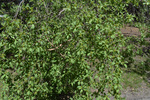
Rhamnus cathartica is a deciduous shrub or small tree typically growing 2 to 6 meters tall. The stems are slender and often thorny, with dark brown to blackish bark that becomes scaly with age. Leaves are opposite or sub-opposite, ovate to elliptic in shape, 3 to 7 cm long and 2 to 4 cm wide, with finely serrated margins and a glossy dark green upper surface contrasting with a paler underside. The leaves have three to five prominent veins curving toward the leaf tip. The small, inconspicuous flowers bloom from May to June, usually in clusters of two to five in leaf axils. Flowers have four greenish-yellow petals about 2 to 3 mm long and four sepals of similar size and shape. Each flower contains four stamens with filaments about 1 to 2 mm long and yellowish anthers. The pistil is single with a two-chambered ovary. Fruit matures from August through September as a small, round drupe about 6 to 9 mm in diameter, glossy black when ripe, containing two to four seeds. Common buckthorn is native to Europe and western Asia and was introduced to South Dakota in windbreaks. It is now an invasive species found in woodlands, fields, and disturbed sites throughout the state, often forming dense thickets that outcompete native vegetation.
-
Rosaceae: Amelanchier alnifolia
R. Neil Reese
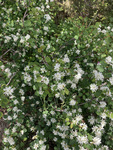
Amelanchier alnifolia is a perennial deciduous shrub or small tree which grows 1 m to 5 m in height (occasionally taller in very moist sites) and often forms thickets. The bark is thin, light brown and tinged with red; smooth or shallowly fissured. The leaves are alternate, oval to nearly circular, 2–5 cm long and 1–4.5 cm wide. The margins are entire below and toothed mostly above the middle. Serviceberries have white to pink flowers, borne in racemes, and bloom from April to June. Five sepals are green 1-3 mm long, triangular with the tips recurved. The 5 petals are white, 5-12 mm long and obovate, A shallowly cupped hypanthium of 3-4 mm is visible at anthesis. Each flower has 10-20 stamens and a pistil with 5 styles. The fruit is a deep red to dark purple, berry-like pome, 10-15 mm long and 8-11 mm wide. This species is commonly found open slopes and along streams throughout much of South Dakota.
-
Rosaceae: Crataegus chrysocarpa
R Neil Reese
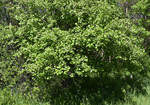
Crataegus chrysocarpa is a perennial multi-stemmed shrub, 2–4 m tall, with a rounded top, straight to curved thorns 3–6 cm long, the young stems are light brown and become gray with age. The alternate, simple leaves have blades that are ovate, 2–6 cm long, shallowly lobed, the lobes pointed. The margins are sharply toothed on the upper half, with glands on the tips of the larger teeth and with small teeth to smooth at the bottom. The blade surfaces have sparsely appressed hairs. The petioles are 1-4 cm long, with 6-9 mm long stipules that are rapidly deciduous. The inflorescence consists of small terminal clusters of 5- to 12 flowers at the ends of lateral branchlets. Each flower has a hairy, cup-shaped hypanthium with 5 sepals 2–4 mm long, and glandular margins. The 5 petals are round, white, 7–10 mm long and abruptly narrowed into a short claw. There are 10 stamens and an inferior ovary with 3 or 4 styles. The fruit is a red pome, 8–15 mm in diameter, sparsely pubescent when young and later becoming smooth. Fireberry hawthorn blooms in May and June on open wooded hillside and prairie ravines of the eastern and western borders of South Dakota.
-
Rosaceae: Crataegus douglasii
R. Neil Reese
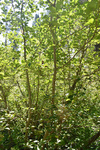
Crataegus douglasii is a deciduous shrub or small tree with a deep, extensive root system and may form dense thickets by root suckering. Stems are erect, often branched, reaching heights of 3–8 meters. The bark is smooth and gray on young stems, becoming rougher and fissured with maturity. Leaves are alternate, simple, ovate to oblong, generally 3 to 8 centimeters long and 2 to 5 centimeters wide, with finely serrate margins and petioles about 1 to 2.5 centimeters long. Flowering occurs from May to June, producing clusters of white flowers about 1.5 to 2 centimeters in diameter. Each flower has five petals approximately 5 to 8 millimeters long and wide, and five greenish sepals about 2 to 4 millimeters long and 1 to 2 millimeters wide. There are typically 20 to 25 stamens inserted around a superior ovary, with filaments about 4 to 6 millimeters long and yellow anthers. The pistil consists of a single ovary with a short style and a lobed stigma. The fruit is a pome, rounded to slightly flattened, about 10 to 15 millimeters in diameter, dark purple to nearly black when mature, ripening in late summer to early fall. Black hawthorn is native to western North America and can be found in South Dakota, primarily in riparian woodlands, foothills, and open forests.
-
Rosaceae : Dasiphora fruticosa
R. Neil Reese
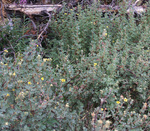
Dasiphora fruticosa is a perennial, spreading, bushy shrub with erect branches 20-100 cm tall. The young branches are covered with soft white hairs that are lost with age, the bark turning red and becoming shredded. The alternate, compound odd-pinnate leaves have petioles up to 12 mm long and brownish stipules 6-12 mm long. The blades have 3-7 linear to narrowly obovate leaflets, 10-20 mm long, with entire margins and hairs on both surfaces, the top with scattered white hairs and the bottom with a denser, gray covering. The inflorescence consist of single axillary flowers and small terminal cymes of 2-5 flowers. The flowers have a saucer-shaped hypanthium, 3.5-5 mm wide, with 5 spreading, pointed, green sepals 4-6 mm long, alternating with small bracts. The 5 yellow, spreading, round to club-shaped petals are 6-13 mm long. There are 20-30 stamens, inserted on the edge of a nectar ring, and numerous hairy pistils on an elongated receptacle. The fruit is a cluster of light brown, hairy, ovoid achenes, each < 2 mm long. Shrubby cinquefoil blooms from June into August on hillsides, meadows and in canyons in western South Dakota.
Synonym: Potentilla fruticosa
-
Rosaceae : Prunus americana
R. Neil Reese
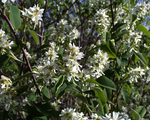
Prunus americana is a perennial, deciduous shrub or small tree, 2-6 m tall, usually forming thickets from root-suckers. There are generally many stems per plant, the older stems bark becomes dark gray and scaly, the younger stems are reddish brown to gray with a flaking waxy cuticle, typically smooth but occasionally with persistent hairs. The branches spread widely, with older lateral twigs developing into spines up to 7 cm long. the simple, alternate leaves have petioles 8-20 mm long, often with glands near the base of the blade and stipules 5-14 mm long. The leaf blade is ovate to lanceolate-ovate, 6-10 cm long, sharply pointed, the margins with teeth or doubled teeth, green and smooth above and with hairs on the lower side. The inflorescence consists of axillary and terminal clusters o 2-5 flowers on smooth pedicels 7-20 mm long, and usually appearing before the leaves and remaining as the leaves develop. The flowers have a conical hypanthium ~3 mm long, the 5 green, reflexed sepals are 3-4 mm long with hairs on the upper side. The 5 oblong ovate white petals are constricted (clawed)8-12 mm long. there are 20-30 stamens inserted on the edge of the hypanthium in several rows, with a single 2-carpeled pistil, the style 12-15 mm long with a capitate stigma. The fruit is a fleshy drupe, yellow to reddish-purple, 2-3 cm long and 2-2.5 cm in diameter, often having a waxy coating. Wild plums bloom in April and May and ripen in August and September. They are common in woodlands, thickets, pastures, along streams and roadsides throughout South Dakota.
-
Rosaceae : Prunus virginiana
R. Neil Reese
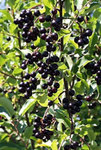
Prunus virginiana is a perennial, deciduous shrub or small tree that forms thickets from root sprouts and grows 2-6 m in height. The bark on the trunk and branches is red brown to dark brown in color. The simple, alternate leaves have petioles 1-3 cm long, with stipules 2-4 mm long and large glands near the base of the blade. The blades are ovate to obovate, 4-12 cm long, 3-6 cm wide, the rounded and the tip pointed, with small teeth on the margins. The upper leaf surface is usually dark green and shiny and the lower surface gray green, occasionally with hairs along the veins. the inflorescences are dense racemes terminating leafy twigs of the season. Each flower has a bell-shaped hypanthium ~1.5 mm long with 5 deciduous sepals 1-1.5 mm long. The 5 white petals are rounded, 3-4 mm long. there are 20-30 stamens in several rows surrounding a single ovoid ovary ~ 1.5 mm long. the fruit is a round, deep red to almost black, fleshy drupe, 8-11 mm in diameter. Chokecherries bloom in April and May in open woodlands, canyons, on prairies and along streams and roadways throughout South Dakota.
-
Rosaceae: Purshia tridentata
R. Neil Reese
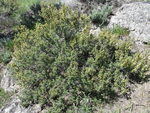
Purshia tridentata is a deciduous, woody shrub growing 1 to 3 meters tall with multiple slender, erect branches arising from a deep root system. The leaves are alternate and simple, measuring 1 to 3 cm long and 0.5 to 1.5 cm wide, with three distinct, obovate to spatulate lobes. The upper leaf surface is dark green and smooth, while the lower surface is lighter green and often covered with fine hairs giving a slightly fuzzy texture. Leaves are borne on petioles 2–5 mm long. The inflorescence consists of solitary flowers or small clusters born in leaf axils, blooming from April through June. The calyx comprises five small, narrowly triangular sepals about 3 to 5 mm long. The flowers have five pale to bright yellow petals each 10–15 mm long and slightly clawed at the base and are often fragrant. Stamens number about 15–30, inserted around the base of the ovary in a circle. The style is slender and elongated, ending in a small, rounded stigma. Fruits are achenes with a long, slender, beak-like tip, enclosed in a dry, papery cup or calyx. They mature from August through September. Rare but native in South Dakota, antelope bitterbrush occurs primarily in dry, rocky, and open shrublands in the southern Black Hills.
-
Rosaceae : Rosa arkansana
R. Neil Reese
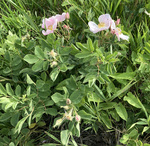
Rosa arkansana is small perennial shrub growing from rhizomes, with a woody base and a mixture of woody and herbaceous stems that often die back to the ground each year. The 10-50 cm tall stems are sparkly to densely covered in unequal prickles. The alternate, petiolate leaves have stipules. The compound odd-pinnate blades have 7-11 obovate to elliptic leaflets, 1-4 cm long and < 3.5 cm wide, with small teeth on the upper 2/3 portion. The flowers are in corymb-like clusters, of 3 or more, at the ends of the new year’s branches and occasionally from side branches on the previous year’s growth. The rounded hypanthium has 5 sepals, 1.5-3 cm long and 3-5 mm wide, that are persistent with the fruit. The 5 white, pink to occasionally red petals are 1.5-3 cm long, obovate and usually notched. There are numerous stamens and 15-30 pistils that develop into achenes 3-5 mm long with long stiff hairs on one side. The accessory fruit (rose hips) contains the achenes. Prairie rose blooms from May into August on prairies, open woodlands and along roadsides throughout South Dakota.
-
Rosaceae: Rosa blanda
R. Neil Reese
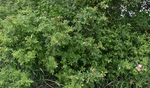
Rosa blanda is a perennial, deciduous woody shrub featuring a fibrous root system anchored by a woody taproot and long, spreading underground rhizomes that actively facilitate colony formation. It reaches a mature plant height of 0.7 to 1.8 m. The stem configuration forms a dense, mounded habit of erect, arching branches that are uniquely smooth and largely thornless, though a sparse concentration of fine, bristly prickles frequently populates the dark reddish-brown to purple bases of older stalks. Leaf insertion is alternate along the stems. The leaves are odd-pinnately compound, measuring 6 to 13 centimeters long, and typically comprise 5 to 7 (rarely 9) leaflets. Each leaflet is dull green to dark green on the upper surface and a paler, dull green on the lower surface; they are oval, elliptic, or obovate in shape, measuring 2.5 to 5 cm long and 1.3 to 2.5 cm wide with coarsely serrated margins and blunt or rounded apices. A distinct petiole is present, measuring 1.5 to 3 cm long. Conspicuous, wide, leaf-like stipules are present, which are fused to the base of the petiole and measure 1.5 to 2.5 cm in length with smooth or finely gland-toothed margins. Flowering occurs primarily from June to August. The inflorescence occurs either as solitary blossoms or in small, few-flowered terminal clusters (corymbs) measuring 5 to 8 cm across. The sepals consist of 5 lanceolate, entire segments that are free, measuring 1.5 to 2.5 cm long and 3 to 5 mm wide, green in color, and prominently persistent, remaining upright on the developing fruit long after blooming. The petals consist of 5 free, broad, obovate segments that are fragrant and pale pink to deep rose (occasionally white), measuring 2 to 4 cm long and wide. There are numerous (typically 50 to 100) stamens arranged around the center, measuring 4 to 6 mm long with fine yellow filaments and bright yellow anther heads. The pistils are numerous, clustered within a deeply concave receptacle (hypanthium), with short, distinct styles forming a dense, flattened head of stigmas at the mouth of the flask-like structure. The fruit is a fleshy, berry-like, globose to pear-shaped hypanthium or "rose hip" measuring 8 to 12 mm in diameter; it changes from green to a glossy, bright red or orange-red color upon reaching maturity between late August and October, frequently persisting into the winter months. The smooth rose is native to South Dakota, appearing frequently across the eastern and northern regions of the state where it can be found in open prairies, dry or mesic woodland edges, thickets, fence rows, roadsides, and sandy lakeshores.
-
Rosaceae: Rosa woodsii
R. Neil Reese
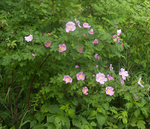
Rosa woodsii is a perennial, deciduous shrub. It typically forms upright to arching thickets and grows from a fibrous root system with extensive rhizomes, allowing it to spread vegetatively. Plants usually reach 0.5 to 2 meters in height. Stems are slender, brown to reddish, and armed with straight or slightly curved prickles of variable size. New stems are often hairy. Leaves are alternate, pinnately compound, usually with 5 to 9 leaflets. Leaflets are oblong to elliptic, 1–4 cm long and 0.5–2 cm wide, with sharply serrated margins. The upper surface is dull green and glabrous to sparsely hairy, while the lower surface may have fine hairs. A short petiole (up to 2 cm) is present, often glandular and hairy, with prominent, persistent stipules at the base that are broad, flat, and fused to the petiole for much of their length. Flowering occurs from May to July. Inflorescences are solitary or in small corymbs at the end of branches. Each flower is 3–5 cm across, with five free, green sepals (1–2 cm long, narrowly lanceolate, and sometimes glandular on the back) that are often persistent on the fruit. There are five pink petals, rounded and spreading, 1–2 cm long, notched at the tip. Numerous stamens (typically over 50) form a ring around the pistils, with yellow filaments and anthers. The pistils are numerous, each with a short style, enclosed within the hypanthium (floral cup). The fruit is a fleshy, bright red to orange, ovoid to globose hip, 1–2 cm in diameter, maturing from August to October. The hips persist into winter and provide an important food source for wildlife. Woods’ rose is native to South Dakota and occurs across the state in a wide range of habitats, including prairies, streambanks, woodland edges, and open forests.