

-
This site is dedicated to Mrs. Dorothy Gill, a Dakota Elder, a mentor and friend.

-
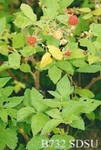
Rosaceae : Rubus idaeus ssp. strigosus
R. Neil Reese
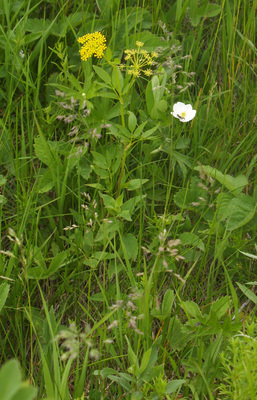
Rubus idaeus ssp. strigosus is the red raspberry native to North America. The plants are sub-shrubs from a perennial, rhizomatous rootstock, with stems that are semiwoody, erect to arching, 0.5-3 m in length, sparingly to copiously covered in prickles. The stems produce leaves the first year, leafy shoots and flowers from the leaf axils the second year, and then die back to the ground. The alternate, petiolate, compound leaves have 3 or 5 ovate to oblong leaflets 4-10 cm long. There are 1-2 pairs of lateral, unlobed, sessile leaflets, and a central leaflet, often 2 or 3 lobed, attached via a short rachis segment. Each leaflet has a pointed tip and rounded to heart-shaped base. The margins are single or double toothed, the upper surface is dark green, sparsely hairy to smooth and the lower surface is densely hairy, appearing silvery. The inflorescence consists of 1 to a few small axillary, leafy racemes each with several flowers. The hypanthium is flat to cupped, the green calyx has 5 reflexed lobes, 4-7 mm long, the 5 white, ascending, petals are narrowly oblong to spatulate, 4-6 mm long. there are numerous stamens and pistils inserted into a conic receptacle. The fruit is a cluster of red 1-seeded, finely hairy drupelets, 12-18 mm long. American wild raspberries bloom from May into July in open woodlands, on hillsides and along streambanks in counties scattered throughout South Dakota.
Synonym: Rubus idaeus ssp. sachalinensis
-
Rosaceae: Rubus occidentalis
R. Neil Reese
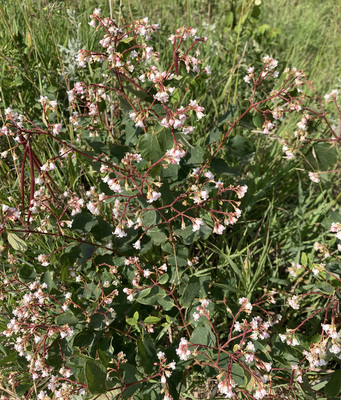
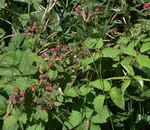
Rubus occidentalis is a deciduous, woody bramble that forms arching or trailing canes up to 1.5–3 meters long. The canes are biennial, with first-year primocanes typically green and covered in fine hairs and sparse prickles, and second-year floricanes are brown, woody and more heavily armed with curved prickles. They usually die following fruit ripening. Leaves are alternate and compound, usually with three to five leaflets. Leaflets are ovate to lanceolate, 3 to 8 cm long and 2 to 5 cm wide, with serrated margins and pointed tips. The upper surface of the leaflets is dark green and slightly hairy; the underside is lighter green and more densely hairy. Petioles are 1 to 3 cm long. The inflorescence is a loose cluster of white to pale pink flowers blooming from May through July. Flowers have five broadly ovate petals, 10 to 15 mm long and 8 to 12 mm wide. The calyx consists of five ovate sepals, 5 to 8 mm long and 3 to 5 mm wide, often hairy on the outer surface. Each flower contains numerous stamens, typically 30 to 50, with filaments about 2 to 3 mm long and yellow anthers approximately 1 to 2 mm long. The pistils number 20 to 40 per flower, each slender, 2 to 3 mm long, tapering to a pointed stigma. Fruits mature from July through August as aggregate drupes about 1 to 1.5 cm in diameter, glossy black when ripe, each composed of multiple small drupelets. Black raspberry is native to South Dakota, and grows in open woods, forest edges, thickets, and disturbed sites, scattered throughout the eastern and southern parts of the state.
-
Rosaceae : Rubus parviflorus
R. Neil Reese
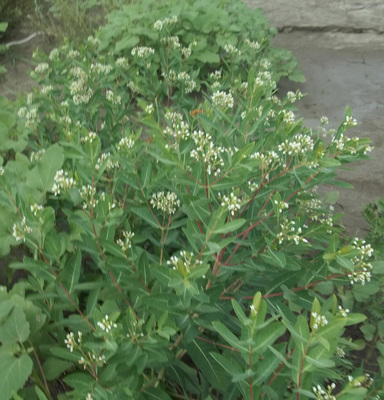
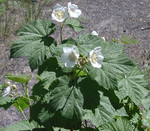
Rubus parviflorus is a perennial shrub that spreads by rhizomes, with erect, unarmed stems 0.5-3 m long, the younger stems having glandular hairs and the older stems developing gray, exfoliating bark. The simple, alternate leaves are palmately lobed, 6-20 cm long and 11-18 cm wide, and the leaf margins are doubly toothed. The petioles are 6-15 cm long, often with glandular hairs, with attached, lanceolate stipules, 5-12 mm long. the inflorescence is a terminal cluster of 3-7 flowers. The flowers have a small hypanthium with 5 sepals, 10-16 mm long, with a tail-like appendage about ½ the length , and 5white, obovate petals, 2-2.5 cm long. there are numerous stamens and many, simple pistils that are inserted in a conical receptacle. The fruit is a thimble-like aggregate of red drupelets that fall as a unit leaving the persistent receptacle. Thimbleberries bloom from May into July in open woods, hillsides and along streambanks in western South Dakota.
-
Rosaceae: Sorbus scopulina
R. Neil Reese
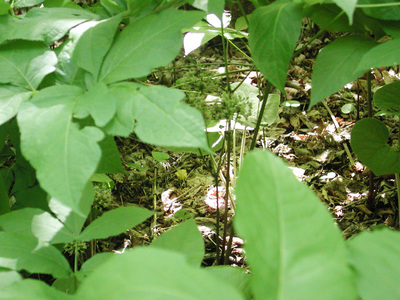
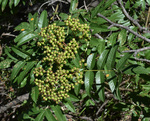
Sorbus scopulina is a perennial, deciduous shrub or small tree with a woody and fibrous root system. Mature plants are typically multi-stemmed and reach 2–6 meters in height. Stems are upright, slender, and brown to grayish, with smooth bark on young stems aging to slightly roughened with lenticels. Leaves are alternate, pinnately compound, 10–20 cm long, with 9–15 lanceolate to oblong leaflets per leaf. Each leaflet is 2–7 cm long and 0.7–2 cm wide, with serrated margins, a pointed tip, and a rounded or slightly tapered base; upper surfaces are dark green and glabrous, while lower surfaces are paler and may have sparse hairs, especially along the midrib. Petioles are present, 2–5 cm long, and leaf rachises may be slightly hairy. Flowering occurs from May to July, with dense, flat-topped corymbs 5–12 cm across, each bearing dozens of small, white, five-petaled flowers. The calyx has five small, green, triangular sepals, 1–2 mm long and 1 mm wide, fused at the base and persistent in fruit. Petals are five, white, oblong to ovate, 3–5 mm long and 2–3 mm wide, free and spreading. Each flower has 15–20 stamens with yellow anthers about 1.5 mm long. The pistil is compound (inferior ovary), formed by 3–5 united carpels, with 3–5 styles (sometimes fused at the base) and capitate stigmas. The fruit is a small, round pome, 6–10 mm in diameter, bright red to orange-red when mature in late summer to early fall (August–September). Greene’s mountain-ash is native to the Black Hills and western regions of South Dakota, where it inhabits moist forests, stream banks, canyons, and mountain slopes, typically in partial shade and well-drained soils.
-

Rosaceae: Spiraea lucida
R. Neil Reese
Spiraea lucida is a perennial, deciduous shrub with a fibrous root system and sometimes short, woody rhizomes or stolons, often forming loose clumps. Mature plants are typically 0.5–1.5 meters tall. Stems are upright to arching, slender, and brown to reddish, with smooth bark and occasional fine hairs on young growth. Leaves are alternate, simple, and oblong to elliptic or lanceolate, 2–7 cm long and 1–3 cm wide, with serrated or doubly serrated margins. The upper surface is shiny, dark green, and glabrous, while the lower surface is paler and may be sparsely hairy or glabrous. Petioles are present and short, 2–5 mm long. Flowering occurs from June to August, with dense, flat-topped to slightly rounded corymbs 3–7 cm across, each bearing numerous small, white to pinkish, five-petaled flowers, 6 to 10 mm in diameter. The calyx has five small, triangular sepals, 1–2 mm long, green, free, and persistent. Petals are five, white to pale pink, obovate, 2–4 mm long and 1–2 mm wide, free and spreading. Each flower has 20–30 stamens with yellow anthers about 1 mm long. The pistil consists of five separate carpels, each with a slender style and capitate stigma. The fruit is an aggregate of five small, dry, brown follicles, each 3–5 mm long, that split open at maturity in late summer (August–September) to release several tiny seeds. Shining meadowsweet is native to South Dakota and can be found in the Black Hills, western prairies, open woodlands, stream banks, and rocky slopes, especially in well-drained, sandy or gravelly soils with full sun to partial shade.
Synonym: Spiraea betulifolia var. lucida
-
Salicaceae :Populus deltoides ssp. monilifera
R. Neil Reese
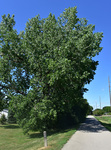
Populus deltoides is a large tree up to 40 m in height with a truck up to 2 m diameter at breast height, often branching near the base, ascending at a moderate angle and forming a very broad crown. The youn stens are olive brown to orangish, becoming grayish tan as they age, the main trunk and larger branches have tan bark the is deeply furrowed. The winter buds are brown, ovoid, resinous and large, 1-2 cm long. The simple, alternate, deciduous leaves are deltoid, 4-14 cm long, 4-15 cm wide, light green with rounded teeth and a pointed end. The petioles are long (3-13 cm) and laterally compressed. The trees are dioecious, the male trees producing staminate catkins 5-13 cm long with flowers containing up to 80 stamens. The female (pistilate) catkins are about the same length at flowering but elongating in fruit. The flowers contain a single pistil that forms an elliptic-ovoid, 3-4 valved capsule about 1 cm long containing 7-10 cottony seeds. Plains cottonwoods bloom in March into June, releasing seeds in June and July. Primarily riparian, the trees are found along streams, lakes and other moist areas throughout South Dakota.
-
Salicaceae: Populus tremuloides
R. Neil Reese
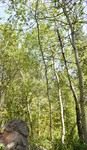
Populus tremuloides is a deciduous, fast-growing tree reaching 15 to 25 meters tall with smooth, pale greenish white to gray bark that becomes furrowed with age. The root system is extensive and shallow with vigorous lateral root suckering, allowing the tree to form large clonal colonies. Leaves are alternate, nearly round to broadly ovate, 4 to 8 cm long and 3 to 7 cm wide, with finely serrated margins and flattened petioles that cause the leaves to tremble in the wind. Flowers are produced in catkins; male and female catkins are on separate trees (dioecious). Male catkins are slender and cylindrical, 2 to 6 cm long and about 0.5 to 1 cm wide, releasing pollen from April to May. Female catkins are slightly larger, 3 to 8 cm long and about 0.7 to 1.2 cm wide, maturing from May through June. The fruit consists of small capsules, 5 to 10 mm long, that split open to release numerous tiny seeds attached to cottony hairs which aid in wind dispersal. Native to South Dakota, quaking aspen is widespread in the northern and mountainous regions, commonly found in mixed forests, riparian zones, and upland areas.
-
Salicaceae: Salix amygdaloides
R. Neil Reese
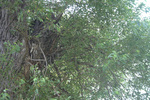
Salix amygdaloides is a deciduous shrub or small tree growing 6 to 12 meters tall. Young stems have smooth gray bark that becomes furrowed with age. Branches are slender, flexible, and often show a reddish or yellowish tint. Leaves are alternate, simple, narrowly lanceolate to elliptical, 5 to 12 cm long and 1 to 3 cm wide, with finely serrated margins. The upper leaf surface is dark green and mostly smooth, while the underside is paler and can be slightly hairy. Petioles are short, about 5 to 10 mm long. This species is dioecious, meaning male and female flowers grow on separate trees. Flowers emerge in early spring before or alongside leaves, arranged in slender catkins 2 to 6 cm long. Male catkins have multiple stamens, typically 2 per flower, with yellow anthers; female catkins are shorter and thicker, bearing flowers with a single pistil each, with long styles and feathery stigmas. Fruit is a small capsule, maturing in late spring to early summer, releasing tiny seeds surrounded by cotton-like hairs for wind dispersal. Peachleaf willow is native to South Dakota, commonly found along streams, floodplains, and moist bottomlands.
-
Salicaceae: Salix interior
R. Neil Reese
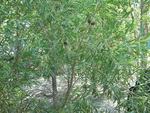
Salix interior is a deciduous shrub or small tree typically growing 3 to 8 meters tall. It often forms thickets by root suckering along riverbanks and sandbars. The bark on young stems is smooth and greenish to reddish-brown, becoming furrowed and grayish with age. Branches are slender and flexible. Leaves are alternate, simple, and lanceolate to narrowly elliptical, measuring 4 to 10 cm long and 1 to 3 cm wide. Leaf margins are finely serrated. The upper leaf surface is dark green and glabrous (smooth), while the underside is paler and often finely hairy. Petioles measure about 5 to 10 mm long. This species is dioecious, with male and female flowers on separate plants. Flowers appear in early spring (March–May), arranged in slender catkins 3 to 7 cm long. Male catkins are slender, 2–6 cm long, bearing numerous yellow stamens—typically 2 per flower. Female catkins are shorter and clustered, each flower containing a single pistil with long styles and feathery stigmas. Like other willows, the flowers lack true petals and sepals but have small floral scales (bracts) subtending each flower. The fruit is a small capsule that splits open to release numerous tiny seeds surrounded by cottony hairs which aid in wind dispersal. Sandbar willow is native to South Dakota, commonly growing on sandbars, riverbanks, and other moist, sandy or silty sites throughout South Dakota.
-
Salicaceae: Salix planifolia
R. Neil Reese
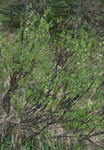
Salix planifolia is a deciduous shrub or small tree growing typically 0.5–2 meters tall, often forming dense thickets in alpine and subalpine environments. Branches are slender, flexible, and may be slightly hairy when young, often having a reddish or grayish hue. The bark on young stems is smooth, becoming furrowed with age. Leaves are alternate, simple, and broadly lanceolate to ovate, typically 3 to 8 cm long and 1 to 3 cm wide. Leaf margins are finely serrated or sometimes nearly smooth. The upper leaf surface is dark green and glabrous, while the underside is paler and often covered with fine hairs. Petioles are short, about 3 to 8 mm long. This species is dioecious, with male and female flowers borne on separate plants. Flowers emerge in spring to early summer (April–June), as slender catkins 2 to 6 cm long. Male catkins are slender, typically 2–5 cm long, bearing numerous stamens (usually 2 per flower) with yellow anthers. Female catkins are shorter, bearing flowers each with a single pistil with a long style and feathery stigmas. There are small, leaf-like floral scales (bracts) subtending each flower. The fruit is a small capsule that splits open to release numerous tiny seeds surrounded by cottony hairs. Planeleaf willow is native to South Dakota, growing in mountainous regions of the Black Hills, in moist to wet sites, including stream banks and alpine meadows.
-
Salicaceae: Salix scouleriana
R. Neil Reese
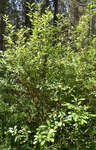
Salix scouleriana is a deciduous shrub or small tree growing 3 to 10 meters tall. It has a fast growth habit and often colonizes disturbed or burned areas. The bark on young shoots is smooth and reddish-brown, becoming furrowed and grayish with age. Branches are slender and flexible. Leaves are alternate, simple, and lanceolate to narrowly elliptical, measuring 4–12 cm long and 1 to 4 cm wide. Leaf margins are finely serrated. The upper leaf surface is dark green and glabrous, while the underside is paler and may be slightly hairy. Petioles are about 5 to 12 mm long. This species is dioecious, with male and female flowers born on separate plants Flowering occurs in early spring (April–May), before leaf or with emergence. Flowers are arranged in catkins 3 to 7 cm long. Male catkins are slender, 3–8 cm long, bearing numerous stamens, usually 2 per flower with yellow anthers. Female catkins are shorter and thicker, bearing flowers each with a single pistil an elongated style and feathery stigmas. The flowers have small, leaf-like floral scales (bracts) subtending each flower. The fruit is a small capsule, elliptical to oblong in shape and measuring 4 to 7 mm in length. It splits open to release numerous tiny seeds surrounded by cottony hairs. Scouler’s willow is native to western South Dakota, found in montane to subalpine habitats, especially on recently disturbed soils.
-
Smilacaceae: Smilax rotundifolia
R. Neil Reese
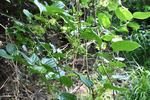
Smilax rotundifolia is a perennial, woody climbing vine that develops from a extensive, branching rhizomatous rootstock. The vine frequently achieves climbing heights of 3 to 12 m, supported by a fast-growing, highly branched, round to weakly 4-angled stem that is armed with stout, scattered, green prickles with distinct dark or blackish tips. Leaf insertion is alternate along the stem, and the leaves are simple, globally orbicular, ovate, or broadly heart shaped. The blades display a lustrous bright to medium-green color on both sides and are 5 to 13 cm long and 4 to 12 cm wide. Both the upper and lower leaf surfaces are glabrous and smooth, while petioles are present, measuring 0.5 to 1.5 cm long and notable for producing a pair of coiling, stipular tendrils near their base that aid in climbing. Flowering occurs from April through June, arranged in axillary, spherical umbel inflorescences on peduncles that measure up to 1.5 cm in length. Because this species is dioecious, individual plants bear either staminate (male) or pistillate (female) flowers. The perianth consists of 6 distinct tepals arranged in two whorls the 3 outer are 3 to 5 mm long, oblong, free, and yellowish green to bronze. The 3 inner are nearly identical in size, free, matching in color, and slightly narrower, with all tepals spreading outward or recurving at peak bloom. In staminate flowers, there are 6 free stamens that measure roughly 2 to 3 mm long, with white or pale yellow filaments and oblong, unilocular anthers. In pistillate flowers, a single superior pistil is present with a globose, 3-celled ovary, lacking a defined style but bearing 3 short, spreading, recurved stigmas. The fruit is a small, globose, fleshy berry measuring 5 to 8 mm in diameter, which transitions from green to a glaucous blue-black or solid black color as it reaches maturity between September and November and often persist on the vine through the winter. Common greenbrier is native to South Dakota, occurring primarily in the eastern half of the state within moist-to-dry bottomland forests, wooded ravines, riparian borders, and thickets.
-
Tamaricaceae: Tamarix ramosissima
R. Neil Reese
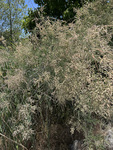
Tamarix ramosissima is a deciduous, perennial shrub or small tree with a deep, extensive root system. Mature plants typically reach 3–6 meters in height. Stems are slender, highly branched, and covered with reddish-brown to gray bark that becomes fissured with age. Leaves are alternate, scale-like, very small (1–3 mm long), narrow, and overlapping, giving the branches a feathery, wispy appearance. Flowering occurs from May to September, with inflorescences forming dense, elongated, spike-like racemes 5–15 cm long, bearing numerous small, five-petaled, pink to pale rose flowers about 4–6 mm in diameter. The calyx is cup-shaped with five fused sepals, 1.5–2 mm long, often glandular-hairy. The corolla has five free petals, 2–4 mm long, ovate to rounded, pale pink to rose-colored. Each flower has five stamens, about 3–4 mm long, with yellow anthers. The pistil consists of a single ovary with a slender style and capitate stigma. The fruit is a small, dry capsule, 1–2 mm long, containing numerous tiny seeds surrounded by tufts of white, silky hairs aiding wind dispersal; fruits mature from July to September. Saltcedar is introduced and invasive in South Dakota, native to Eurasian regions including southeastern Europe, central Asia, and China. It thrives in riparian zones, floodplains, saline soils, and disturbed sites, often outcompeting native vegetation due to its tolerance of drought, salinity, and flooding.
-
Tiliaceae: Tilia americana
R. Neil Reese
Taxonomic Description:
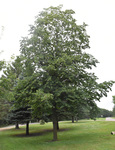
Tilia americana is a long-lived, deciduous tree with a deep, widespread woody and fibrous root system. Mature trees typically reach 15–30 meters in height, with a straight trunk up to 1 meter in diameter and a broad, rounded crown. The bark is stringy, smooth and gray on branches, developing ridges and furrows on larger branches and the trunk. Twigs are green and slightly hairy when young, becoming smooth, sometimes reddish brown, with age. Leaves are alternate, simple, broadly ovate to heart-shaped (cordate), 10–20 cm long and 7–15 cm wide, with sharply serrated margins, a long tapering tip, and a distinctly asymmetrical base. The upper leaf surface is dark green and glabrous, while the lower surface is paler and finely hairy, especially along veins; leaves have long, slender petioles 5–10 cm long. Stipules are present when young but fall off early in the season. Flowering occurs from June to July, with inflorescences forming drooping, branched cymes (clusters), 5–10 cm long, each attached to a narrow, strap-shaped, pale green bract 5–10 cm long. Each cyme bears 5–15 fragrant, yellowish-white, perfect flowers. The calyx consists of five green, triangular sepals, 4–6 mm long and 2–3 mm wide, free and slightly hairy. The corolla has five, creamy-white, oblong petals, 7–10 mm long and 3–4 mm wide, free and spreading. Each flower has numerous (20–40) stamens with slender filaments and yellow anthers about 1 mm long; the pistil is single, with a five-celled, superior ovary, a slender style, and a capitate stigma. The fruit is a small, globose to ovoid, gray-brown, woody nutlet, 6–10 mm long, often with faint ribs and covered in short, fine hairs; fruits mature from August to October. American basswood is native to eastern South Dakota and is found in rich, moist woods, bottomlands, stream banks, and the eastern deciduous forest edge, typically in deep, fertile, well-drained loams under full sun to partial shade.
-
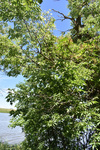
Ulmaceae: Celtis occidentalis
R. Neil Reese
Celtis occidentalis is a perennial, medium to large deciduous tree. It grows from a deep, spreading root system that is sometimes shallow and wide, allowing for some basal sprouting. Trees can reach heights of 9–20 meters (occasionally taller), with a trunk up to 60 cm or more in diameter. Young bark is thin, gray, and smooth; mature bark is distinctively ridged with warty, corky projections. Branches are spreading and may be somewhat pendulous. Leaves are alternate, simple, ovate to lanceolate, 7–12 cm long and 3–7 cm wide, with an unequal (oblique) leaf base, sharply toothed margins, acuminate tips, and rough upper surfaces; leaves are attached by slender, slightly pubescent petioles. Both young stems and leaves may be slightly hairy, especially below. Flowering occurs from April to May before or with leaf emergence. Flowers are small, greenish and inconspicuous, borne singly (staminate) or in small cymes (bisexual/pistillate) in the leaf axils; individual flowers have 4–5 petal-like sepals. Flowers are mostly monoecious (male and female flowers on the same tree) but can be functionally unisexual. Fruit is a single-seeded, round drupe (hackberry), 6–10 mm in diameter, green turning deep purple or dark red at maturity in late summer to fall. The thin-shelled drupe contains a hard seed and a thin layer of sweet, edible flesh. Common hackberry is native to South Dakota, found in riparian forests, woodland margins, shelterbelts, river bluffs, and occasionally in upland prairies, statewide but especially common in eastern river valleys and shelterbelts.
-
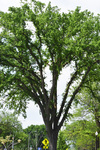
Ulmaceae: Ulmus americana
R. Neil Reese
Ulmus americana is a large, deciduous tree with a deep, widespread woody and fibrous root system. Mature trees typically reach 20–30 meters in height, with some specimens exceeding 40 meters. The trunk is stout, with grayish-brown bark that becomes deeply furrowed and ridged with age. Branches form a broad, vase-shaped crown with arching limbs. Leaves are alternate, simple, and ovate to elliptical, 7–15 cm long and 5–10 cm wide, with doubly serrated margins and an asymmetrical, uneven base. The upper leaf surface is dark green and rough to the touch with coarse hairs, while the lower surface is lighter green and softly hairy, especially along veins. Petioles are short, 5–15 mm long. Stipules are present, small, and fall early. Flowering occurs in early spring (March to April) before leaf emergence, with wind-pollinated, perfect but apetalous flowers arranged in dense, axillary clusters (cymes) 1–3 cm long. The calyx is inconspicuous; petals are absent. Stamens number 4–5 per flower with elongate filaments and yellow anthers. The pistil has a single ovary with a slender style and two stigmas. The fruit is a flat, round samara, 1–1.5 cm in diameter, with a central seed surrounded by a papery wing, maturing from April to May. American elm is native to South Dakota and occurs primarily in moist bottomlands, floodplains, riverbanks, and rich woodlands, favoring deep, fertile, well-drained soils in full sun to partial shade.
-
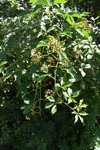
Vitaceae: Parthenocissus vitacea
R. Neil Reese
Parthenocissus vitacea is a vigorous, deciduous woody vine capable of climbing 10 to 20 meters high by means of tendrils that allow it to attach to surfaces such as trees, rocks, or buildings. The root system consists of a robust, woody perennial base from which the climbing stems arise annually. The leaves are alternate and petiolate, with petioles 5 to 12 cm long. Each leaf is palmately compound with five leaflets, each leaflet ovate to lanceolate, 5 to 12 cm long and 3 to 7 cm wide, with serrate margins and a glossy dark green upper surface that turns reddish-purple in fall. The flowers are small, greenish, and inconspicuous, arranged in loose, branched panicles blooming from June through August. Each flower has five sepals that are lanceolate to ovate, 1.5 to 3 mm long and about 1 mm wide. The corolla consists of five tiny petals about 2 to 4 mm long and 1 to 1.5 mm wide, broadly ovate with a rounded apex. There are five stamens with short filaments and yellow anthers. The pistil has a superior ovary with a slender style about 3 to 4 mm long, ending in a small, bifid stigma. The fruit develops from August through October, maturing into small, globose berries approximately 6 to 8 mm in diameter, dark blue to black when ripe. Woodbine is native to South Dakota, commonly found climbing on trees, fence lines, and rocky bluffs in woodland edges and riparian zones throughout the state.
-
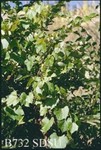
Vitaceae : Vitis riparia
R. Neil Reese
Vitis riparia is a perennial viny shrub with stem growing to 25 m in length. The young branches are green to a dull reddish brown and the older stems are woody with exfoliating bark. The simple, alternate leaves have smooth petioles up to 8 cm long. The blades are 7-20 cm long and nearly as wide, shallowly to deeply palmately lobed. Leaves on fertile branches usually have 3 major lobes with a broad gaps between the 2 basal lobes. The leaves on vegetative branches are more evenly divided. The margins are hairy and sharply toothed. The inflorescence consist of pyramidal panicles 4-12 cm long, opposite the leaves of this year's new branches. The plants are monoecious, separate male and female flowers are typically on the same plant, mixed in a cluster or separate, tiny with 5 green to yellowish petals that drop without expanding. The male flowers have 5 long, erect to ascending stamens. The female flowers have a short style and 5 short sterile contorted stamens. The fruit are purple black berries, 7-11 mm in diameter. Riverbank grapes bloom in May and June with fruit ripening in July through September. They are found along streams, fence rows, in woodlands and ravines throughout South Dakota.